Archive
How to safely view the May 20, 2012 solar eclipse
Note: Parts of this posting are geared to the Grand Traverse region of Michigan wheer the partial eclipse is interrupted by sunset.
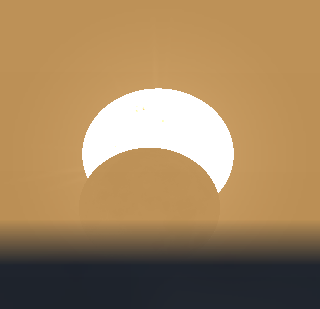
May 20, 2012 eclipse from northern Michigan just before sunset. Created using Stellarium.
We get a chance to view a solar eclipse visible for about 40 minutes on the evening of the 20th this month. Solar eclipses are rather rare events if you stay at one spot on the earth. For the whole earth there are at least two or three solar eclipses that occur in a year, and as many lunar eclipses. To see a lunar eclipse one only has to be on the night side to the earth at the time. A solar eclipse requires you to be in the path of the moon’s shadow.
We are getting a chance to see a partially eclipsed sun. Solar eclipses are highly personal events. The exact timing and what you’ll see depends on your location. The society will be holding an eclipse watch at the Sleeping Bear Dunes National Lake Shore lake Michigan Overlook on Pierce Stocking Scenic Drive. In Traverse City, a good vantage point to watch is along the south of east sides of the bays. For both locations the eclipse will start at 8:19 p.m., with the eclipse starting 2 seconds earlier at the Lake Michigan Overlook at 8:19:17 p.m. The sun will set at 9:12 p.m. at the overlook and 2 minutes earlier in Traverse City.
The times I’ve derived for the above is from the website CalSky.com., a not often easy site to navigate. Once you get your location input the calendar feature is very comprehensive.
Solar eclipses or eclipses of the sun, as they are sometimes referred to are listed as three types: partial, total, and annular. Every solar eclipse has a partial phase, where the moon covers only part of the sun. In a total eclipse the moon covers, for a few minutes, the entire photosphere (bright face) of the sun, An annular eclipse is where the moon doesn’t appear large enough to cover the face of the sun, leaving a bright ring or annulus around the moon. This also lasts a few minutes at best.
If you look at your shadow cast by the sun, you’ll notice that the shadow is fuzzy. That fuzzy outer part of your shadow has a name and its called the penumbra. There you are partially blocking the sun’s light. The dark inner shadow is called the umbra, where we get the word umbrella, in which the sun is totally blocked. It just so happens that the moon’s dark umbral shadow just reaches the earth at the moon’s closest.
The May 20th eclipse is classed as an annular eclipse. The area affected by the partial eclipse stretches from east Asia to North America, from the Arctic Ocean to the South Pacific. The path of annularity, where the annular phase can be seen, stretches from south China to Texas. In the United States the annular shadow will cross southern Oregon, northern California, Nevada, southern Utah, Colorado, northern Arizona, cross New Mexico and end in Texas at sunset.
Since the sun is north of the celestial equator, the north end of the eclipse zone stretches farther east than the central or southern parts of the eclipse area. Therefore we will see nearly half of the partial portion of the eclipse. The eclipse map can be found on NASA’s web site here. Select the first entry, and select the May 20th eclipse.
How to safely observe the eclipse
The question with any solar eclipse is: Can I view it safely? The answer is yes, if you take precautions. One gets the impression from all the warnings that looking at the sun during the eclipse is more dangerous than normal. That isn’t true. It’s just not less dangerous. Normally we don’t look at the sun, so we don’t think of it. During the partial phase of the eclipse, its total light is dimmer, but the face of the sun is just as bright and dangerous to look at without proper viewing methods.
The easiest and safest way to view a solar eclipse is with pinhole projection. I tested one a few weeks ago we had a long narrow box about 4 feet long. I put a small hole in one end. It happened to be a 1/8th inch hole, and put a clipboard with a sheet of white paper on the other end and got a respectable sized image of the sun.. On eclipse day I will replace the one pinhole with several of different sizes. The larger the hole the brighter but fuzzier image, the smaller the hole the dimmer and sharper the image.
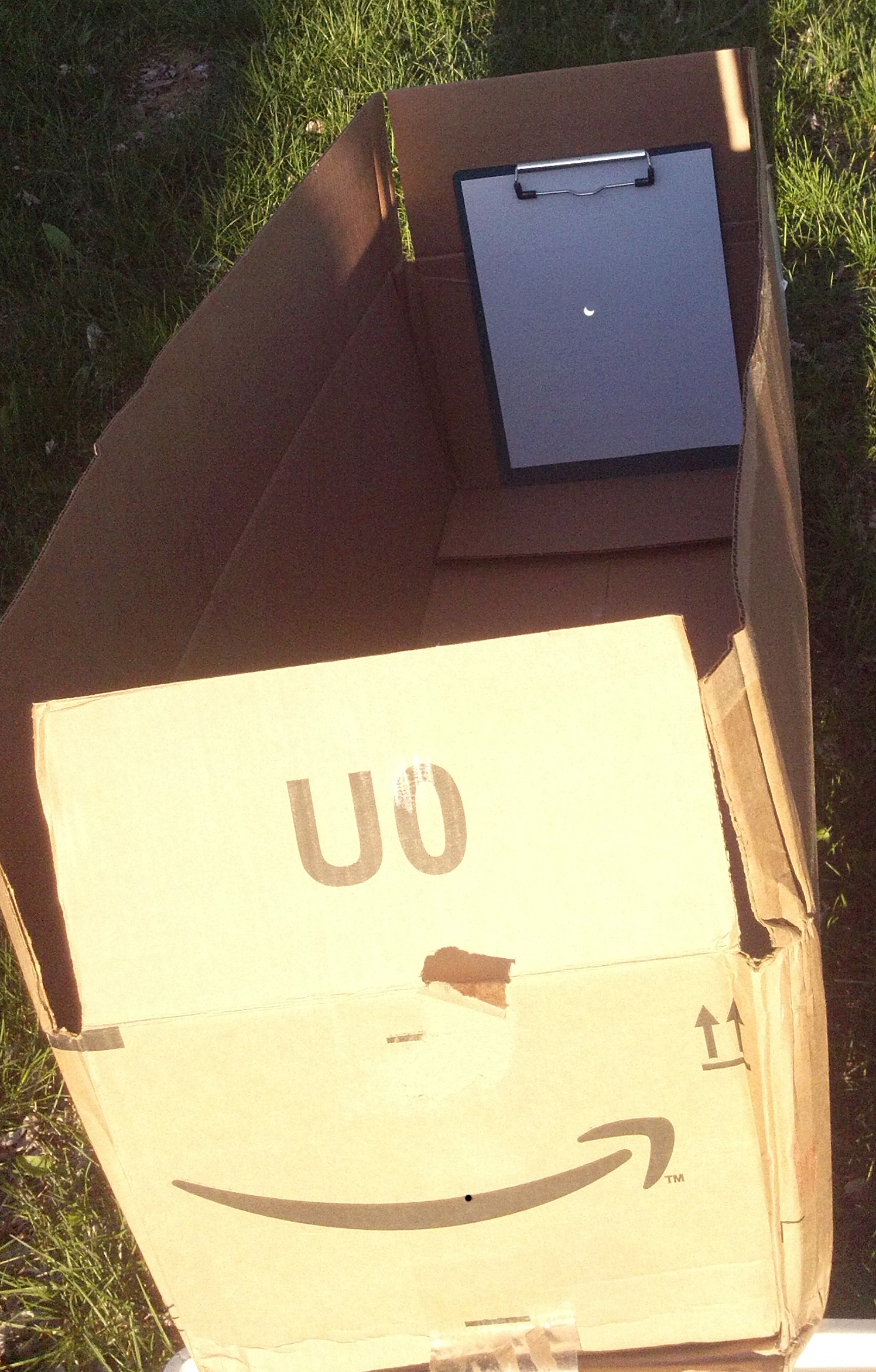
Pinhole Projection of the sun. Solar image brightened and moon shadow added, however sun diameter is correct.
Various outlets have solar eclipse filters which are made of aluminized mylar which go for about a dollar. They should be safe if used as directed.
Solar filters for telescopes must be placed in front of the objective and not at the eyepiece. These can be obtained from Enerdyne in Suttons Bay, Orion, OPT and other online sources. Order early!. Also remember to cover your finder telescope or get a filter for it too.
The telescope itself can project a large image. See the following image from the 1994 solar eclipse. Use an inexpensive but low power eyepiece in case the sun’s heat damages it.
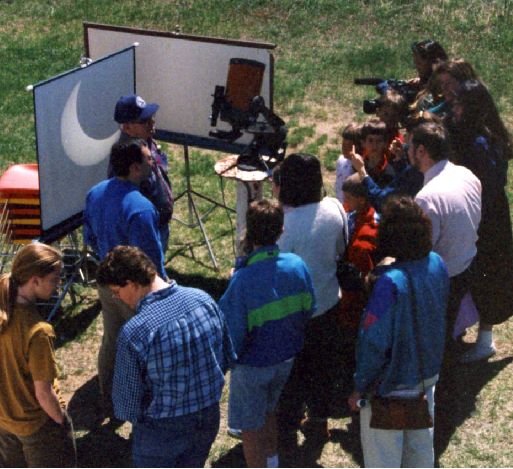
Telescope projection of the sun. Photo by Eileen Carlisle.
Be safe and have a great time. There’s an even better solar eclipse on August 21, 2017, whose path of totality crosses the United States from coast to coast.
05/08/2012 – Ephemeris – Observing Saturn’s Rings
Ephemeris for Tuesday, May 8th. The sun rises at 6:22. It’ll be up for 14 hours and 33 minutes, setting at 8:56. The moon, 3 days past full, will rise at 12:09 tomorrow morning.
The planet Saturn is a wonderful sight in telescopes now. In a little as 20 power a spotting scope with show Saturn’s rings, but may not distinctly separate the planet out. At 50 power the planet is easily separated from the rings. It you have a telescope with eyepieces of differing focal lengths and/or a Barlow lens that doubles the magnification of your eyepieces, you can experiment with using higher powers. I like a crisp image at lower powers rather than a fuzzy image at higher powers. Saturn’s rings are its best known feature. They are about 170 thousand miles wide and perhaps only a hundred feet thick. They aren’t solid but billions of small icy particles each orbiting Saturn at their own speed, and kept in line by collisions with its ring mates.
Times are for the Traverse City/Interlochen area of Michigan. They may be different for your location.
Addendum
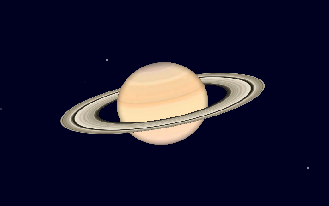
Image of Saturn created with Cartes di Ciel showing current ring tilt.
The rings as they appear from earth. The outside ring is the A ring. Then the dark Cassini’s Division, which is sometimes hard to spot. Then the broad and bright B ring. The inner C ring is hard to spot.
 Bob Moler's Ephemeris Blog