Ephemeris: 10/08/2026 – Finding the Great Andromeda Galaxy
This is Ephemeris for Thursday, October 8th. Today the Sun will be up for 11 hours and 20 minutes, setting at 7:10, and it will rise tomorrow at 7:50. The Moon, 2 days before new, will rise at 6:44 tomorrow morning.
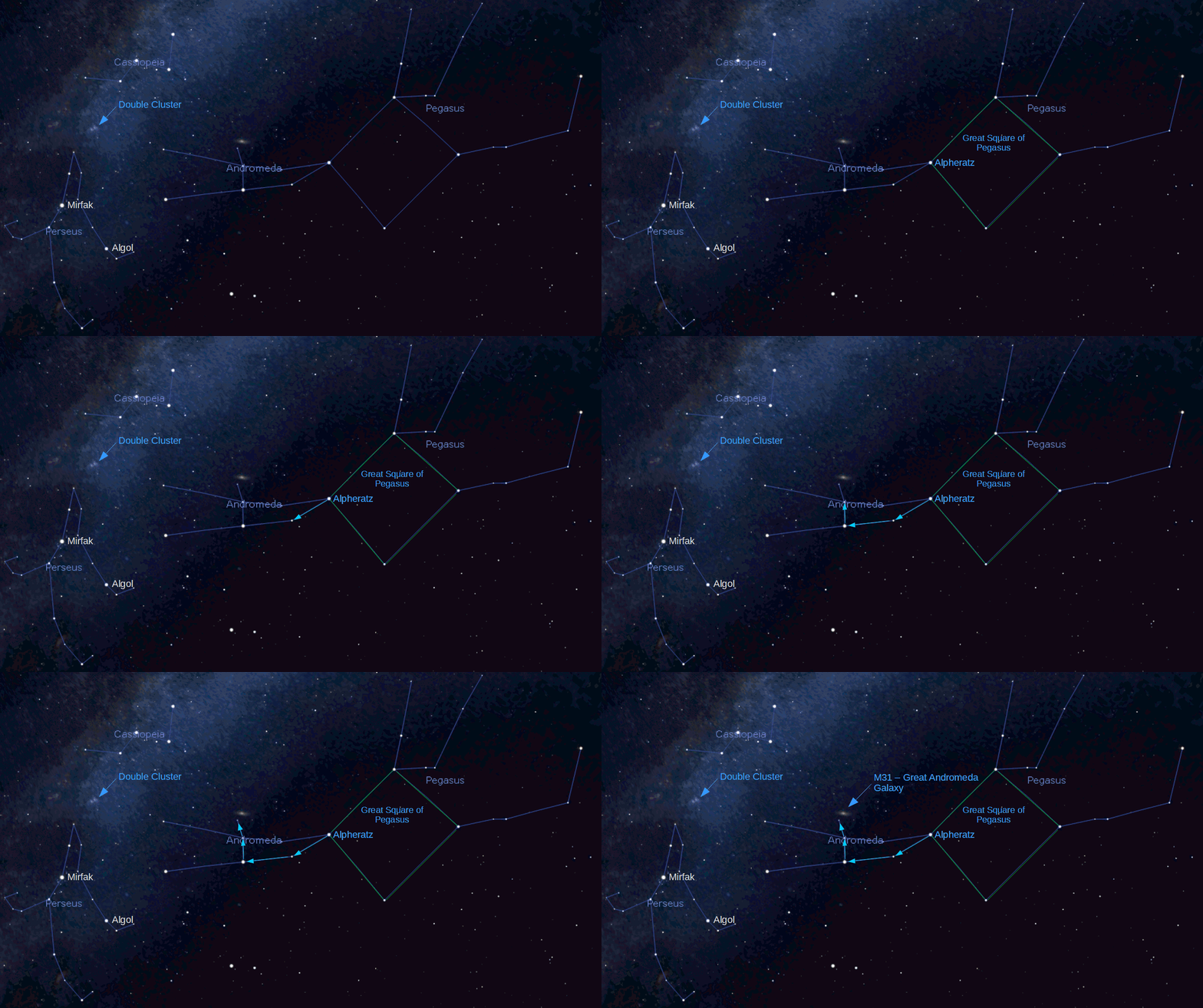
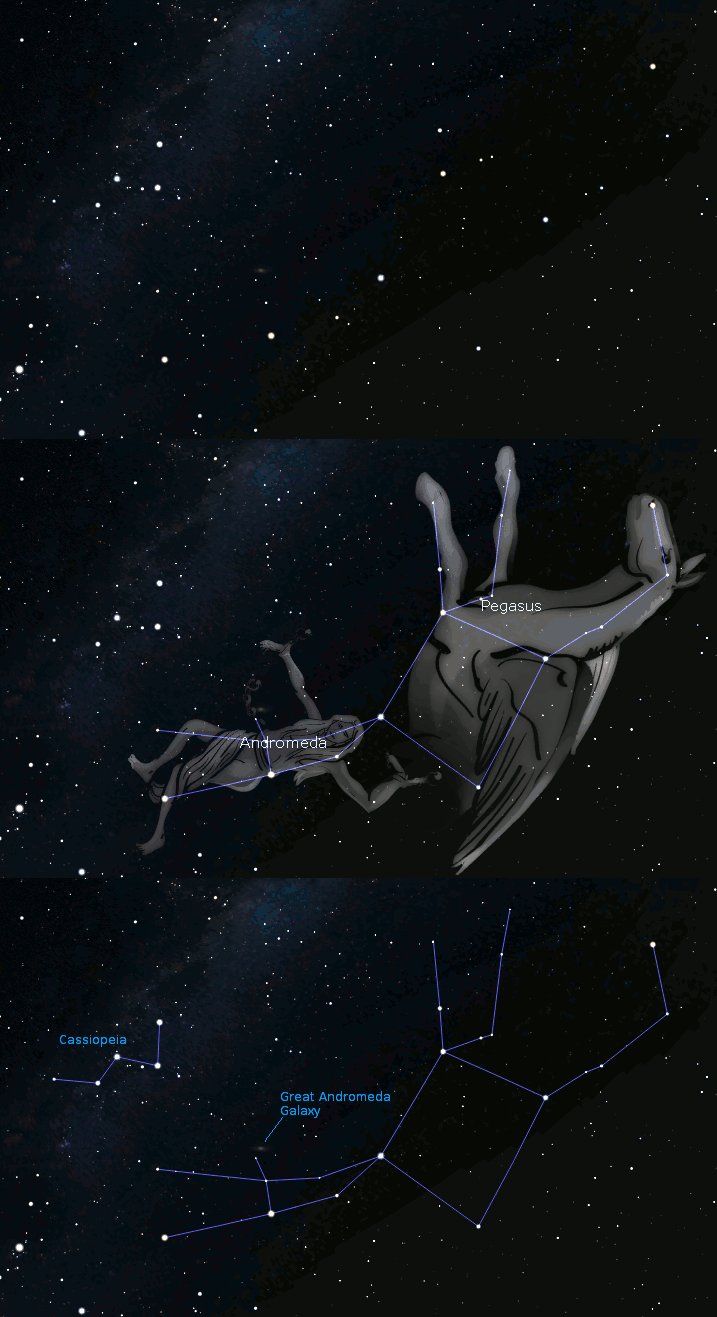
The closest large galaxy to our Milky Way is the Great Andromeda Galaxy, seen high in the eastern sky when it gets dark. It is barely visible to the naked eye. Locate it by star-hopping: First find a large square of stars high in the east-southeast at 9 PM, standing on one corner, the Great Square of Pegasus. The left star of the square is the head of the constellation Andromeda. Follow two stars to the left and a bit downward, then two stars straight up. The galaxy is near that last star as a small smudge of light. Binoculars are the best way to see it as a thin spindle of light, which is the galaxy’s nucleus. Using a telescope, one can see, besides its nucleus, its two satellite galaxies.
The astronomical event times given in this blog are for the Traverse City/Interlochen area of Michigan (Lat 44.7° N, Long 85.7° W; EDT, UT – 4 hours) unless stated otherwise. Times will be different for other locations.
Addendum
Ephemeris: 10/7/2026 – Taking our weekly look at the whereabouts of the naked-eye planets
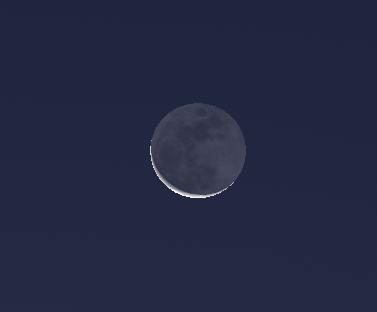
This is Ephemeris for Wednesday, October 7th. Today the Sun will be up for 11 hours and 23 minutes, setting at 7:12, and it will rise tomorrow at 7:49. The Moon, 3 days before new, will rise at 5:32 tomorrow morning.
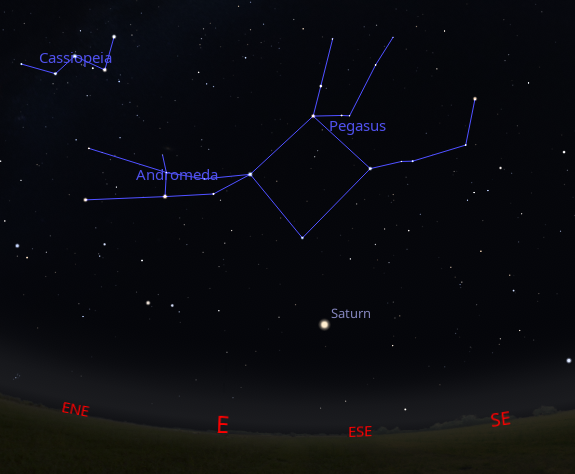
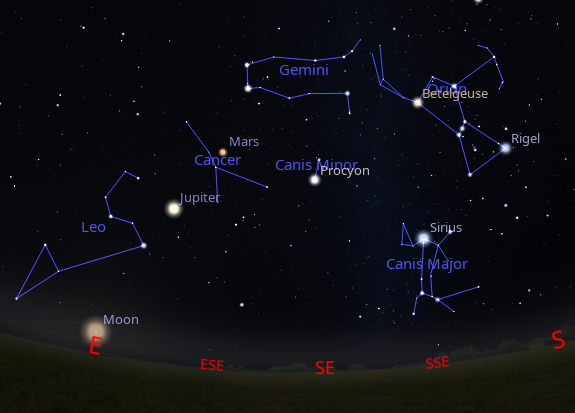
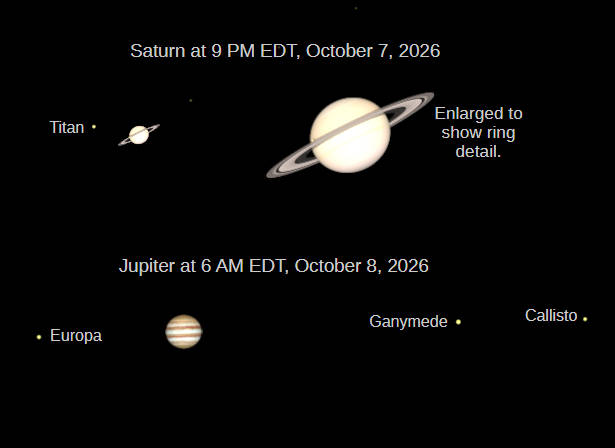
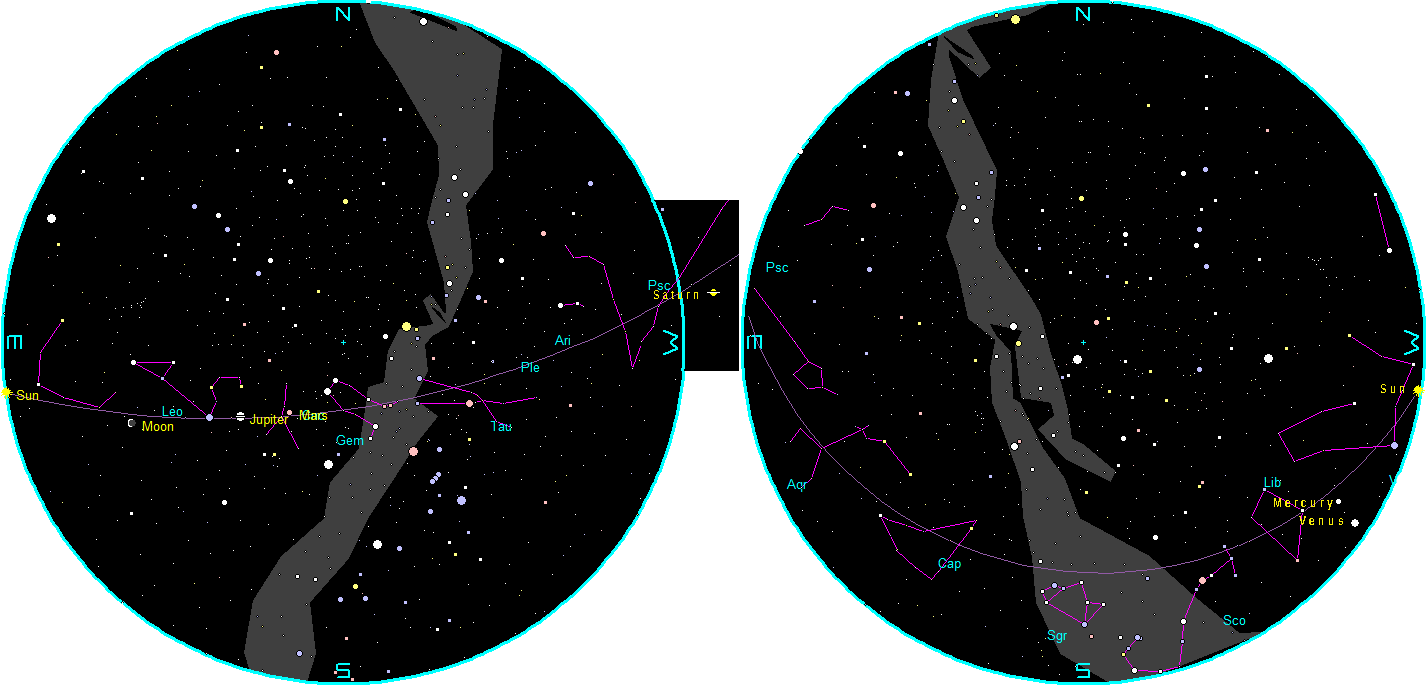
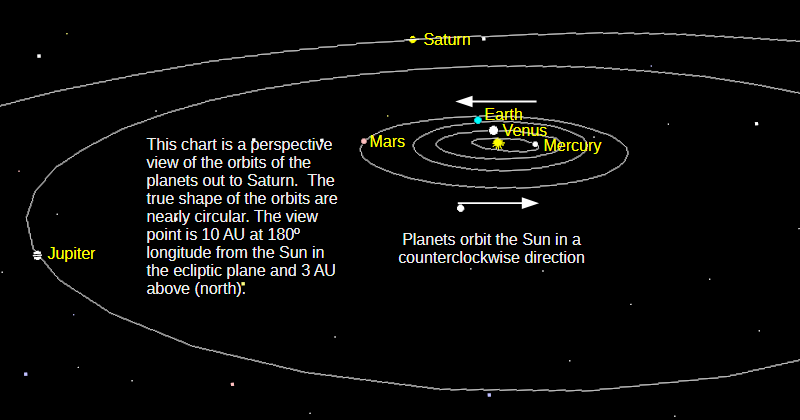
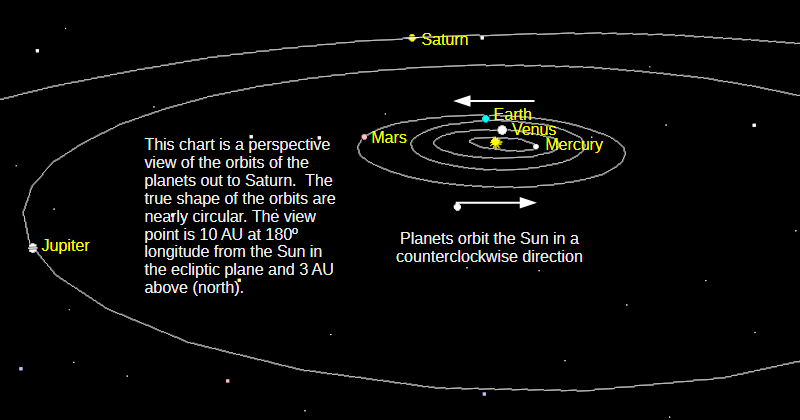
Let’s take our weekly look at the whereabouts of the naked-eye planets. Three of the naked-eye planets are visible in the night sky. Mercury sets too soon after sunset to be seen. Venus is will pass between the earth and the sun on the 23rd, and might be seen in the morning sky a week later. Tonight, Saturn will be in the eastern sky as it gets dark. It is the brightest starlike object low in that direction. It will be below the four stars that make large distinctive pattern, that marks the body of Pegasus the flying horse, called the Great Square. At 6 AM, Jupiter and Mars will in the east. Jupiter is brightest and while red Mars will be above and to the right of Jupiter. It will pass Jupiter on November 15th.
The astronomical event times given in this blog are for the Traverse City/Interlochen area of Michigan (Lat 44.7° N, Long 85.7° W; EDT, UT – 4 hours) unless stated otherwise. Times will be different for other locations.
Addendum
Ephemeris: 10/06/2026 -Finding the constellation of Cepheus the King
This is Ephemeris for Tuesday, October 6th. Today the Sun will be up for 11 hours and 26 minutes, setting at 7:13, and it will rise tomorrow at 7:48. The Moon, 3 days past last quarter, will rise at 4:18 tomorrow morning.
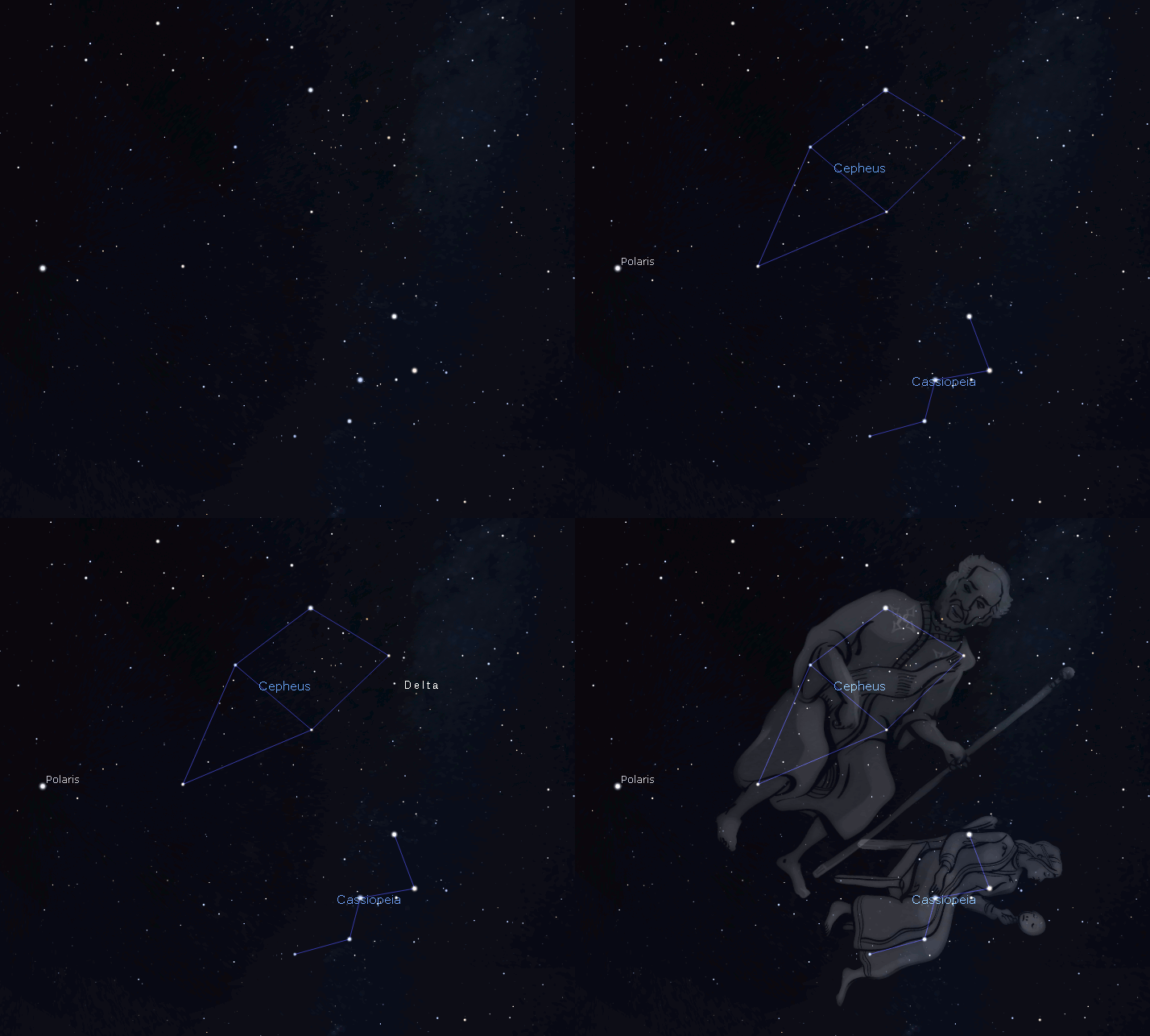
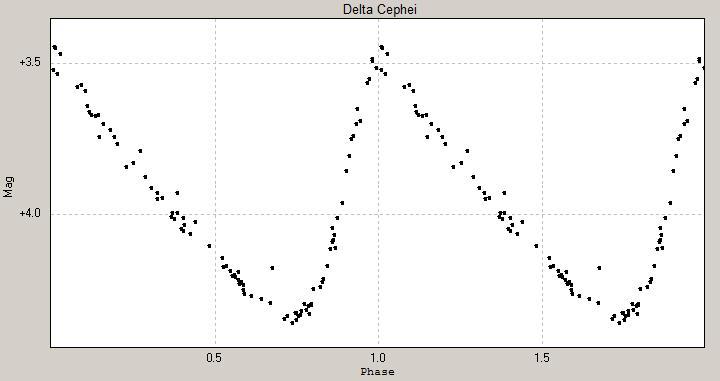
There’s a faint constellation in the northeast above the W shaped constellation of Cassiopeia. It’s a nearly upside down church steeple of a constellation called Cepheus the king, and husband of queen Cassiopeia. Cepheus’ claim to modern astronomical fame is that one of its stars, Delta (δ) Cephei, is the archetype for the important Cepheid variable stars. Delta is the bottom most of a trio of stars at the right corner of the constellation. In the early 20th century, Henrietta Leavitt discovered that Cepheids in the nearby galaxy the Small Magellanic Cloud varied in brightness with a period of days that was related to their brightness. This meant that Cepheids could be used as standard candles to measure the distances to other galaxies.
The astronomical event times given in this blog are for the Traverse City/Interlochen area of Michigan (Lat 44.7° N, Long 85.7° W; EDT, UT – 4 hours) unless stated otherwise. Times will be different for other locations.
Addendum
Ephemeris: 10/05/2026 – Finding and observing Cassiopeia over the year
This is Bob Moler with Ephemeris for Monday, October 5th. Today the Sun will be up for 11 hours and 30 minutes, setting at 7:15, and it will rise tomorrow at 7:47. The Moon, 2 days past last quarter, will rise at 3:02 tomorrow morning.
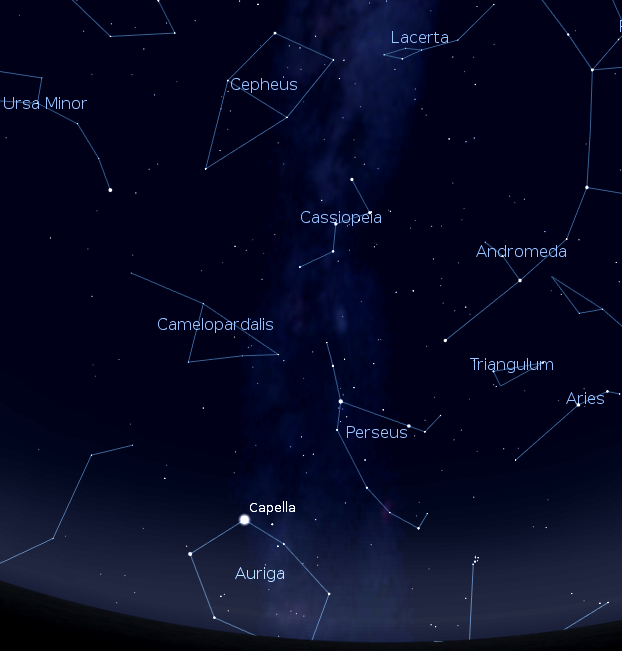
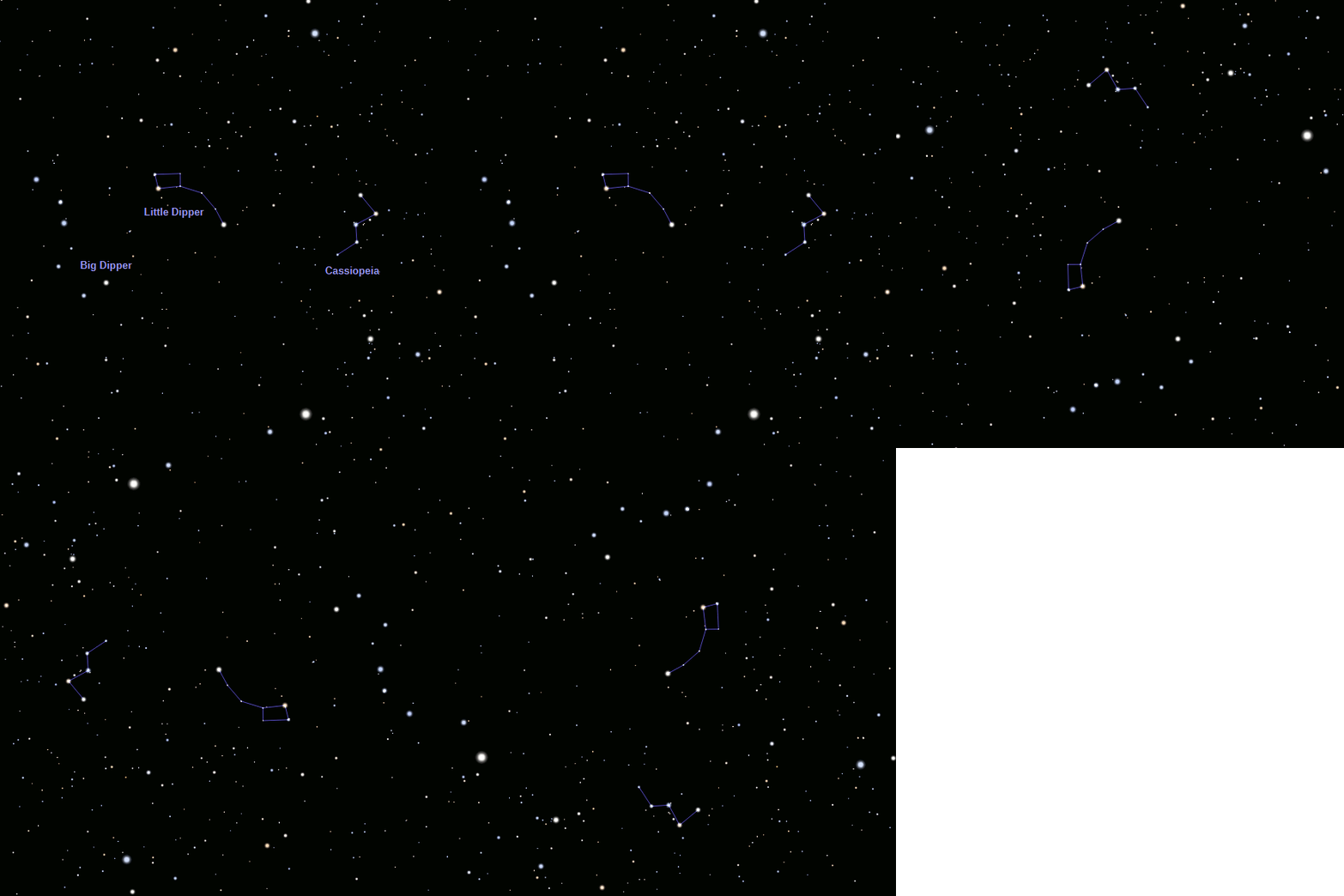
High in the northeastern sky at 9:00 PM the constellation of Cassiopeia the queen can be spotted. Its stars make a letter W in the sky. For anyone located north of 34º north latitude it is circumpolar, meaning that it never sets, as it appears to move around the North Pole of the sky. In the summer it is a W low in the north. It becomes kind of an open and angular number 3 in the autumn. In the winter it is overhead and looks like an M. In springtime it looks like the Greek capital letter Sigma in the northwest. I will visit Cassiopeia later this autumn and relate her story and other autumn constellations including her daughter Andromeda, husband King Cepheus, future son-in-law Perseus, his horse Pegasus, and the sea monster, Cetus.
The astronomical event times given in this blog are for the Traverse City/Interlochen area of Michigan (Lat 44.7° N, Long 85.7° W; EDT, UT – 4 hours) unless stated otherwise. Times will be different for other locations.
Addendum
Ephemeris: 10/02/2026 – GTAS meeting, Our Galactic Neighborhood
This is Bob Moler with Ephemeris for Friday, October 2nd. Today the Sun will be up for 11 hours and 39 minutes, setting at 7:21, and it will rise tomorrow at 7:43. The Moon, 1 day before last quarter, will rise at 11:11 this evening.
The Grand Traverse Astronomical Society (GTAS) will host its October meeting tonight at 8 PM at Northwestern Michigan College’s Joseph H Rogers Observatory. I will present a talk about one of my favorite fall topics: Our Galactic Neighborhood, fearturing the Great Andromeda Galaxy. This galaxy is the farthest object one can see with the naked eye. The photons that hit the retina of the eye have been traveling for two and a half million years. It and the Milky Way belong a small group of galaxies. Afterward, about 9 PM if it’s clear, there will be viewing of the heavens through the observatory’s telescopes. The observatory is located on Birmley Rd. The meeting is also on Zoom, see gtastro.org for more information.
The astronomical event times given in this blog are for the Traverse City/Interlochen area of Michigan (Lat 44.7° N, Long 85.7° W; EDT, UT – 4 hours) unless stated otherwise. Times will be different for other locations.
Addendum
Ephemeris: 10/01/2026 – Previewing October skies
This is Ephemeris for Thursday, October 1st. Today the Sun will be up for 11 hours and 42 minutes, setting at 7:23, and it will rise tomorrow at 7:42. The Moon, 2 days before last quarter, will rise at 10:06 this evening.
Let’s look at the skies for the month of October. The Sun will still be moving south rapidly. Daylight hours in the Interlochen/Traverse City area and will drop from 11 hours and 42 minutes today to 10 hours, 13 minutes at months end. The altitude of the sun above the southern horizon at local noon will be 42 degrees today in the Interlochen area and will descend to 31 degrees on Halloween. Venus will pass the Sun, moving from the evening sky to the morning sky on the 23rd. Venus has not been too noticeable in the evening for the last month, but by early November it will seem to suddenly appear in the morning sky. It can be mistaken as a UFO, especially with its tiny Cheshire Cat crescent smile in binoculars or a small telescope.
The astronomical event times given in this blog are for the Traverse City/Interlochen area of Michigan (Lat 44.7° N, Long 85.7° W; EDT, UT – 4 hours) unless stated otherwise. Times will be different for other locations.
Addendum
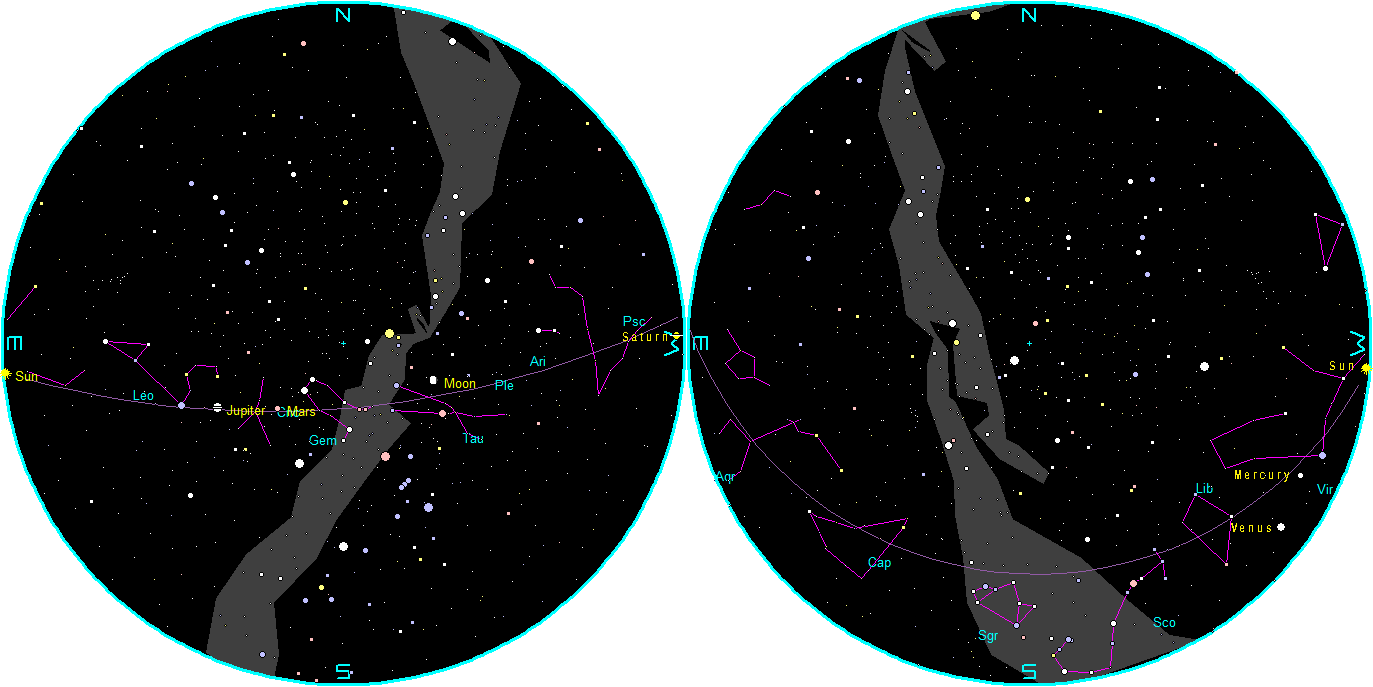
October Evening Star Chart
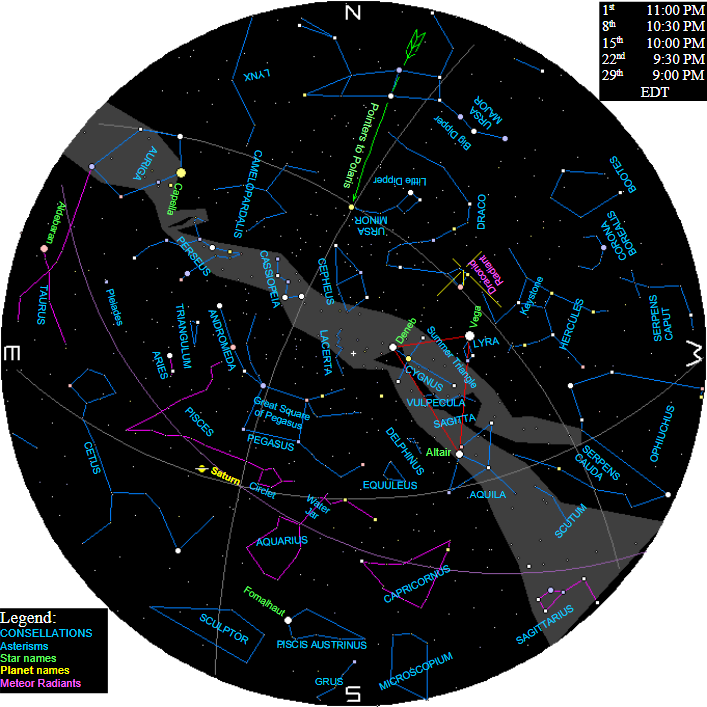
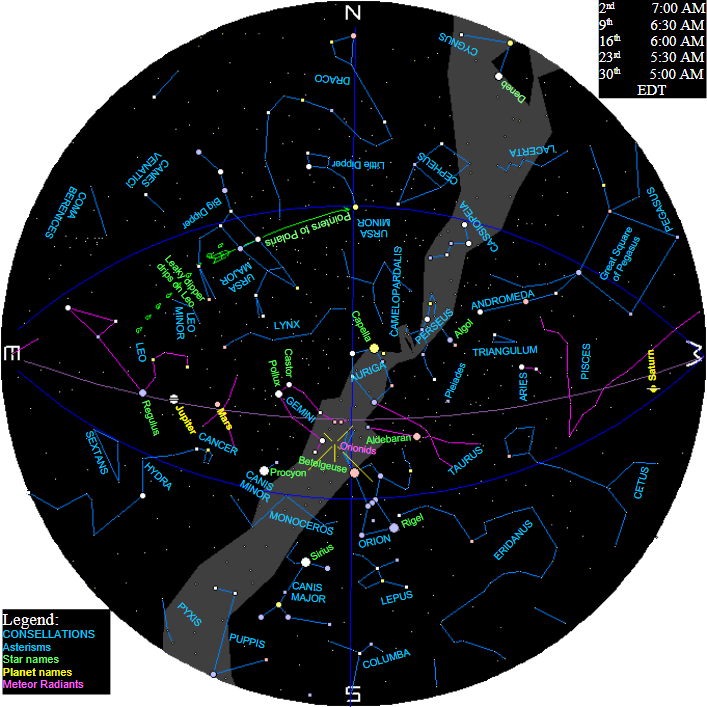
The planets and stars are plotted for the 15th at 10 p.m. EDT in the evening and 6 a.m. for the morning chart. These are the chart times. Note that Traverse City is located approximately 45 minutes behind our time meridian, West 75° longitude. (An hour 45 minutes behind our daylight saving time meridian during EDT). To duplicate the star positions on a planisphere you may have to set it to 1 hour 45 minutes earlier than the current time.
October Morning Star Chart
Twilight Limits, Nautical and Astronomical
| EDT | |||||||
| Morning | Twilight | Evening | Twilight | Dark | Night | Moon | |
| Date | Astro. | Nautical | Nautical | Astro. | Start | End | Illum. |
| 2026-10-01 | 6h05m | 6h39m | 20h29m | 21h04m | 21h04m | 22h07m | 66% |
| 2026-10-02 | 6h06m | 6h40m | 20h27m | 21h02m | 21h02m | 23h11m | 54% |
| 2026-10-03 | 6h08m | 6h42m | 20h26m | 21h00m | 21h00m | – | 43% |
| 2026-10-04 | 6h09m | 6h43m | 20h24m | 20h58m | 20h58m | 0h25m | 32% |
| 2026-10-05 | 6h10m | 6h44m | 20h22m | 20h56m | 20h56m | 1h44m | 22% |
| 2026-10-06 | 6h11m | 6h45m | 20h20m | 20h54m | 20h54m | 3h03m | 13% |
| 2026-10-07 | 6h13m | 6h47m | 20h18m | 20h52m | 20h52m | 4h19m | 7% |
| 2026-10-08 | 6h14m | 6h48m | 20h17m | 20h50m | 20h50m | 5h32m | 2% |
| 2026-10-09 | 6h15m | 6h49m | 20h15m | 20h49m | 20h49m | 6h15m | 0% |
| 2026-10-10 | 6h16m | 6h50m | 20h13m | 20h47m | 20h47m | 6h16m | 0% |
| 2026-10-11 | 6h18m | 6h51m | 20h11m | 20h45m | 20h45m | 6h18m | 3% |
| 2026-10-12 | 6h19m | 6h53m | 20h10m | 20h43m | 20h43m | 6h19m | 7% |
| 2026-10-13 | 6h20m | 6h54m | 20h08m | 20h42m | 20h42m | 6h20m | 12% |
| 2026-10-14 | 6h21m | 6h55m | 20h06m | 20h40m | 20h45m | 6h21m | 19% |
| 2026-10-15 | 6h23m | 6h56m | 20h05m | 20h38m | 21h32m | 6h23m | 28% |
| 2026-10-16 | 6h24m | 6h58m | 20h03m | 20h37m | 22h27m | 6h24m | 36% |
| 2026-10-17 | 6h25m | 6h59m | 20h01m | 20h35m | 23h29m | 6h25m | 46% |
| 2026-10-18 | 6h26m | 7h00m | 19h56m | 20h33m | – | 6h26m | 55% |
| 2026-10-19 | 6h28m | 7h01m | 19h54m | 20h32m | 0h34m | 6h28m | 65% |
| 2026-10-20 | 6h29m | 7h02m | 19h53m | 20h30m | 1h41m | 6h29m | 74% |
| 2026-10-21 | 6h30m | 7h04m | 19h51m | 20h29m | 2h49m | 6h30m | 82% |
| 2026-10-22 | 6h31m | 7h05m | 19h49m | 20h27m | 3h58m | 6h31m | 89% |
| 2026-10-23 | 6h32m | 7h06m | 19h48m | 20h26m | 5h08m | 6h32m | 95% |
| 2026-10-24 | 6h34m | 7h07m | 19h47m | 20h24m | 6h21m | 6h34m | 99% |
| 2026-10-25 | 6h35m | 7h09m | 19h45m | 20h23m | – | – | 100% |
| 2026-10-26 | 6h36m | 7h10m | 19h44m | 20h21m | – | – | 99% |
| 2026-10-27 | 6h37m | 7h11m | 19h42m | 20h20m | – | – | 94% |
| 2026-10-28 | 6h38m | 7h12m | 19h41m | 20h19m | – | – | 88% |
| 2026-10-29 | 6h40m | 7h13m | 19h39m | 20h17m | 20h17m | 21h02m | 79% |
| 2026-10-30 | 6h41m | 7h15m | 19h38m | 20h16m | 20h16m | 22h15m | 69% |
| 2026-10-31 | 6h42m | 7h16m | 19h37m | 20h15m | 20h15m | 23h34m | 58% |
Twilight calendar was generated using Cartes du Ciel (Sky Charts).
See my blog post: Twilight Zone for the definitions of the different periods of twilight here: https://bobmoler.wordpress.com/2018/09/27/.
NASA Calendar of Planetary Events
Oct  1  Th            Venus: 30.8° E
     1  Th   4:41 PM  Moon Perigee: 369300 km
     2  Fr   7:35 AM  Moon North Dec.: 28° N
     3  Sa   9:25 AM  Last Quarter
     4  Su   7:52 AM  Saturn Opposition
     5  Mo   1:30 AM  Moon-Mars: 1.2° S
     5  Mo   7:06 AM  Moon-Beehive: 0.4° S
     6  Tu   6:18 AM  Moon-Jupiter: 0.2° S
     6  Tu   9:19 PM  Moon Descending Node
     6  Tu  10:57 PM  Moon-Regulus: 0.6° N
     6  Tu  11:59 PM  Mercury-Venus: 5° N
    10  Sa  11:50 AM  New Moon
    10  Sa  11:55 AM  Mars-Beehive: 0.4° S
    11  Su  10:30 PM  Moon-Venus: 3.3° S
    12  Mo   5:59 AM  Mercury Elongation: 25.2° E
                      (Poor for N. Hemisphere observers
    12  Mo   4:08 PM  Moon-Mercury: 2.3° N
    14  We   4:25 PM  Moon-Antares: 0.5° N
    15  Th  10:45 PM  Moon South Dec.: 27.9° S
    16  Fr   6:56 PM  Moon Apogee: 404600 km
    18  Su  12:13 PM  First Quarter
    21  We   4:53 AM  Moon Ascending Node
    21  We   2:16 PM  Orionid Shower: ZHR = 20
    23  Fr  11:29 PM  Venus Inferior Conjunction
    25  Su  11:12 PM  Full Moon
    27  Tu   8:11 PM  Moon-Pleiades: 1° S
    28  We   1:01 PM  Moon Perigee: 364400 km
    29  Th  12:40 PM  Moon North Dec.: 27.8° N
Nov  1  Su            Venus: 13.9° W
Sky Events Calendar by Fred Espenak and Sumit Dutta (NASA’s GSFC), with modifications by the author.
http://eclipse.gsfc.nasa.gov/SKYCAL/SKYCAL.html.
If you go to the above site, you can print out a list like the above for the entire year or calendar pages for your time zone.
Sun and Moon Rising and Setting Events
     LU                  Ephemeris of Sky Events for Interlochen/TC
October, 2026    Local time zone: EDT
+-----------------------------------------------------------------------+
| DATE |  SUN     SUN  DAYLIGHT|   TWILIGHT*    |MOON  RISE OR    ILLUM |
|      |  RISE    SET    HOURS |  END    START  |PHASE SET** TIME FRACTN|
+=======================================================================+
|Thu  1| 07:40a  07:23p  11:42 | 08:26p  06:37a |      Rise 10:06p   68%|
|Fri  2| 07:42a  07:21p  11:39 | 08:24p  06:39a |      Rise 11:11p   56%|
|Sat  3| 07:43a  07:19p  11:36 | 08:22p  06:40a |L Qtr Rise 12:25a   45%|
+------+-----------------------+----------------+-----------------------+
|Sun  4| 07:44a  07:17p  11:33 | 08:20p  06:41a |      Rise 01:44a   34%|
|Mon  5| 07:45a  07:15p  11:30 | 08:18p  06:42a |      Rise 03:02a   24%|
|Tue  6| 07:47a  07:13p  11:26 | 08:16p  06:43a |      Rise 04:18a   15%|
|Wed  7| 07:48a  07:12p  11:23 | 08:15p  06:45a |      Rise 05:32a    8%|
|Thu  8| 07:49a  07:10p  11:20 | 08:13p  06:46a |      Rise 06:44a    3%|
|Fri  9| 07:50a  07:08p  11:17 | 08:11p  06:47a |      Rise 07:55a    1%|
|Sat 10| 07:52a  07:06p  11:14 | 08:09p  06:48a |New   Set  06:47p    0%|
+------+-----------------------+----------------+-----------------------+
|Sun 11| 07:53a  07:04p  11:11 | 08:08p  06:50a |      Set  07:09p    2%|
|Mon 12| 07:54a  07:03p  11:08 | 08:06p  06:51a |      Set  07:34p    6%|
|Tue 13| 07:55a  07:01p  11:05 | 08:04p  06:52a |      Set  08:06p   11%|
|Wed 14| 07:57a  06:59p  11:02 | 08:02p  06:53a |      Set  08:44p   18%|
|Thu 15| 07:58a  06:58p  10:59 | 08:01p  06:55a |      Set  09:31p   26%|
|Fri 16| 07:59a  06:56p  10:56 | 07:59p  06:56a |      Set  10:26p   34%|
|Sat 17| 08:00a  06:54p  10:53 | 07:57p  06:57a |      Set  11:28p   44%|
+------+-----------------------+----------------+-----------------------+
|Sun 18| 08:02a  06:52p  10:50 | 07:56p  06:58a |F Qtr Set  12:33a   53%|
|Mon 19| 08:03a  06:51p  10:47 | 07:54p  06:59a |      Set  01:40a   63%|
|Tue 20| 08:04a  06:49p  10:44 | 07:53p  07:01a |      Set  02:48a   72%|
|Wed 21| 08:06a  06:47p  10:41 | 07:51p  07:02a |      Set  03:57a   80%|
|Thu 22| 08:07a  06:46p  10:38 | 07:50p  07:03a |      Set  05:07a   88%|
|Fri 23| 08:08a  06:44p  10:35 | 07:48p  07:04a |      Set  06:20a   94%|
|Sat 24| 08:10a  06:43p  10:33 | 07:47p  07:06a |      Set  07:36a   98%|
+------+-----------------------+----------------+-----------------------+
|Sun 25| 08:11a  06:41p  10:30 | 07:45p  07:07a |      Set  08:56a  100%|
|Mon 26| 08:12a  06:40p  10:27 | 07:44p  07:08a |Full  Rise 06:34p   99%|
|Tue 27| 08:14a  06:38p  10:24 | 07:42p  07:09a |      Rise 07:11p   95%|
|Wed 28| 08:15a  06:37p  10:21 | 07:41p  07:10a |      Rise 08:00p   89%|
|Thu 29| 08:16a  06:35p  10:18 | 07:40p  07:12a |      Rise 09:02p   81%|
|Fri 30| 08:18a  06:34p  10:15 | 07:38p  07:13a |      Rise 10:15p   71%|
|Sat 31| 08:19a  06:32p  10:13 | 07:37p  07:14a |      Rise 11:34p   60%|
+-----------------------------------------------------------------------+
* Nautical Twilight
** Moonrise or moonset, whichever occurs between sunset and sunrise
Generated using my LookingUp for DOS app.
Ephemeris: 09/30/2026 – Taking our weekly look at the whereabouts of the naked-eye planets
This is Ephemeris for Wednesday, September 30th. Today the Sun will be up for 11 hours and 45 minutes, setting at 7:25, and it will rise tomorrow at 7:40. The Moon, 3 days before last quarter, will rise at 9:14 this evening.
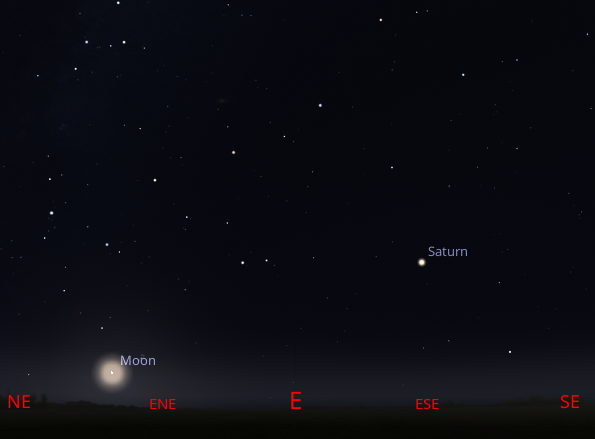
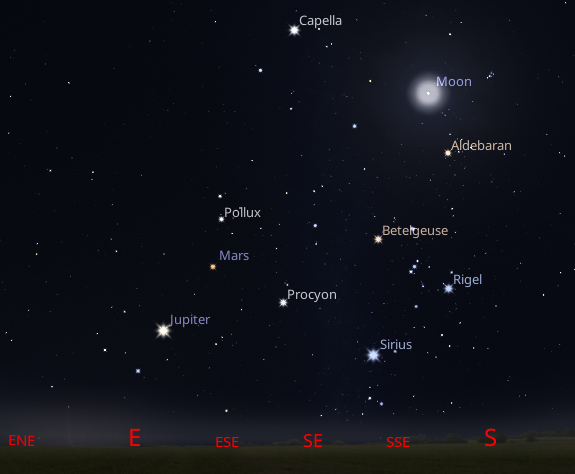
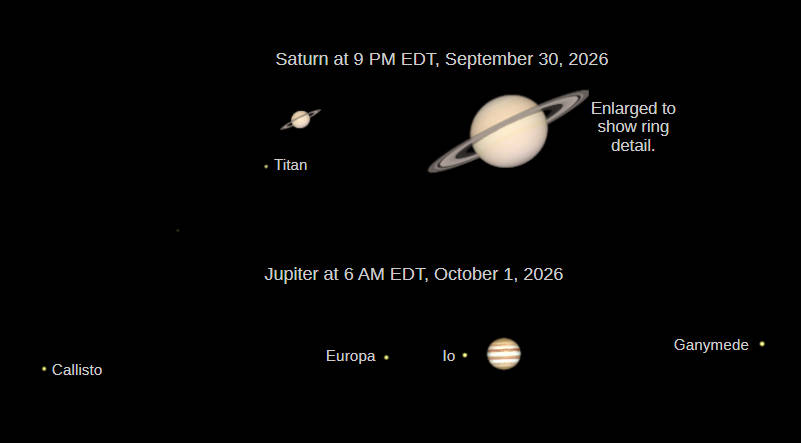
Let’s take our weekly look at the whereabouts of the naked-eye planets. Venus, now is too close to the horizon at sunset to easily spot. At sunset Venus will be only 4º above the horizon at sunset and will set at 7:52 PM. We will await its dramatic reappearance in the morning sky by early November. Saturn will be in the eastern sky as it gets dark. It is the brightest starlike object low in that direction. It will be below the four stars that make large distinctive pattern, that marks the body of Pegasus the flying horse, called the Great Square. At 6 AM, Jupiter and Mars will in the east. Jupiter is brightest and while red Mars will be above and just below and nearly in line with Castor and Pollux of Gemini.
The astronomical event times given in this blog are for the Traverse City/Interlochen area of Michigan (Lat 44.7° N, Long 85.7° W; EDT, UT – 4 hours) unless stated otherwise. Times will be different for other locations.
Addendum
Ephemeris: Finding Andromeda and the great galaxy within
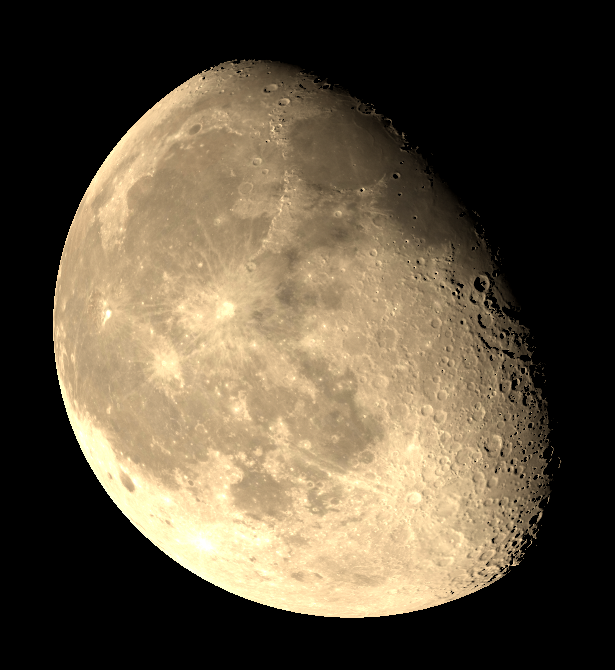
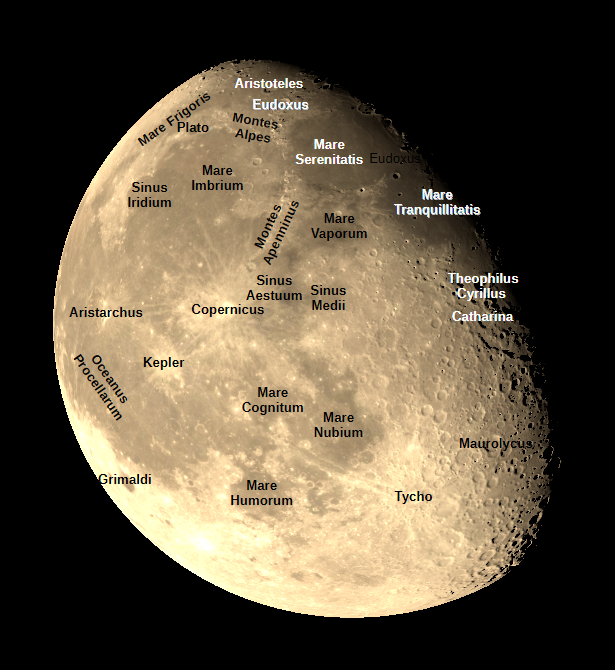
This is Ephemeris for Tuesday, September 29th. Today the Sun will be up for 11 hours and 48 minutes, setting at 7:26, and it will rise tomorrow at 7:39. The Moon, 3 days past full, will rise at 8:35 this evening.
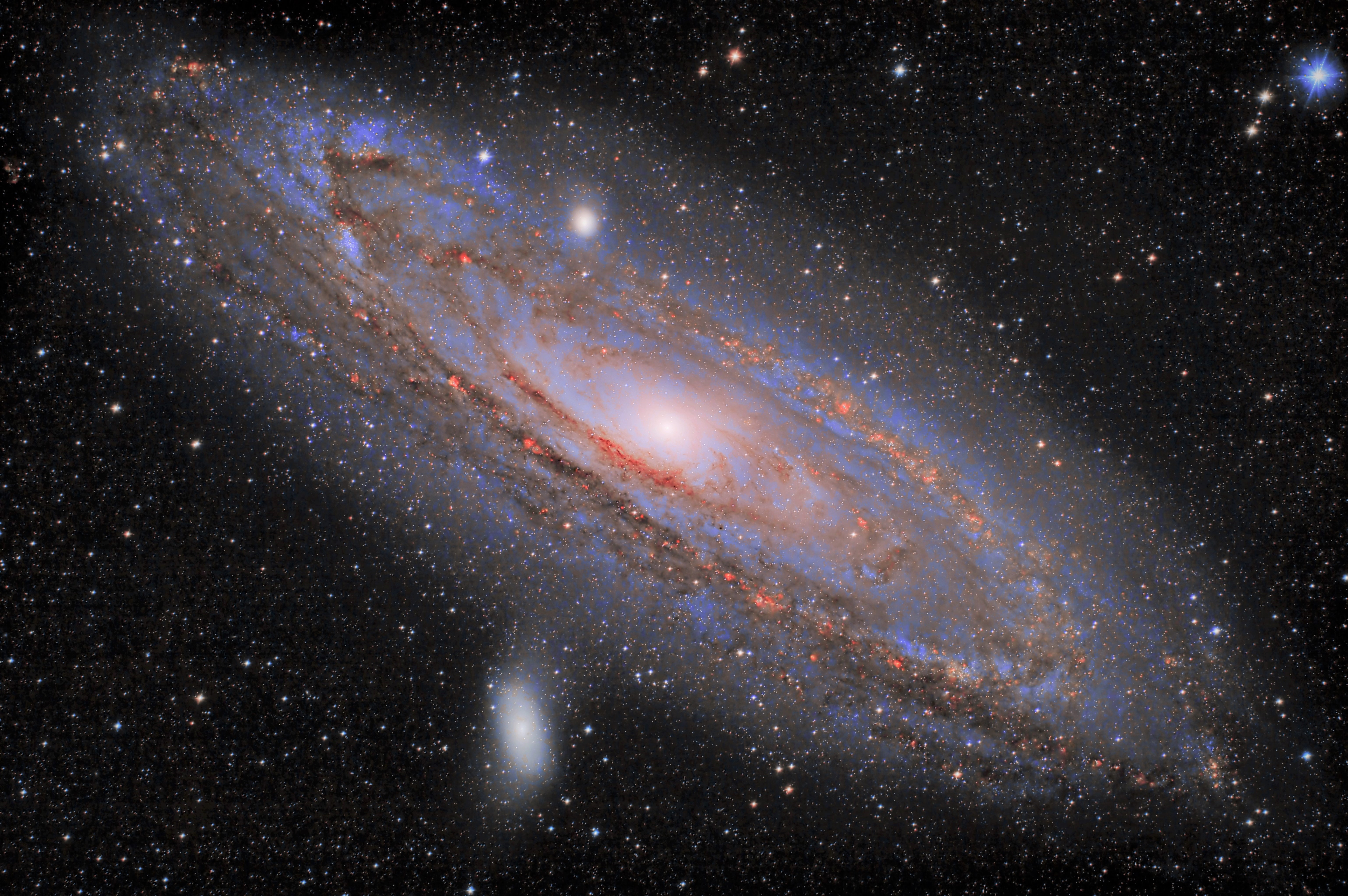
For at least the last thousand or so years a fuzzy spot in the constellation of Andromeda has been known. It was known as the Great Andromeda Nebula until a little over 100 years ago. Nebula means cloud, and it belonged to the Milky Way. At that time it was finally recognized as another Milky Way just like ours. So the word to call it was galaxy, a word that’s related to milk. It looks to be among the stars of Andromeda, but it’s far beyond the stars that we make the constellation of Andromeda. Current estimates place it at about two and a half million light years away, well beyond the stars that we see in Andromeda that range to only a few thousand light years distance. It could collide with our galaxy in about 4 billion years or so.
The astronomical event times given in this blog are for the Traverse City/Interlochen area of Michigan (Lat 44.7° N, Long 85.7° W; EDT, UT – 4 hours) unless stated otherwise. Times will be different for other locations.
Addendum
Ephemeris: 09/28/2026 – What happens to the Earth during Autumn
This is Ephemeris for Monday, September 28th. Today the Sun will be up for 11 hours and 51 minutes, setting at 7:28, and it will rise tomorrow at 7:38. The Moon, 2 days past full, will rise at 8:04 this evening.
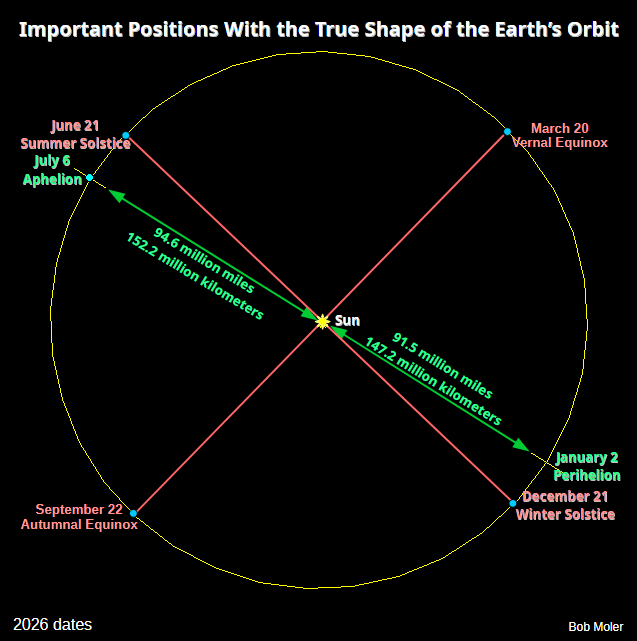
Autumn is a season of change. The Sun, at noon each day, will not rise as high as the previous day. Sunrises will occur progressively later each day, while the Sun sets progressively earlier. This is not occuring by the earth moving away from the sun giving us colder temporatures. In fact throughout autumn we’re moving slowly closer to the Sun. But the entire yearly range in the sun’s distance change is only 3 million miles out of 93 million. The reason for the change of season is the tilt of the axis of the Earth to its orbital plane around the sun. The axis of the Earth points in a single direction, currently towards the star Polaris, so as the Earth moves around the Sun the Earth’s axis appears to change its orientation with the Sun.
The astronomical event times given in this blog are for the Traverse City/Interlochen area of Michigan (Lat 44.7° N, Long 85.7° W; EDT, UT – 4 hours) unless stated otherwise. Times will be different for other locations.
Addendum
Ephemeris: 09/25/2026 – Our Harvest Moon marks the Chinese Mid-Autumn Festival
This is Ephemeris for Friday, September 25th. Today the Sun will be up for 12 hours and 0 minutes, setting at 7:34, and it will rise tomorrow at 7:34. The Moon, 1 day before full, will set at 7:29 tomorrow morning.
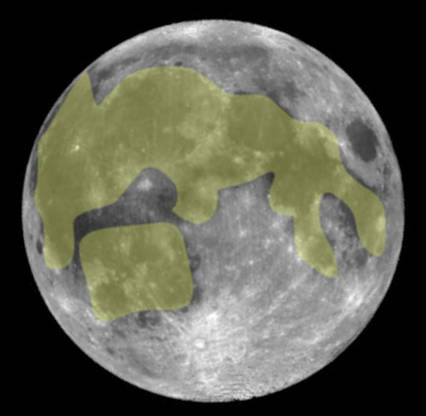
Tomorrow the Moon will be full. And since it’s only four days past the autumnal equinox, this makes it the Harvest Moon. This full moon also marks the Chinese Mid-Autumn Festival to honor the Moon and the story of Chang’e a mortal woman to took an elixir and flew off to the Moon and became a goddess. Another story revolves around the Jade Rabbit pounding Medicine. Beside the face one can see in the dark maria on the moon, we call the Man in the Moon, the Chinese saw the figure of a rabbit seen on the face of the Moon. He is a companion to Chang’e, and has a mortar and pestal with him. He pounds out the medicine that makes the inhabitants of the sky immortal. The Chinese lunar probes are named Chang’e, their rovers: Yutu, the Jade Rabbit.
The astronomical event times given in this blog are for the Traverse City/Interlochen area of Michigan (Lat 44.7° N, Long 85.7° W; EDT, UT – 4 hours) unless stated otherwise. Times will be different for other locations.
Addendum