Archive
08/02/2013 – Ephemeris – Star Party tonight!
Ephemeris for Friday, August 2nd. The sun rises at 6:30. It’ll be up for 14 hours and 35 minutes, setting at 9:06. The moon, half way from last quarter to new, will rise at 3:38 tomorrow morning.
Tonight the Grand Traverse Astronomical Society and the NMC Astronomy Club will host a star party at Northwestern Michigan College’s Rogers Observatory starting at 9 p.m. featuring, if it’s clear, the planets Venus and Saturn. Some of the wonders of the summer sky can be seen as it gets darker. There are sparkling binary stars and star clusters including the Great Globular Star Cluster in Hercules, the Wild Duck Cluster, the Ring Nebula, the expanding gasses of a dying star. There are also other wonders of the Milky Way to be seen. There will be a program if the skies are too cloudy to observe. The observatory is located south of Traverse City, on Birmley Road between Garfield and Keystone roads.
Times are for the Traverse City/Interlochen area of Michigan. They may be different for your location.
08/01/2013 – Ephemeris – Previewing August skies
Ephemeris for Thursday, August 1st. The sun rises at 6:29. It’ll be up for 14 hours and 38 minutes, setting at 9:07. The moon, 3 days past last quarter, will rise at 2:49 tomorrow morning.
Let’s look ahead at the month of August in the skies. Daylight hours will decrease from 14 hours and 38 minutes today to 13 hours 16 minutes on the 31st. The altitude of the sun at local noon, that is degrees of angle above the horizon will decrease from 63 degrees today to just over 53 degrees on the 31st. Straits area listeners can subtract one more degree from those angles. Local noon, when the sun is due south, is about 1:43 p.m. The Perseid meteor shower will reach its peak at between 2 and 4 p.m. on the 12th. That means that more than likely the morning of the 12th and 13th will be equally good. I tend to prefer viewing before the peak, if given a choice. There are some observing events planned for that time.
Times are for the Traverse City/Interlochen area of Michigan. They may be different for your location.
Addendum
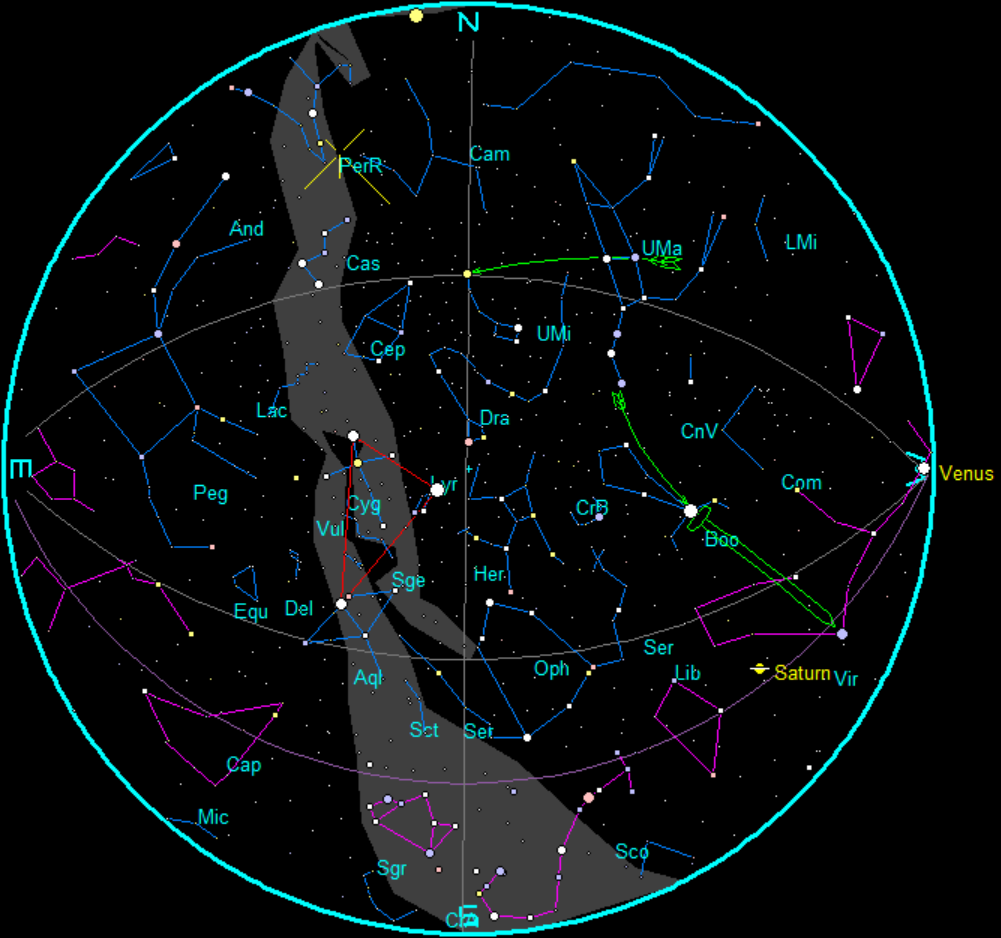
The sky as it would appear on August 15, 2013 at 10 p.m., without the moon.
The constellation abbreviations, names and bright star names are found here.
- The arrow from the pointer stars of the Big Dipper to Polaris the North Star, near the north celestial pole.
- Follow the arc of the handle of the Big Dipper to Arcturus.
- A Leaky Dipper drips on Leo
- Follow the spike to Spica.
- The Summer Triangle (in red)
- PerR is the Perseid meteor radiant
 Bob Moler's Ephemeris Blog