Archive
01/30/2015 – Ephemeris – Looking ahead at the Sun’s advance in February and what’s happening after it sets
Ephemeris for Friday, January 30th. The sun will rise at 8:04. It’ll be up for 9 hours and 43 minutes, setting at 5:48. The moon, half way from first quarter to full, will set at 5:25 tomorrow morning.
February is the shortest month, even so the daylight hours through out the month will be getting longer. Daylight hours will increase from 9 hours and 49 minutes on Sunday the first to 11 hours and 6 minutes on the 28th. The sunrise time will decrease from 8:02 Sunday to 7:22 at month’s end. The sunset times will increase from 5:51 on Sunday to 6:28 on the 28th. Along with that the altitude of the sun at noon will increase from 28 degrees on Sunday to nearly 38 degrees at month’s end. Local noon, by the way for Interlochen and Traverse City is about 12:55 p.m. The planet Jupiter will reach its closest to the Earth in 6 days. Comet Lovejoy will continue to fade as it retreats from the Earth and the Sun.
Times are for the Traverse City/Interlochen area of Michigan. They may be different for your location.
Addenda
Monthly Star Chart
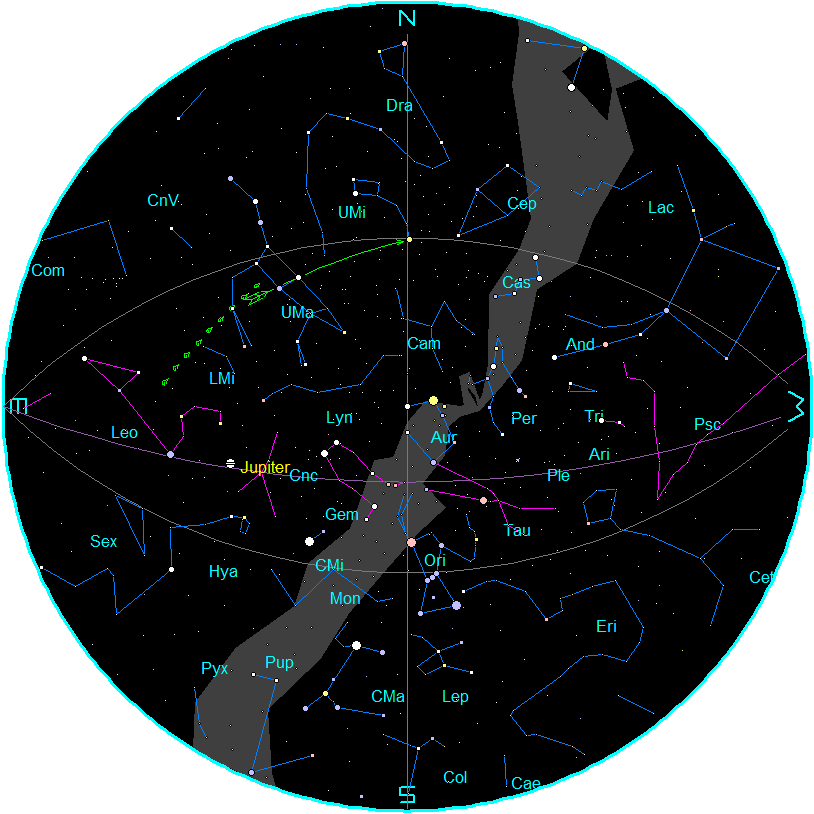
Star Chart for February 2015. Created using my LookingUp program.
The Moon is not plotted. The planets and stars are plotted for the 15th at 9 p.m. That is chart time.
Evening astronomical twilight ends at 7:31 p.m. on February 1st, increasing to 8:06 p.m. on the 28th.
Morning astronomical twilight starts at 6:21 a.m. on February 1st, and decreasing to 5:45 a.m. on the 28th.
Add a half hour to the chart time every week before the 15th and subtract and hour for every week after the 15th.
For a list of constellation names to go with the abbreviations click here.
The green pointer from the Big Dipper is:
- Pointer stars at the front of the bowl of the Big Dipper point to Polaris the North Star.
- Drill a hole in the bowl of the Big Dipper and the water will drip on the back of Leo the Lion.
Comet C/2014 Q2 (Lovejoy)
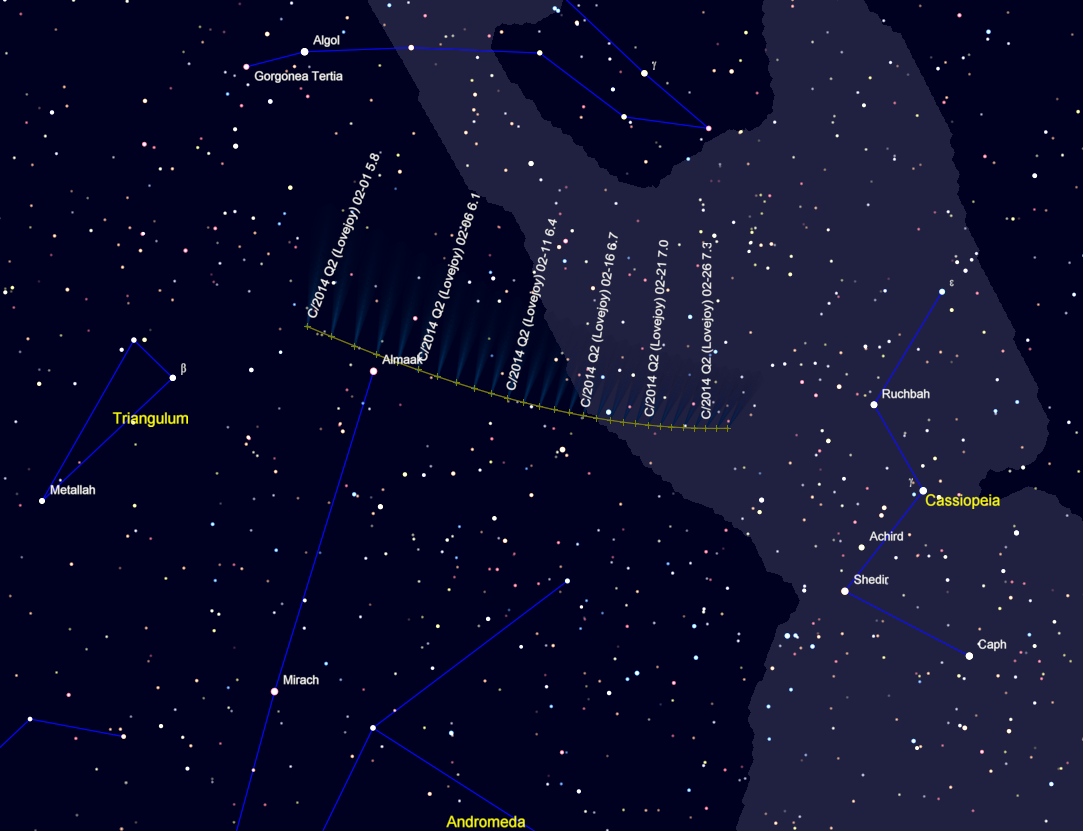
Track of Comet C/2014 Q2 (Lovejoy) for February 2015.
Comet C/2014 Q2 (Lovejoy) will be fading fast throughout February as it moves from Andromeda to Cassiopeia.
Calendar of Planetary Events
Credit: Sky Events Calendar by Fred Espenak and Sumit Dutta (NASA’s GSFC)
To generate your own calendar go to http://eclipse.gsfc.nasa.gov/SKYCAL/SKYCAL.html
Times are Eastern Standard Time on a 24 hour clock. Some additions made to aid clarity.
Conjunctions like the Moon-Saturn: 2.3° S means Saturn will appear 2.3° south of the Moon.
| Feb | 01 | Su | Venus: 23.8° E of Sun | |
| 03 | Tu | 18:09 | Full Moon | |
| 06 | Fr | 01:25 | Moon Apogee: 406,200 km | |
| 06 | Fr | 11:55 | Jupiter Opposition from the Sun | |
| 08 | Su | 12:10 | Moon Ascending Node | |
| 11 | We | 22:50 | Last Quarter | |
| 12 | Th | 19:10 | Moon-Saturn: 2.3° S | |
| 14 | Sa | 12:18 | Moon South Dec.: 18.4° S | |
| 17 | Tu | 01:20 | Moon-Mercury: 3.5° S | |
| 18 | We | 18:47 | New Moon | |
| 19 | Th | 02:29 | Moon Perigee: 357000 km | |
| 20 | Fr | 19:56 | Moon-Venus: 2° S | |
| 20 | Fr | 20:28 | Moon-Mars: 1.5° S | |
| 21 | Sa | 11:05 | Moon Descending Node | |
| 22 | Su | 00:18 | Venus-Mars: 0.4° N | |
| 24 | Tu | 10:59 | Mercury Greatest Elongation: 26.7° W | |
| 25 | We | 12:14 | First Quarter | |
| 25 | We | 18:02 | Moon-Aldebaran: 1° S | |
| 25 | We | 23:18 | Neptune Conjunction with the Sun | |
| 27 | Fr | 02:19 | Moon North Dec.: 18.3° N | |
| Mar | 01 | Su | Venus: 30.1° E of Sun | |
 Bob Moler's Ephemeris Blog