Archive
08/01/2016 – Ephemeris – Previewing August skies
Ephemeris for Monday, August 1st. The Sun rises at 6:29. It’ll be up for 14 hours and 38 minutes, setting at 9:07. The Moon, 1 day before new, will rise at 6:19 tomorrow morning.
Let’s look ahead at the month of August in the skies. Daylight hours will decrease from 14 hours and 38 minutes today to 13 hours 15 minutes on the 31st. The altitude of the sun at local noon, that is degrees of angle above the horizon will decrease from 63 degrees today to just over 53 degrees on the 31st. Straits area listeners can subtract one more degree from those angles. Local noon, when the sun is due south, is about 1:43 p.m. The big event of the month will be in the early morning sky: The Perseid meteor shower will reach its peak on Friday morning the 12th. However you’ll have to wait until after 1:30 a.m. for the moon to set. But that will allow viewing of the shower up to 3 hours of the peak. I’ll have more then.
Times are for the Traverse City/Interlochen area of Michigan. They may be different for your location.
Addendum
August Star Chart
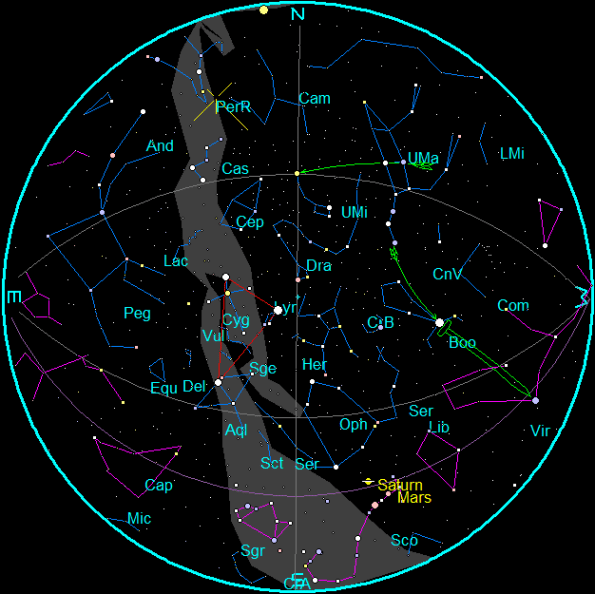
Star Chart for August 2016. Created using my LookingUp program. To enlarge in Firefox right-click on image then click View image.
The planets and stars are plotted for the 15th at 10 p.m. EDT. That is chart time. Note, Traverse City is located approximately 45 minutes behind our time meridian. (An hour 45 minutes behind our daylight saving time meridian.) To duplicate the star positions on a planisphere you may have to set it to 1:45 earlier than the current time if you are near your time meridian.
Evening nautical twilight ends at 10:23 p.m. EDT on the 1st, increasing to 9:26 p.m. EDT on the 31st.
Morning nautical twilight starts at 5:14 a.m. EDT on the 1st, and decreasing to 5:58 a.m. EDT on the 31st.
Add a half hour to the chart time every week before the 15th and subtract a half hour for every week after the 15th. Before the 13th also subtract an hour for Standard Time.
For a list of constellation names to go with the abbreviations click here.
- Pointer stars at the front of the bowl of the Big Dipper point to Polaris the North Star
- Follow the arc of the handle of the Big Dipper to the star Arcturus
- Extend the arc to a spike to point to Spica.
- The Summer Triangle is outlined in red. Vega in Lyra (Lyr), Deneb in Cygnus (Cyg) and Altair in Aquila (Aql).
Calendar of Planetary Events
Credit: Sky Events Calendar by Fred Espenak and Sumit Dutta (NASA’s GSFC)
To generate your own calendar go to http://eclipse.gsfc.nasa.gov/SKYCAL/SKYCAL.html
Times are Eastern Time.
    Date    Time    Event
Aug 01  Mo       Venus: 15.3° E
    02  Tu 16:45 New Moon
    04  Th 02:19 Moon-Venus: 3.1° N
    04  Th 18:12 Moon-Mercury: 0.6° N
    05  Fr 03:48 Moon Ascending Node
    05  Fr 07:57 Venus-Regulus: 1° N
    05  Fr 23:28 Moon-Jupiter: 0.2° N
    09  Tu 20:05 Moon Apogee: 404300 km
    10  We 14:21 First Quarter
    12  Fr 08:10 Moon-Saturn: 4° S
    12  Fr 08:26 Perseid Shower: ZHR = 90
    14  Su 09:05 Moon South Dec.: 18.5° S
    16  Tu 16:59 Mercury Elongation: 27.4° E
    18  Th 05:27 Full Moon
    19  Fr 10:14 Moon Descending Node
    20  Sa 01:34 Mercury-Jupiter: 3.8° N
    21  Su 21:20 Moon Perigee: 367000 km
    24  We 01:09 Mars-Antares: 1.8° N
    24  We 21:11 Mars-Saturn: 4.3° N
    24  We 23:41 Last Quarter
    25  Th 12:21 Moon-Aldebaran: 0.2° S
    27  Sa 07:17 Moon North Dec.: 18.5° N
    27  Sa 17:53 Venus-Jupiter: 0.1° N
    28  Su 16:09 Mercury-Venus: 5° N
Sep 01  Th       Venus: 23.5° E
 Bob Moler's Ephemeris Blog