Archive
01/12/17 – Ephemeris – Venus is at greatest eastern elongation today
Ephemeris for Thursday, January 12th. The Sun will rise at 8:17. It’ll be up for 9 hours and 7 minutes, setting at 5:25. The Moon, at full today, will rise at 6:04 this evening.
Today, around 8 a.m. the planet Venus will reach its greatest eastern elongation from the Sun. What that means in simple terms is that Venus will appear as far east of the Sun that it can get. The angle between it and the Sun will be 47.1 degrees. Venus, like Mercury orbits the Sun inside the Earth’s orbit, so is always seen close to the Sun. In telescopes Venus will look like a tiny half illuminated orb, like a first quarter Moon. That’s for the same reason. The Sun is illuminating half of the side we can see. Venus is moving directly toward us now, at a distance of 63 million miles (102 million km). As Venus approaches us, it will grow in size in telescopes, becoming larger in appearance than Jupiter the largest planet. It will leave the evening sky, passing between the Earth and the Sun, only 26 million miles away on March 25th.
Times are for the Traverse City/Interlochen area of Michigan. They may be different for your location.
Addendum
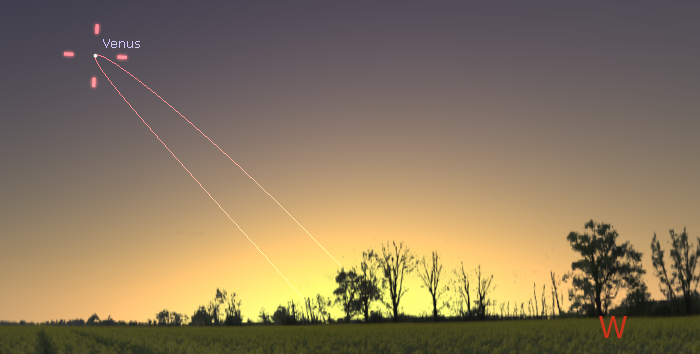
Venus at 5:30 p.m. January 12, 2017 also displaying its orbit. Created using Stellarium.
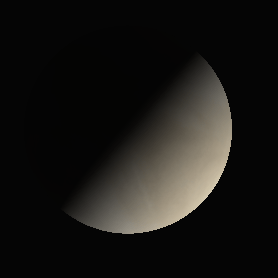
Venus in a telescope showing it half illuminated at greatest eastern elongation. Created using Stellarium.
There’s an odd phase effect called the “Venus Dichotomy” where at the instant of greatest elongation that Venus’ phase is not exactly half illuminated. Half phase may differ by several hours. The actual time of greatest eastern elongation according to NASA’s SKYCAL Calendar at https://eclipse.gsfc.nasa.gov/SKYCAL/SKYCAL.html is January 12 at 7:59 a.m. EST or 12:59 UT.
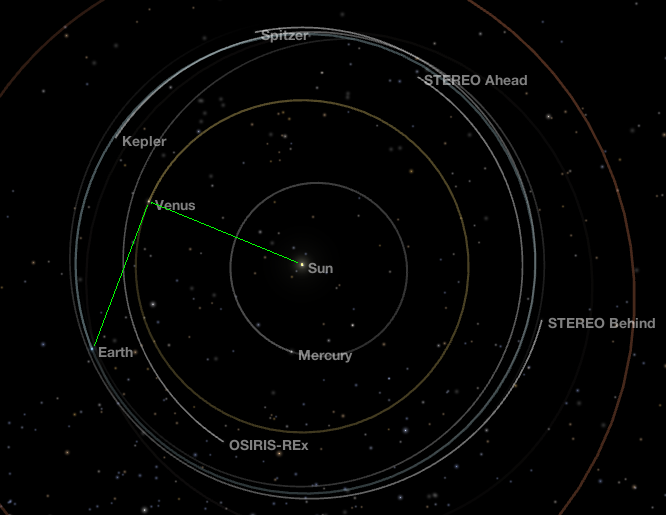
Inner solar system showing the relationship of Venus and the Earth. At greatest elongation The angle between Venus-Sun line and Venus-Earth line is 90 degrees. which is why Venus shows as half illuminated. Created using the application NASA’s Eyes.
Note that the chart above also shows NASA’s inner solar system missions. To download the app, created by the Jet Propulsion Laboratory (JPL), go to https://eyes.nasa.gov/. Use it to follow the progress of NASA solar system missions.
 Bob Moler's Ephemeris Blog