03/18/2022 – Ephemeris – Spring is two days away!
This is Ephemeris for Friday, March 18th. Today the Sun will be up for 12 hours and 3 minutes, setting at 7:52, and it will rise tomorrow at 7:47. The Moon, at full today, will rise at 8:28 this evening.
Sunday morning March 20th, at 11:33 am the Sun will cross overhead at the earth’s equator as it appears to head north, starting for us, the season of spring. It will be the vernal equinox. As you can tell from my intro, we’re already above 12 hours of daylight, and we’ll add another 3 plus hours of daylight before summer begins in three months. We are already adding about 3 minutes a day of daylight to that goal now, the maximum rate. With the Sun out longer and its ascension higher in the sky each day, it is rapidly adding energy to the Northern Hemisphere. We won’t feel that immediately. While the land rapidly absorbs heat, the oceans and lakes, especially the Great Lakes, are big heat sinks, taking much longer to warm up.
The astronomical event times given are for the Traverse City/Interlochen area of Michigan (EDT, UT – 4 hours). They may be different for your location.
Addendum
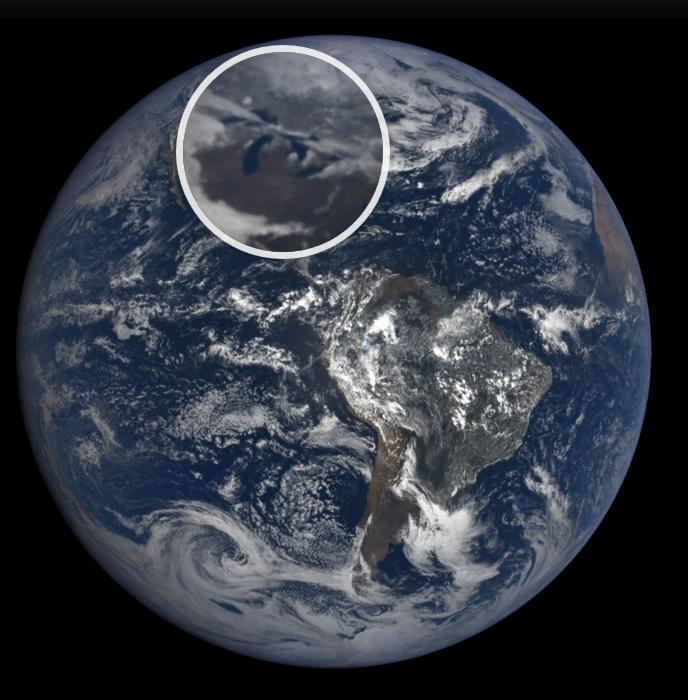
The Earth from 2 days before the vernal equinox 2018, with the North Pole not quite in sunlight. I’ve added a magnifying spot showing Michigan. It was a rare clear day when this image was taken. Credit NOAA/DSCOVR satellite/EPIC camera. The DSCOVR satellite is located in a halo orbit around the Sun-Earth Lagrange L1 point nearly a million miles sunward of the Earth.
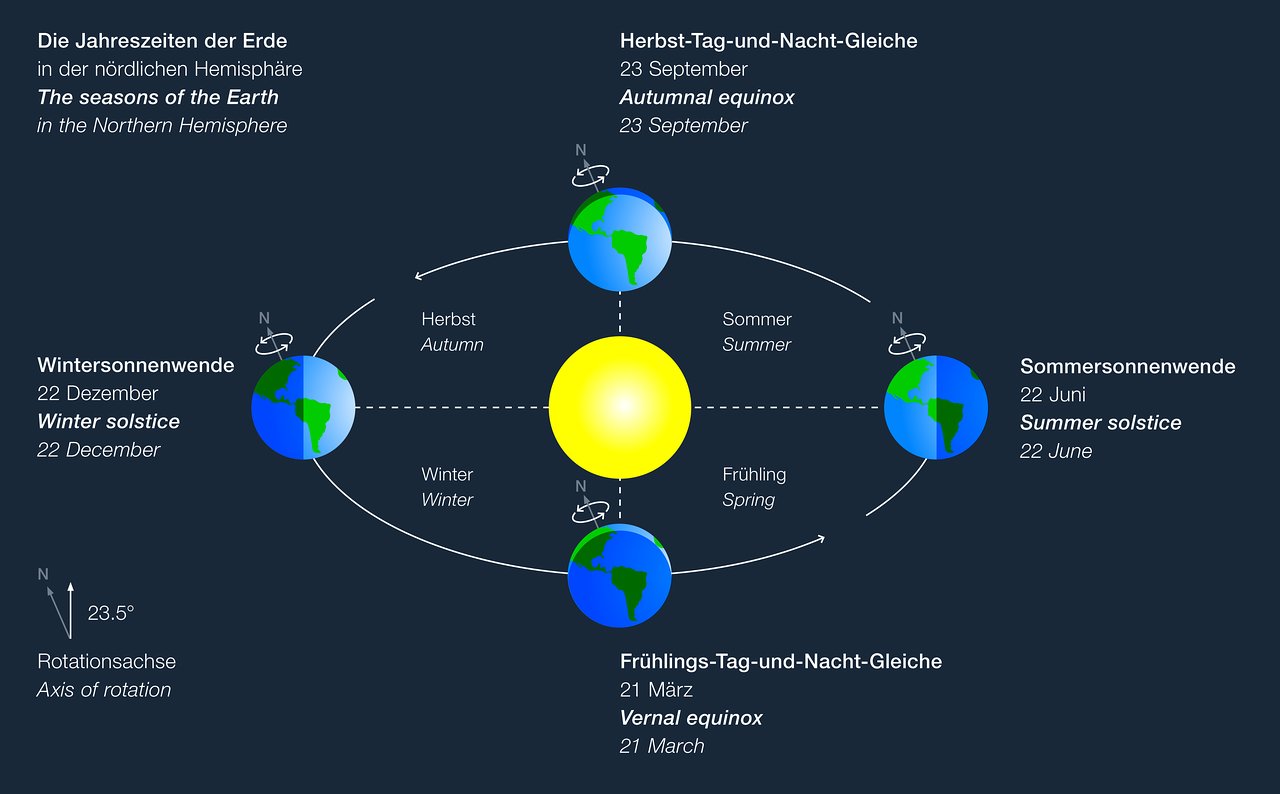
Earth’s position at the solstices and equinoxes. This is a not to scale oblique look at the Earth’s orbit, which is nearly circular. The Earth is actually farthest from the Sun on July 4th. The dates for the equinoxes and solstices are shown one day later than it is actually. Click on the image to enlarge. Credit: ESO (European Southern Observatory), which explains the captions in German and English.
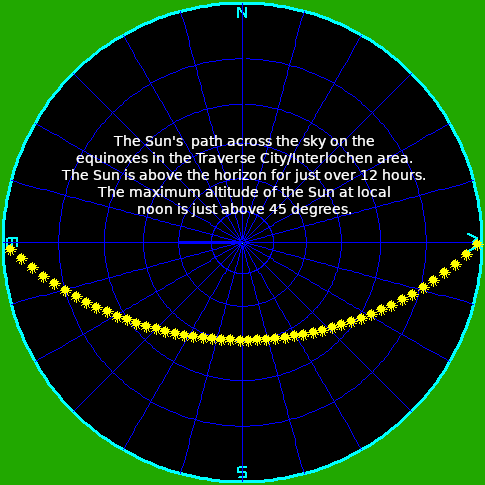
The Sun’s path through the sky on an equinox day from the Traverse City/Interlochen area in Michigan. The Sun is plotted every 15 minutes. This is a stereographic projection which compresses the image near the zenith and enlarges the image towards the horizon. Created using my LookingUp program.
 Bob Moler's Ephemeris Blog