07/11/2022 – Ephemeris – First color images from the James Webb Space Telescope will be released tomorrow
This is Ephemeris for Monday, July 11th. Today the Sun will be up for 15 hours and 20 minutes, setting at 9:28, and it will rise tomorrow at 6:08. The Moon, 2 days before full, will set at 4:19 tomorrow morning.
Tomorrow at 10:30 am, NASA and the Space Telescope Science Institute will present the first results from the James Webb Space Telescope. These will be, I believe, four multi-spectral images rendered in full color, and other data. The spectral range of Webb in the infrared is greater than Hubble Space Telescope by several factors. Hubble operates mostly in visible light and plus a bit in the ultraviolet and the near infrared. The current alignment images released are monochromatic and rendered in orange for aesthetic reasons, and to hint that these are from the long wavelength part of the spectrum. I expect the new images to look as great or better than anything the Hubble has produced. There will be a Webb image release and celebration at the Milliken Auditorium of the Dennos Museum at 10:30, with doors opening at 10 am; and also at the Main Library in Traverse City.
The astronomical event times given are for the Traverse City/Interlochen area of Michigan (EDT, UT – 4 hours). They may be different for your location.
Addendum
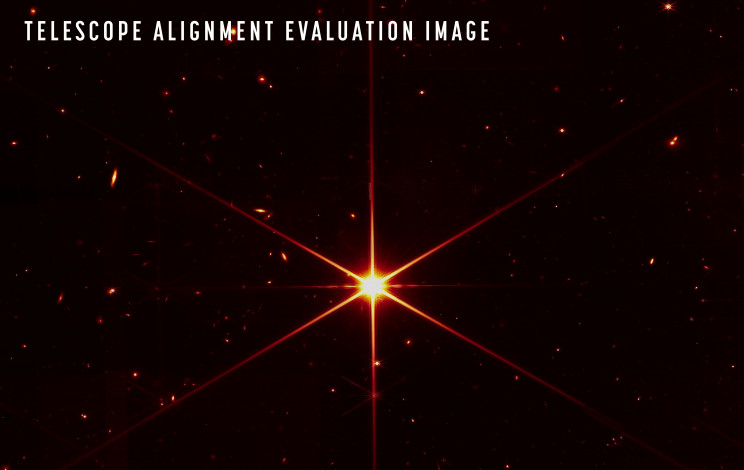
The alignment image of the James Webb Space Telescope after the 18 primary mirror segments have been aligned to act as a single mirror. Beside the alignment star showing its overexposed diffraction spikes, many faint galaxies can be seen. The alignment star, near the Big Dipper, is almost too faint to be seen in binoculars. Credit: NASA, Space Telescope Science Institute (STScI).
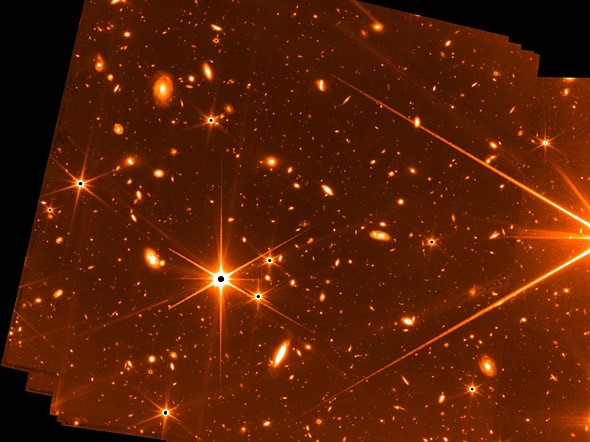
Webb Fine Guidance Sensor (FGC) test image guiding on a star for 72 exposures totaling 32 hours over 8 days. The color key to brightness is white, yellow, orange, red for bright to dim. The black cores to the stars, and at least one galaxy is due to saturating the pixels due to brightness, and are not black holes. Credits: Canadian Space Agency, NASA, FGS team. The Fine Guidance Sensor is a contribution to the James Webb Space Telescope by the Canadian Space Agency.
 Bob Moler's Ephemeris Blog