Archive
04/20/2023 – Ephemeris – There’s a hybrid solar eclipse happening today*
This is Ephemeris for Thursday, April 20th. Today the Sun will be up for 13 hours and 43 minutes, setting at 8:33, and it will rise tomorrow at 6:48. The Moon is new today, and won’t be visible.
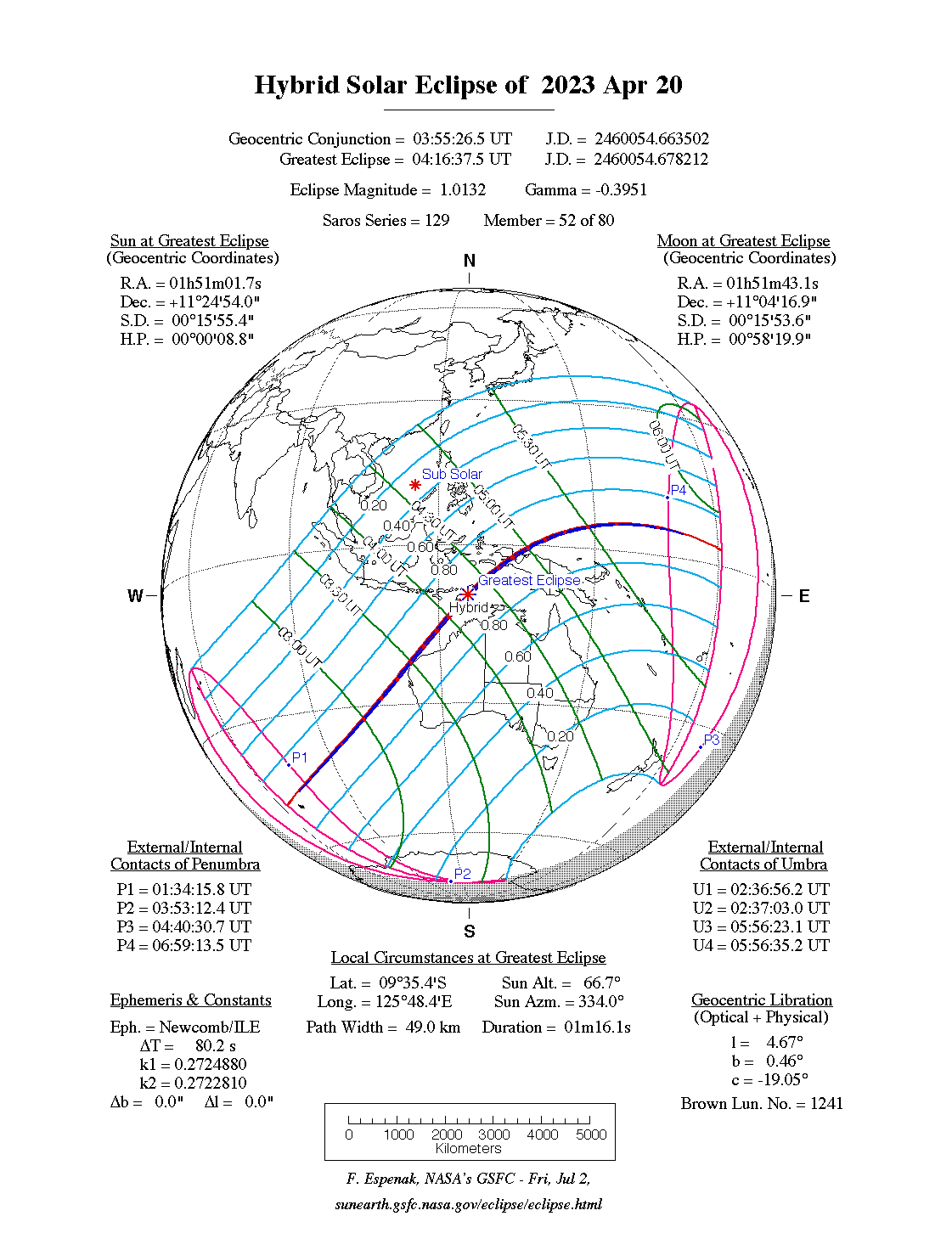
Last night and in the early morning hours this morning, for us, there was a solar eclipse visible from the Indian Ocean, through Indonesia and ending in the Pacific Ocean. This was a type of eclipse that I haven’t talked about before, a hybrid eclipse. It started at sunrise with the Moon too far away to completely cover the face of the Sun, as an annular eclipse. The central part of the eclipse path, due to the fact that the Earth is a sphere, was nearly four thousand miles closer to the Moon than at sunrise and sunset, evolves into a total eclipse. As the Moon’s shadow falls off toward the limb of the Earth, the increasing distance of the shadow to the Earth’s surface, causes the Moon to shrink enough to revert to an annular eclipse once again.
Next eclipse season, more specifically October 14th, there will be an annular eclipse, whose path crosses the US from the Oregon-California border to Texas. We will get a partial eclipse out of it. The big event will occur in the next eclipse season when a total solar eclipse will occur to cross the US from Texas to Maine on April 8, 2024. The path of totality will clip the southeast corner of Michigan.
The astronomical event times given are for the Traverse City/Interlochen area of Michigan (EST, UT –4 hours). They may be different for your location.
* By the time you read this, the eclipse is either happening right now, or it’s over.
Addendum
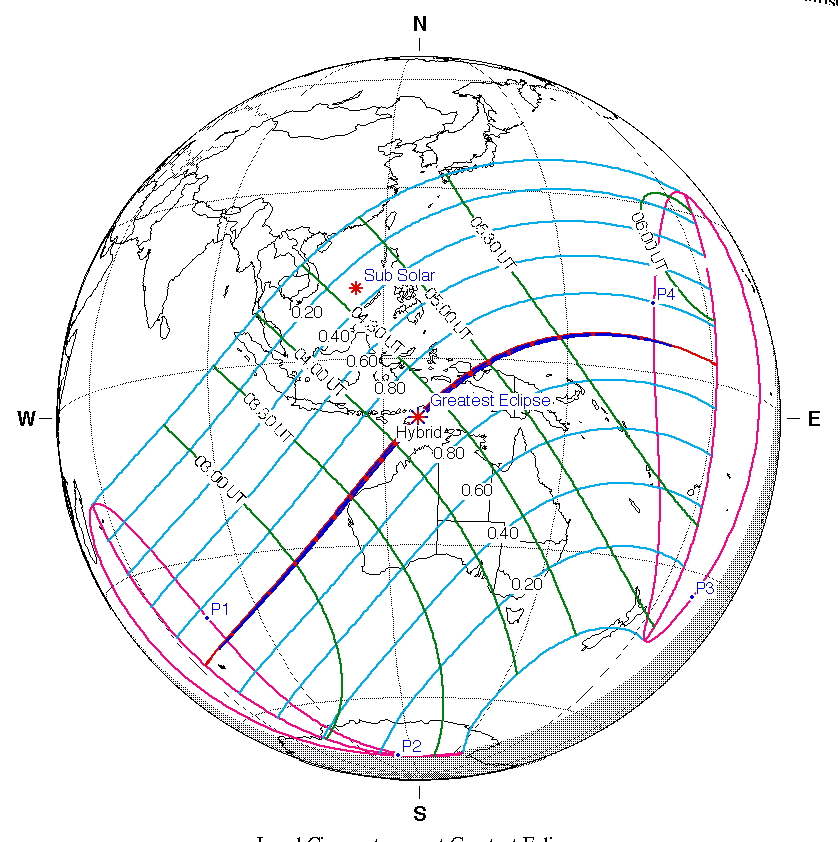
World solar eclipse map for the hybrid eclipse, April 20, 2023. The central path is in red, while the total eclipse part of the path is highlighted in blue. The image is of the world solar eclipse map for the hybrid eclipse, April 20, 2023. Taken from https://eclipse.gsfc.nasa.gov/SEplot/SEplot2001/SE2023Apr20H.GIF. Credit: NASA’s GSFC, Fred Espenak.
 Bob Moler's Ephemeris Blog