06/02/2023 – Ephemeris – A South Pole adventure and a comet collision presentation – Tonight!
This is Bob Moler with Ephemeris for Friday, June 2nd. Today the Sun will be up for 15 hours and 22 minutes, setting at 9:22, and it will rise tomorrow at 5:59. The Moon, 1 day before full, will set at 5:14 tomorrow morning.
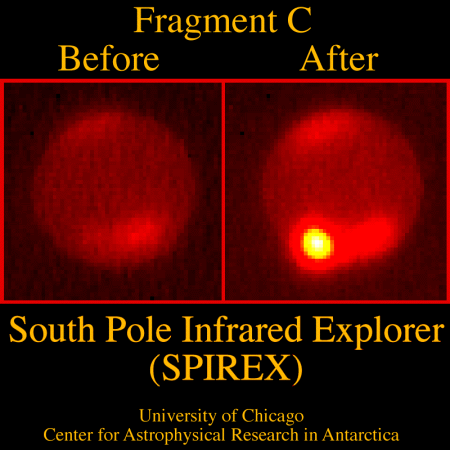
An Antarctic Odyssey: Winter-Over at South Pole Station will be the presentation by John W. Briggs, via Zoom, at tonight’s meeting of the Grand Traverse Astronomical Society at Northwestern Michigan College’s Rogers Observatory at 9 pm. John was a team member building a 24-inch infrared telescope and related experiments that were set up at the South Pole in time for him and colleagues to observe the July 1994, explosive crash of fragmented comet Shoemaker-Levy 9 into the planet Jupiter. There are two ways to attend: In person at the observatory, south of Traverse City on Birmley Road, or via Zoom with a link provided by the society’s website gtastro.org just prior to the meeting.
The astronomical event times given are for the Traverse City/Interlochen area of Michigan (EDT, UT –4 hours). They may be different for your location.
Addendum
About the Program
An Antarctic Odyssey: Winter-Over at South Pole Station
A presentation via Zoom by John W. Briggs
Abstract:
In a lavishly illustrated presentation, John W. Briggs of New Mexico will describe his year-long experience living at the Geographic South Pole while working for the Center for Astrophysical Research in Antarctica. In preparation for this at Yerkes Observatory of the University of Chicago, John was a team member building a 24-inch infrared telescope and related experiments that were set up at the Pole in time for him and colleagues to observe the July 1994, explosive crash of fragmented comet Shoemaker-Levy 9 into the planet Jupiter.
John weathered the “winter-over” with 26 other members of the U.S. Antarctic Program in an experience that many believe approximates what life will be like someday at a lunar or Martian outpost. Once begun, South Pole winter-over is an irreversible commitment, since the Program’s special LC-130 ski planes can’t land in the winter temperatures — in 1994, sometimes as low as 107 degrees F. below zero (with windchill, as low as -180 degrees). John will delight the audience with his perspective on the total South Pole experience — the strange natural environment, the odd social atmosphere, and the challenging, ongoing science.
 Bob Moler's Ephemeris Blog