This is Bob Moler with Ephemeris for Labor Day, Monday, September 4th. Today the Sun will be up for 13 hours and 5 minutes, setting at 8:14, and it will rise tomorrow at 7:09. The Moon, 2 days before last quarter, will rise at 10:32 this evening.
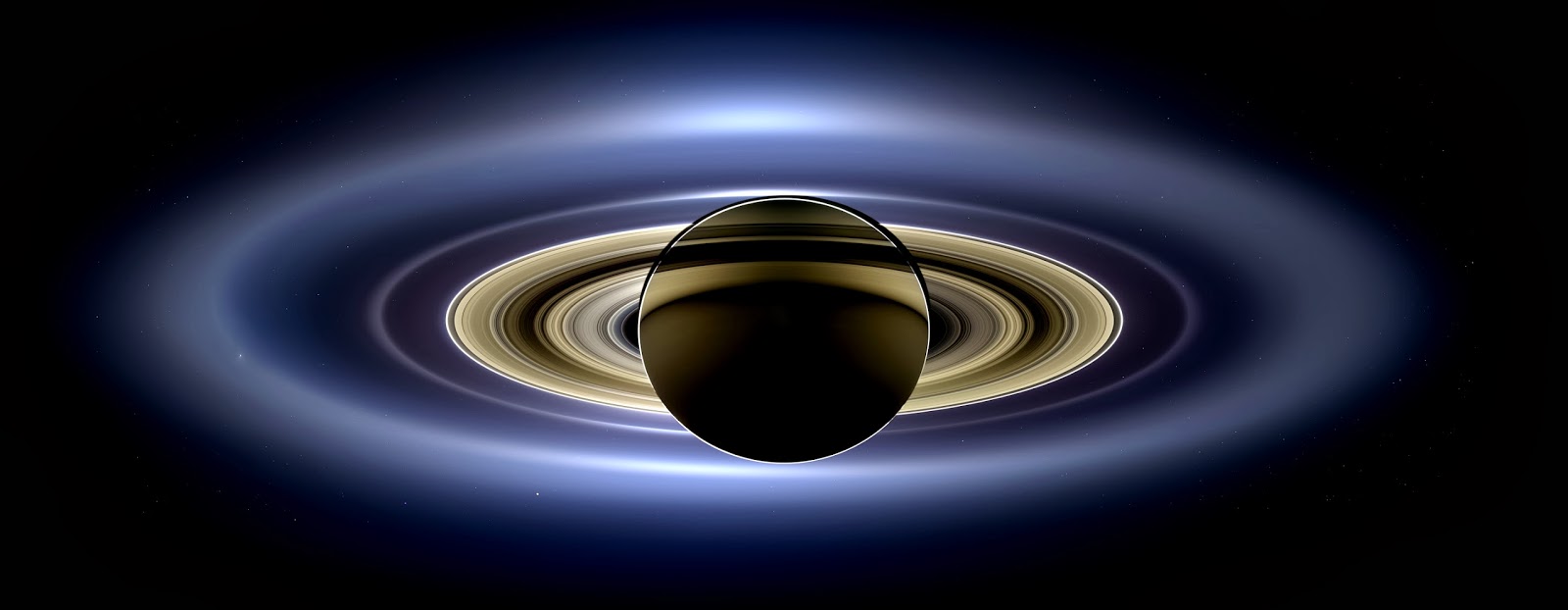
We are going to take one more look at Saturn’s rings, and these are the rings which are not visible from the Earth, but only from spacecraft in the vicinity of Saturn. We have the A, B and C rings which are visible from here Then there’s a D ring inside the C ring. There’s the F ring, a very thin ring which is controlled by a tiny moon called Prometheus, just outside the A ring. Farther out there’s an E ring which is a very diffuse ring, in the orbit of the moon Enceladus, which is an active satellite. It has geysers at the at its South Pole which vent water ice and organic compounds, which form the E ring. Saturn has many more rings and ring arcs in orbit around it, too numerous to mention here.
The astronomical event times given are for the Traverse City/Interlochen area of Michigan (EDT, UT –4 hours). They may be different for your location.
Addendum
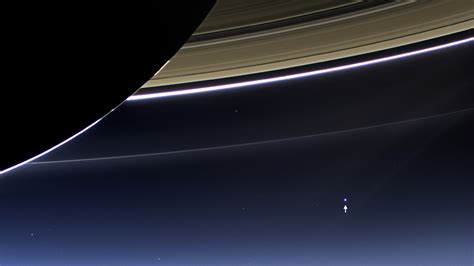
“The day the Earth smiled” image from the Cassini spacecraft. The spacecraft, at that time was behind Saturn, in its shadow, performing an eclipse of the Sun. The rings are seen from their unlit side. The bright areas in the rings are due to forward scattering of very small particles, like seeing dust in a sun beam. The innermost D and C rings are made of those small particles. The B ring is made-up of larger particles, more densely packed, so in this image it turns out to be black. Next out is the A ring, and the skinny ring on the outside of the A ring is the F ring. Farther out through the very faint the G ring. And the outermost is the E ring caused by the geysers from the moon Enceladus, which can be seen near the inner edge on the left side of the ring. Other than the A, B and C rings the other rings were lettered in order of their discovery, which is why they’re out of order physically. The image has to be enlarged to spot the Earth and all it’s smiling earthlings, packed into one pixel. The Earth is seen at 4 o’clock from Saturn, just outside the G ring. There is a better enlargement below. Tap or click on the image to enlarge it. Credit: NASA/JPL/Cassini/Carolyn Porco.
Off-topic
The Earth and above it, the Moon from the image above. Credit: NASA/JPL/Cassini/Carolyn Porco.
 Bob Moler's Ephemeris Blog