Home > Ephemeris Program, Galaxies > Ephemeris: 11/09/2023 – The Milky Way will collide with the Great Andromeda Galaxy

Ephemeris: 11/09/2023 – The Milky Way will collide with the Great Andromeda Galaxy

November 9, 2023

This is Bob Moler with Ephemeris for Thursday, November 9th. Today the Sun will be up for 9 hours and 49 minutes, setting at 5:21, and it will rise tomorrow at 7:32. The Moon, halfway from last quarter to new, will rise at 4:31 tomorrow morning.

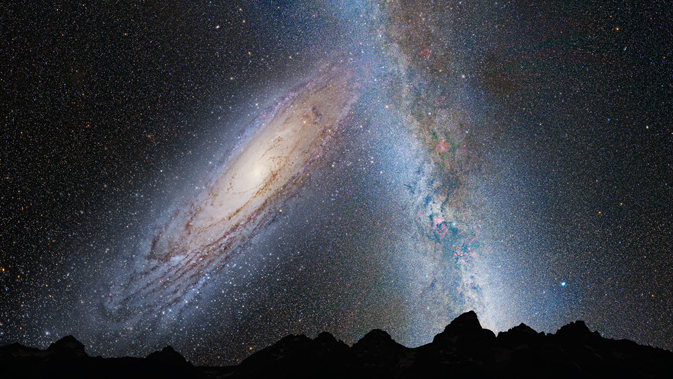
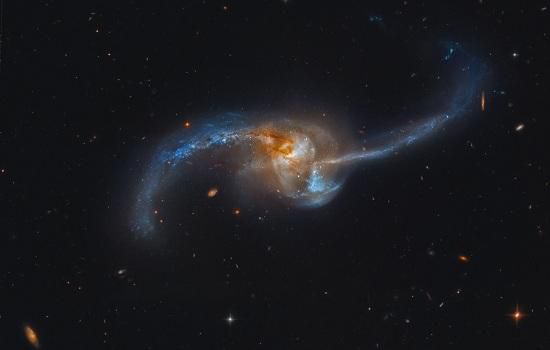
Stars are at extreme distances compared to their sizes, even if one includes their planetary systems. Galaxies in a galaxy cluster are much closer with respect to their size. Astronomers have determined that our Milky Way galaxy will collide with the Great Andromeda Galaxy, some two and a half million light years away, in about four and a half billion years. Don’t worry, it is very unlikely that any stars will collide during the event, though the solar system may be in for a wild ride. As the galaxies approach each other their beautiful spiral structures will begin to distort into tidal tails. Multiple passes of the two will occur before they will coalesce into one large elliptical galaxy. Other galaxies of the Local Group will join in over time.

The astronomical event times given are for the Traverse City/Interlochen area of Michigan (EST, UT –5 hours). They may be different for your location.

Addendum
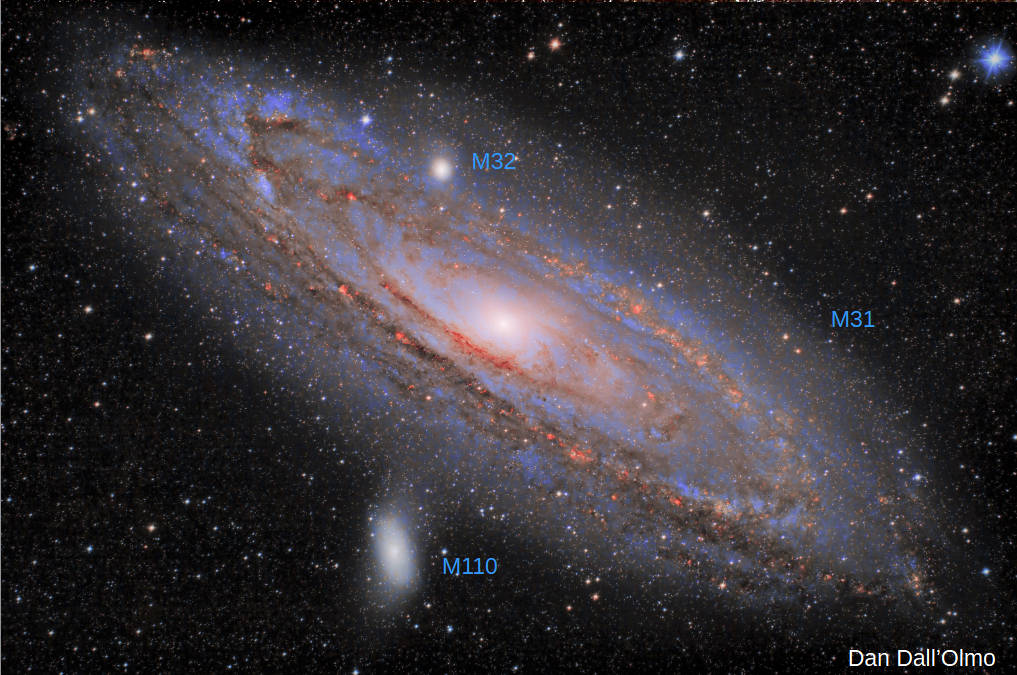
The Great Andromeda Galaxy, and companions
Here is the largest spiral galaxy to our own Milky Way, the Great Andromeda Galaxy. It is annotated with Messier numbers M31, M32 and M110. M110 was given its number long after Messier’s passing, actually after I got in interested in astronomy. However, he had seen it but never numbered it. M110 shows in this particular picture by Dan Dall’Olmo, one of our members in the Grand Traverse Astronomical Society, what look to me to be the formation of tidal effects. Notice that M110 has glows away from its elliptical form towards and away from M31. These may be tidal effects, just as the Moon raises tides on the Earth on the side toward it and the side away from it. Image annotations are mine.
View from Earth-Andromeda collision
Original caption: This illustration shows a stage in the predicted merger between our Milky Way galaxy and the neighboring Andromeda Galaxy, as it will unfold over the next several billion years. In this image, representing Earth’s night sky in 3.75 billion years, Andromeda (left) fills the field of view and begins to distort the Milky Way with tidal pull. (Credit: NASA; ESA; Z. Levay and R. van der Marel, STScI; T. Hallas; and A. Mellinger)
Colliding galaxies. Note the tidal tails. Credit: Hubble Legacy Archive, ESA, NASA.