Ephemeris: 11/14/2023 – Lucy sees an asteroid with a double moon
This is Bob Moler with Ephemeris for Tuesday, November 14th. Today the Sun will be up for 9 hours and 37 minutes, setting at 5:15, and it will rise tomorrow at 7:39. The Moon, 1 day past new, will set at 5:48 this evening.
Two years ago a spacecraft called Lucy was sent out towards the Trojan Asteroids of Jupiter. On the way there it was going to pass another small asteroid, but they found another one that Lucy would come close to, the mission planners tweaked its orbit earlier this year. So Lucy can get close to the small asteroid called Dinkinesh. When Lucy got close to Dinkinesh earlier this month, it took photos, and they found that it had a satellite, and they took other photos from a different angle, and they found out that the satellite actually was two satellites in contact, a contact binary, two bodies stuck together. So that was quite a surprise. Neither body looked smooshed, so their collision appears to have been very gentle.
The astronomical event times given are for the Traverse City/Interlochen area of Michigan (EST, UT –5 hours). They may be different for your location.
Addendum
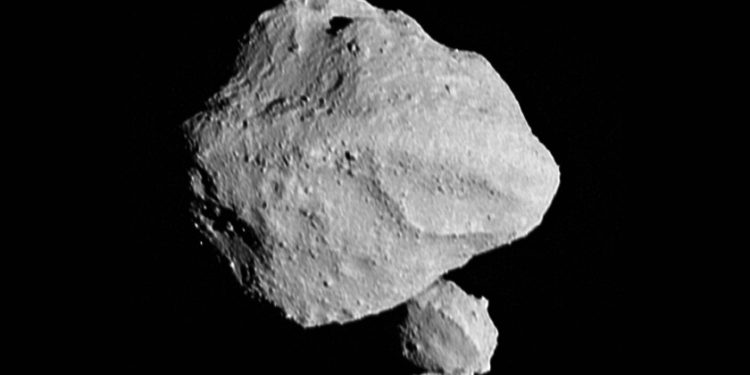
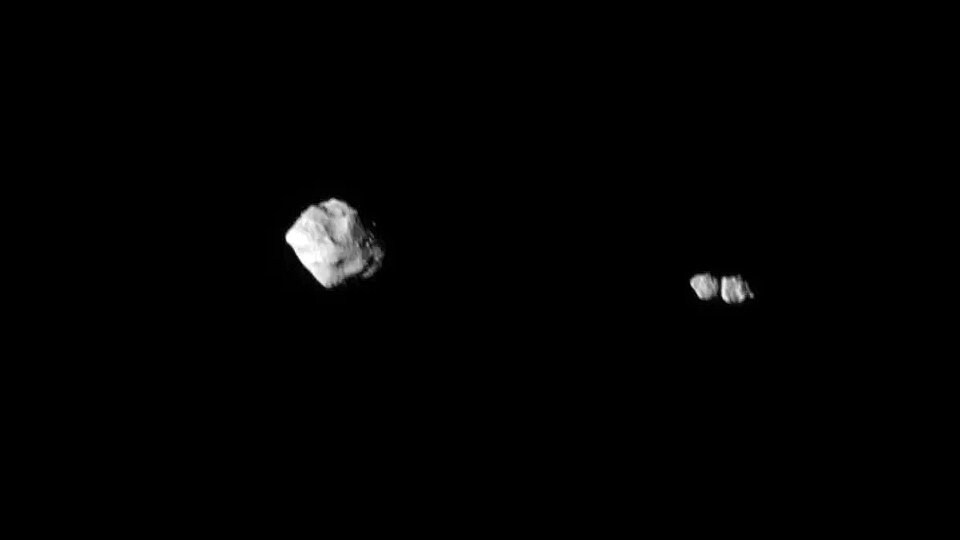
Dinkinesh is the Ethiopian name for the fossil, since it was found in Ethiopia. The name for the fossil given by the discoverers was Lucy, mainly because The Beatles song Lucy in the sky with diamonds was a big hit back then, and it was constantly played in the camp.
The next main belt asteroid that Lucy is going to pass on its way out to Jupiter’s Trojan asteroids is named Donaldjohansson in honor of the discoverer of the Lucy fossil. Jupiter’s Trojan asteroids are two groups of asteroids in the same orbit as Jupiter. One set is 60 degrees ahead of Jupiter in its orbit and the second set is 60 degrees behind Jupiter in its orbit. They’re there because they are at special gravitational points called Lagrangian points. The point ahead of Jupiter is the L4 point and the one trailing is L5. You may have heard me talk about L1 and L2 points having to do with the Earth and Sun system. These are two other Lagrangian points in line with the Sun-Earth axis, that are useful to orbit spacecraft around. There’s another one, but we don’t think there’s anything out there because that’s on the other side of the Sun from us, and none of the other planets have a body opposite to the Sun from them either, so the L3 point is not a viable point.
 Bob Moler's Ephemeris Blog