Ephemeris Extra: 01/02/2024 – Two remarkable astronomical events for 2024
Ephemeris Extra posts are freestanding posts not tied to a specific Ephemeris radio program on Interlochen Public Radio
Total Solar Eclipse, April 8th
The big astronomical event of 2024, for us in Michigan, will be the total eclipse of the Sun, on the afternoon of Monday, April 8th. The path of totality will just clip the southeastern corner of Michigan by a few miles, so if you want to see the best of totality you need to leave the state. Totality is when the Moon completely covers the brilliant face of the Sun and allows the Sun’s silvery corona to be seen. Totality is the only part of the eclipse that can be viewed without eye protection or by projection.
Two relatively nearby large cities that will see totality are Indianapolis and Cleveland. Parts of Indianapolis will get to see more than 4 minutes of totality. Cleveland will see a little less. The closer you are to the center line of that path the longer totality will last.
For an interactive map of the eclipse path on the Internet, go to eclipse2024.org/eclipse_cities/statemap.html
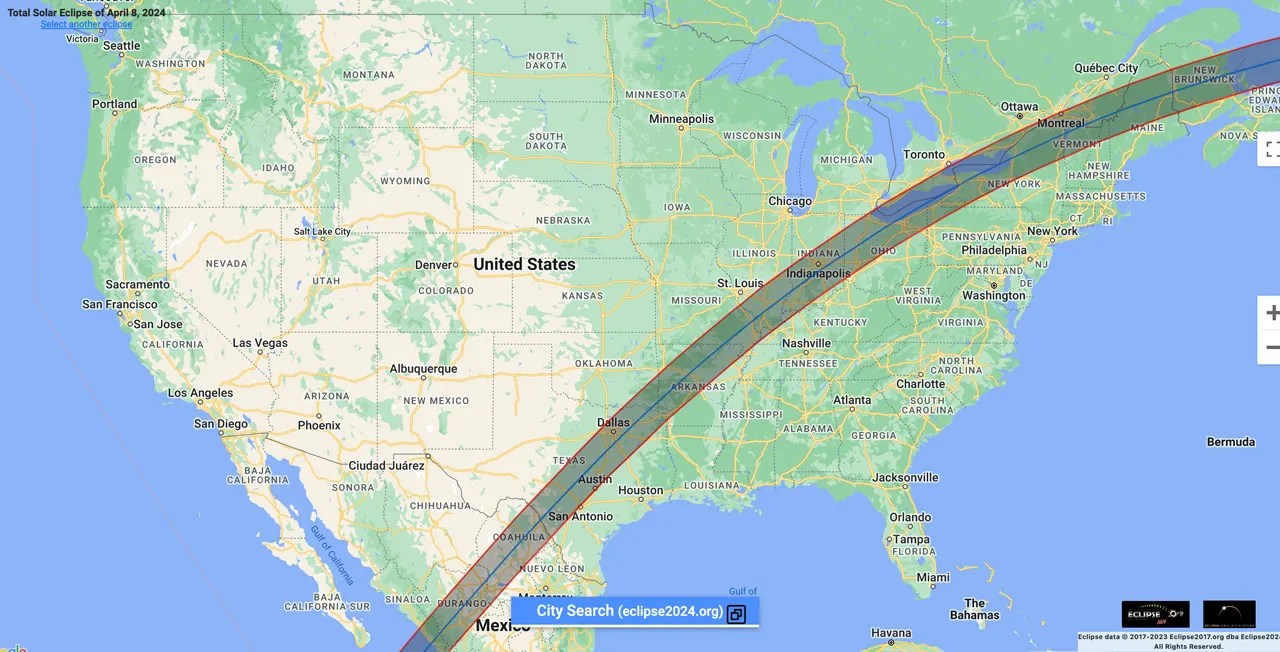
Weather is always a concern for eclipses. In general the farther south one goes the better the chances there are for clear skies. But all bets are off for eclipse day: It’s gonna be is what it’s gonna be. My current inclination is to head southwest along the eclipse path.
For those staying home and not chasing the shadow of the Moon will see a partial eclipse here with up to 87% of the Sun being blocked by the Moon.
Comet Tsuchinshan-ATLAS
We expect to see a new bright comet in October: C/2023 A3 (Tsuchinshan-ATLAS), otherwise known in this article as A3 for short. It may be the brightest comet to appear in our Northern Michigan skies since Comet Hale-Bopp in 1997, and a good deal brighter than 2020’s Comet NEOWISE. At least we’re hoping.
This comet was discovered last January by the station Xi Yi of the Purple Mountain Observatory in China, and a month later by the ATLAS search program on Maui. ATLAS is an acronym for the apocalyptic sounding Asteroid Terrestrial-Impact Last Alert System.
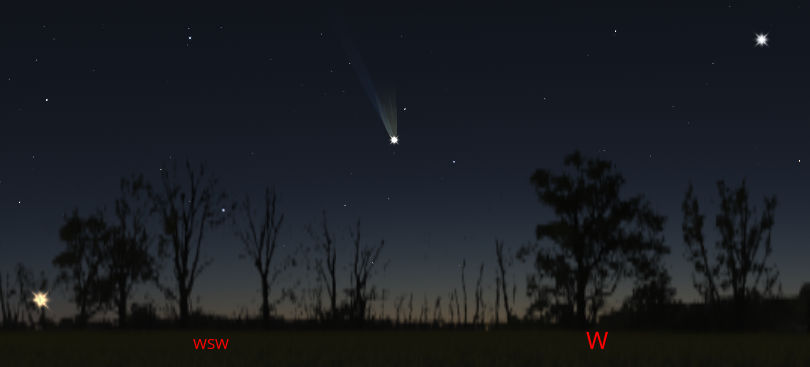
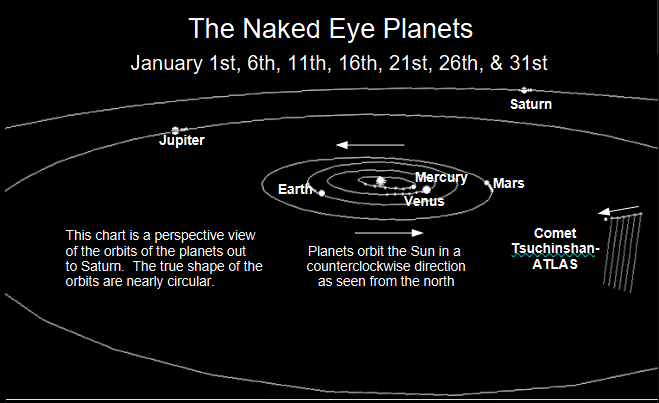
A3 will best be visible from Northern Michigan toward mid-October in the evening, not long after sunset. The comet is expected to reach magnitude 0 at it’s closest to the Sun in late September. However, we will be seeing it best as it’s leaving the vicinity of the Sun. By mid-October its magnitude will have dropped to magnitude 1 which is still pretty bright, and it will be moving at a high angle away from the setting Sun, so it will rapidly increase its distance from the Sun and the horizon faster than it fades in the latter part of October. That is, if it behaves itself. Comets are notoriously fickle in their brightness so we won’t know until we actually see it how bright it’ll be, or how bright or long its tail will be. As of this writing (Mid-December) A3’s brightness is tracking as predicted, at about 16th magnitude. As of January 1st its distance from the Sun was 4.24 AU, about 1 AU inside Jupiter’s orbit. 1 AU (Astronomical Unit) is the mean distance between the Earth and the Sun. The comet can be followed on Seiichi Yoshida’s Weekly Information about Bright Comets webpage: http://www.aerith.net/comet/catalog/2023A3/2023A3.html
 Bob Moler's Ephemeris Blog