Ephemeris: 02/19/2024 – A Kilonova may have exploded close to the Earth 3.5 million years ago
This is Ephemeris for President’s Day, Monday, February 19th. Today the Sun will be up for 10 hours and 38 minutes, setting at 6:16, and it will rise tomorrow at 7:36. The Moon, 3 days past first quarter, will set at 6:00 tomorrow morning.
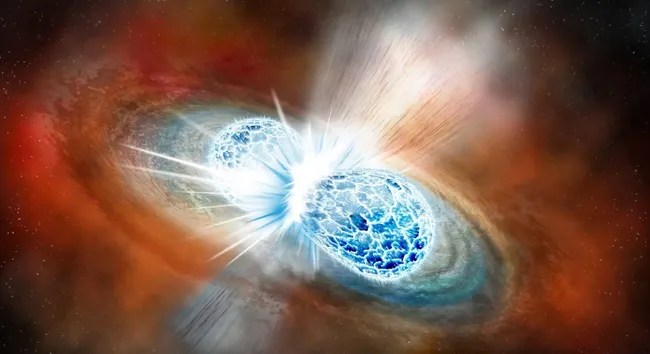
One wouldn’t think that astronomy can be studied by taking samples of sediments from the ocean floor, but it can. One of the rare isotopes of iron is found there, iron 60, it is radioactive and has a half-life of about 2.5 million years. That means in 2.5 million years half of it would decay, and in another 2.5 million years half of the remaining half would decay, and so on. So its presence means it would have arrived relatively recently, compared to the four and a half billion year age of the Earth. One of the thoughts about its origin is that it came from a nearby kilonova, which is a collision of two neutron stars that occurred about 3.5 million years ago. A kilonova is brighter than a nova by about a thousand times, hence its name, but not as bright as a supernova.
The astronomical event times given are for the Traverse City/Interlochen area of Michigan (EST, UT –5 hours). They may be different for your location.
Addendum
And https://phys.org/news/2023-12-scientists-evidence-nearby-kilonova-million.html
 Bob Moler's Ephemeris Blog