Archive
Ephemeris: 01/24/2025 – 100th anniversary of the last total solar eclipse visible in Northern Michigan
This is Ephemeris for Friday, January 24th. Today the Sun will be up for 9 hours and 31 minutes, setting at 5:40, and it will rise tomorrow at 8:08. The Moon, 3 days past last quarter, will rise at 5:22 tomorrow morning.
100 years ago this morning, Saturday, January 24th, 1925 the partial phase of a solar eclipse was already in progress as the Sun rose at 8:12 AM in the Grand Traverse region. I found no record of the weather that day, but being January, I don’t expect it was clear. So after sunrise instead of the daylight getting brighter as the Sun rose, it got darker. This was the last time Northern Michigan experienced a total solar eclipse. Totality was around 9:03 AM. After that the daylight gradually became brighter with the eclipse ending at 10:15 AM. If it was clear that morning the sight would have been spectacular with the eclipsed Sun’s corona shining low in the southeastern sky, off to the right were a group of three planets: Venus, Mercury and Jupiter in a tight line.
The astronomical event times given are for the Traverse City/Interlochen area of Michigan (EST, UT – 5 hours). Times will be different for other locations.
Addenda
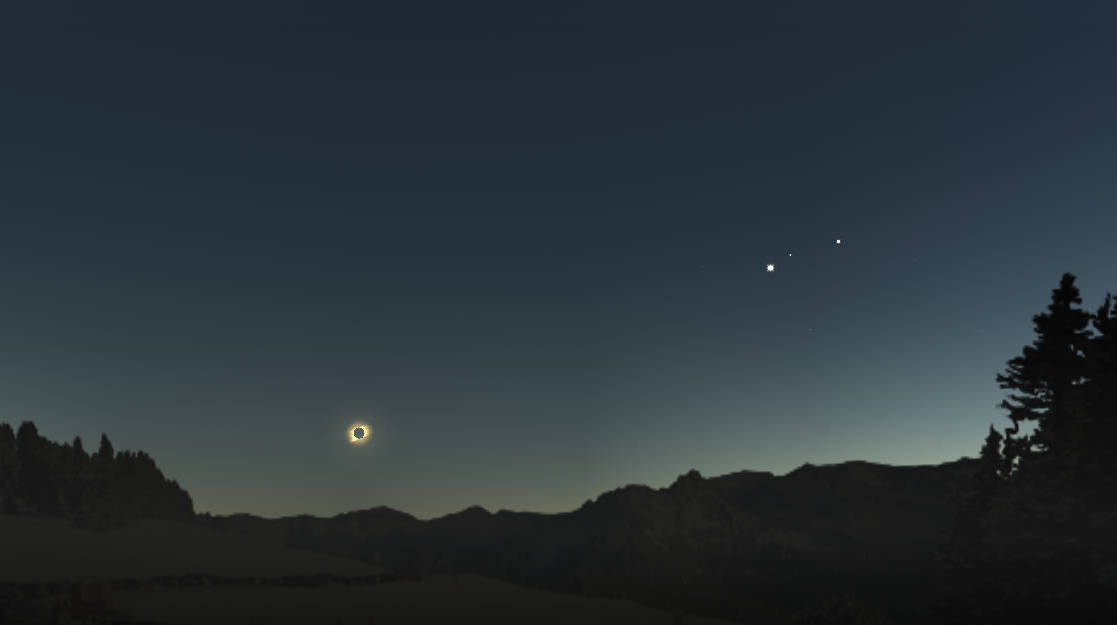
My article in this January’s Stellar Sentinel, newsletter of the Grand Traverse Astronomical Society
Last year’s total solar eclipse was fantastic. Those of us in Northern Michigan had to travel to neighboring states or even further to experience it. When was the last time that someone in Northern Michigan didn’t have to leave home to see a total solar eclipse?
That was 100 years ago this January. On the morning of Saturday, January 24th, 1925 the partial phase of the eclipse was already in progress as the Sun rose at 8:12 AM. I found no record of the weather that day, but being January, I don’t expect that it was clear. So after sunrise instead of the daylight getting brighter as the Sun rose, it got darker. Totality began at 9:02 AM, midi-eclipse was at 9:03, and totality ended at 9:04. After that the daylight gradually became brighter with the eclipse ending at 10:15 AM. And things got back to normal. If it were clear that day, it would have been a spectacular sight with the corona shining brightly around the blacked out Sun only 7° above the southeastern horizon. A little off to the right would be 3 planets: Venus, Mercury and Jupiter within 4° of each other. That scene is reproduced in the image above, created using Stellarium.
The eclipse made especially big news because the path of totality clipped New York City. In fact the northern half of Central Park got to experience totality while the southern part did not.
Most of the then 48 states of the United States got to see at least part of the eclipse, although the path of totality started in northern Minnesota, crossed northern Wisconsin, western UP, and northern lower Michigan. It went across southern Ontario and across New York State, Connecticut, Massachusetts and Rhode Island, then into the Atlantic Ocean. The path of totality ended north of Scotland. Its path of totality crossed the path of last April’s total eclipse at Niagara Falls.
As I was preparing for this article I got to thinking that I saw the total solar eclipse in Bottineau, North Dakota on February 26, 1979. The 1925 eclipse was on January 24th. A one-month difference. Subtracting 1925 from 1979 is a difference of 54 years. I had seen this eclipse before. Eclipses nearly the same character reoccur in a period of 18 years 10 or 11 1/3rd days. The period is called a saros which was discovered by the Babylonians a long time ago. The third of a day is a kicker. Each eclipse of the saros series occurs 120° in longitude west of the previous one so in three saros periods you get 360°, a whole circle, back to the same longitude again. The Greeks had a word for it, exeligmos, meaning ’turning of the wheel’.
So, when is our next chance for a stay-at-home total solar eclipse? On average any particular place on the Earth can see a total solar eclipse about once in 375 years. Traverse City will see its next total solar eclipse on October 26, 2144. That’s cheating on the average, with only 219 years, and only 120 years away If you can’t wait that long, there is a total eclipse in the UP in 2106. There is a much sooner annular eclipse visible from Northern Michigan on June 11, 2048. It’s an exeligmos from the annular eclipse that clipped the southeast corner of Michigan on May 10, 1994, which I viewed from Genoa, Ohio.
We will have a total lunar eclipse this year. Its partial phase begins just after midnight March 14th. Next year we will have another total lunar eclipse in March and a little nibble of a solar eclipse in August.
 Bob Moler's Ephemeris Blog