Archive
Ephemeris: 03/21/2025 – Venus will pass inferior conjunction with the Sun tomorrow
This is Ephemeris for Friday, March 21st. Today the Sun will be up for 12 hours and 13 minutes, setting at 7:56, and it will rise tomorrow at 7:41. The Moon, 1 day before last quarter, will rise at 3:55 tomorrow morning.
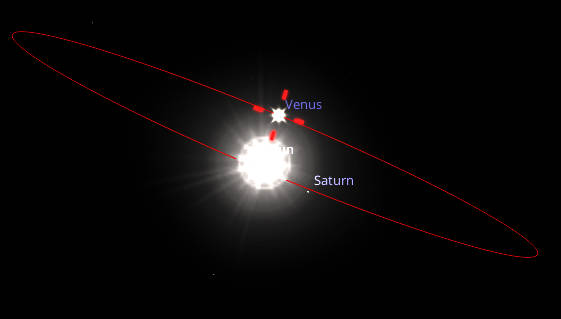
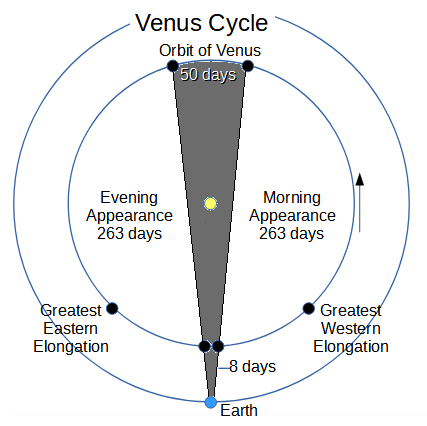
Tomorrow Venus will be in inferior conjunction with the Sun. That means that Venus will be moving between the Earth and the Sun, on its way from the evening sky to the morning sky. Venus’ orbit has an inclination to the Earth’s orbit of 3.4° and when we are closest to Venus as we are now only 26 million miles (42 million kilometers) away, that inclination gets exaggerated so that Venus is almost nine degrees north of the Sun. Venus gets about 8 million miles (13 million kilometers) closer to us than Mars ever gets. Of course when Mars gets that close it is fully illuminated. When Venus is at its closest we’re looking at its night side and couldn’t see anything even if we didn’t have the glare of the Sun.
The astronomical event times given are for the Traverse City/Interlochen area of Michigan (EDT, UT – 4 hours). Times will be different for other locations.
Addendum
 Bob Moler's Ephemeris Blog