Archive
02/14/2013 – Ephemeris – NEAR neared the god of love 13 yaers ago today, Valentine’s Day
Ephemeris for St. Valentine’s Day, Thursday, February 14th. The sun will rise at 7:43. It’ll be up for 10 hours and 26 minutes, setting at 6:10. The moon, 3 days before first quarter, will set at 11:27 this evening.
On Valentine’s day 2000 a spacecraft named NEAR for Near Earth Asteroid Rendezvous slipped into orbit of the asteroid named after the Greek god of love Eros. It is a banana shaped asteroid. NEAR had failed in its first attempt to approach the asteroid, so the date was purely a coincidence of orbital mechanics. This was the first ever orbiting of a spacecraft about an asteroid. Eros proved to be a treasure trove of information. Eros is about 21 by 10 miles in size and roughly rotating end over end in a 5 hour period. At the end of a year long mission the satellite was commanded to land on the center part of Eros that was rotating the least. It survived the landing and operated for 16 days. The spacecraft has since been renamed NEAR-Shoemaker after the late Eugene Shoemaker.
Times are for the Traverse City/Interlochen area of Michigan. They may be different for your location.
Addendum
Eugene Shoemaker is famous in planetary circles of among other things Comet Shoemaker-Levy 9 fame (The comet that crashed into Jupiter in 1994).
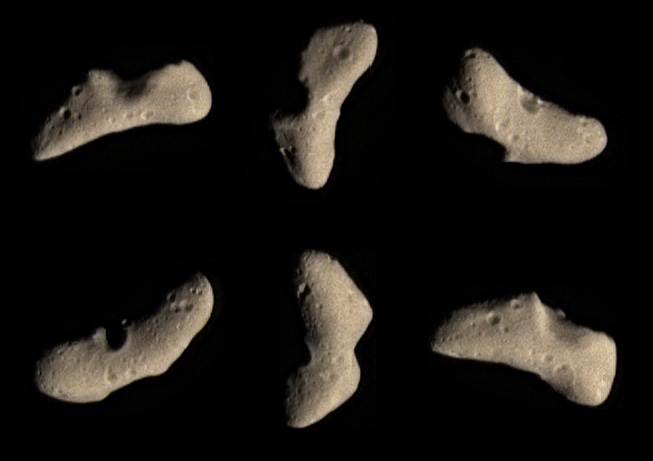
Six views of asteroid 433-Eros in February 2000. Images from NASA’s NEAR-Shoemaker spacecraft.
11/08/11 – Ephemeris – Asteroid 2005 YU55 will pass the earth tonight
Election Day, Tuesday, November 8th. The sun will rise at 7:29. It’ll be up for 9 hours and 53 minutes, setting at 5:22. The moon, 2 days before full, will set at 6:25 tomorrow morning.
Tonight a small asteroid will sail past the earth. It may be small as asteroids go, but it’s a quarter mile in diameter. The asteroid’s designation is 2005 YU55, and it will pass is within the orbit of the moon at 198,000 miles. The moon’s average distance is 240,000 miles. This is the kind of asteroid that is too small to be picked up by current searches in any great percentages. Back in 2005 it was found after it passed the earth, not quite early detection. The folks who track these things think that we’re safe from this one for the next 200 years or so. If 2005 YU55 were to hit it would unleash the power of a hydrogen bomb of thousands of megatons of TNT. [It would be devastating, but no radiation. The dinosaur killer was tens of thousands of times larger.]
* Times are for the Traverse City/Interlochen area of Michigan. They may be different for your location. Text in brackets omitted from program due to time constraints.
10/04/11 – Ephemeris – Good news on the NEO front
Tuesday, October 4th. The sun will rise at 7:43. It’ll be up for 11 hours and 34 minutes, setting at 7:18. The moon, 1 day past first quarter, will set at 1:16 tomorrow morning.
In the last couple of years the WISE satellite, an infrared survey satellite, has been primarily mapping targets for the James Webb Space Telescope proposed to be launched later this decade. As a bonus was the discovery of a great number of asteroids including Near Earth Objects or NEOs. The survey concluded that there are most likely fewer threatening asteroids of all sizes that had been estimated before. That’s definitely good news. However the numbers of asteroids less than 300 meters in diameter is still pretty much unknown. That’s the size of the Apothis asteroid that will pass under the geostationary satellite orbits in 2029. Asteroids that size are still killers, such as the rock that made the crater in Arizona, and another the Tunguska event in Siberia.
* Times are for the Traverse City/Interlochen area of Michigan. They may be different for your location.
08/26/11 – Ephemeris – Observing events this weekend
Friday, August 26th. The sun rises at 6:57. It’ll be up for 13 hours and 32 minutes, setting at 8:30. The moon, 2 days before new, will rise at 5:10 tomorrow morning.
We have a couple of events this weekend to view the heavens hosted by the Grand Traverse Astronomical Society. Starting at 9 p.m. tonight the Northwestern Michigan College’s Rogers Observatory will be open for viewing of the wonders of the summer Milky Way. Then Saturday night starting around 9 if it is clear the society will be at the Open Space or near the beach west of there for an asteroid Vesta viewing night. We’ll be hunting for a dark spot probably as far as we can get from lights. We’ll have a banner visible from the Grand View Parkway to the area we’ll be in. We’ll be viewing this asteroid which is currently being orbited by the Dawn spacecraft. It will look like a star in our telescopes, but one of our members has a piece of Vesta which he will exhibit.
* Times are for the Traverse City/Interlochen area of Michigan. They may be different for your location.
08/19/11 – Ephemeris – Lots of viewing opportunities this weekend
Friday, August 19th. The sun rises at 6:49. It’ll be up for 13 hours and 52 minutes, setting at 8:41. The moon, 2 days before last quarter, will rise at 10:53 this evening.
This will be a big weekend of observing the heavens if it’s clear. First the Grand Traverse Astronomical Society will be part of Friday Night Live on Front Street in Traverse City. Starting at 9 p.m. Northwestern Michigan College’s Rogers Observatory will be open for viewing of the skies. Saturday night starting around 9 the society will be at the Open Space for an asteroid Vesta viewing night. This will be repeated on the 27th. We’ll probably be as far as we can get from lights in the area of the old power planet to view this asteroid which is currently being orbited by the dawn spacecraft. It will look like a star in our telescopes, but one of our members has a piece of Vesta which he will exhibit also at the Open Space.
* Times are for the Traverse City/Interlochen area of Michigan. They may be different for your location.
07/18/11 – Ephemeris – Dawn orbits Vesta
Monday, July 18th. Today the sun will be up for 15 hours and 8 minutes, setting at 9:22. The moon, 3 days past full, will rise at 10:49 this evening. Tomorrow the sun will rise at 6:15.
Two days ago the Dawn spacecraft dropped into orbit of the asteroid Vesta. After nearly four years, most of it thrusting its ion engine, Dawn slipped into orbit of this 320 mile diameter asteroid. It will spend the next year photographing, and scanning the chemical composition of this second largest and brightest of the asteroids. It will slowly spiral closer to Vesta for a closer look. Also the change in velocity of the spacecraft as it orbits Vesta will give clues to the asteroid’s internal structure. Also to be closely monitored will be the large crater near Vesta’s south pole. An impact here less than a billion years ago spread debris throughout the inner solar system. Many of the meteorites on the earth have been traced to Vesta.
* Times are for the Traverse City/Interlochen area of Michigan. They may be different for your location.
06/27/11 – Ephemeris – Asteroid 2011 MD makes a close approach today
Monday, June 27th. Today the sun will be up for 15 hours and 32 minutes, setting at 9:31. The moon, half way from last quarter to new, will rise at 3:32 tomorrow morning. Tomorrow the sun will rise at 5:59.
At about 1:14 this afternoon a small asteroid provisionally named 2011 MD will pass within 8,000 miles of the earth. The asteroid, discovered last Wednesday, is thought to be about 30 feet in diameter. It will fly well within the communication geosynchronous satellites and 3,000 miles lower than the GPS satellites. It is, however, over 7,000 miles above the orbit of the International Space Station. At its closest approach it will be over South Africa. Back in February an asteroid came within 3,400 miles of the earth. And a few years ago a tiny object was picked up before it entered the atmosphere and broke up over the Nubian Desert. There are several observing programs to spot these near earth objects.
* Times are for the Traverse City/Interlochen area of Michigan. They may be different for your location.
 Bob Moler's Ephemeris Blog