Archive
07/04/2016 – Ephemeris – NASA’s going to light off fireworks at Jupiter tonight
Ephemeris for Independence Day, Monday, July 4th. Today the Sun will be up for 15 hours and 27 minutes, setting at 9:31, and it will rise tomorrow at 6:03. The Moon is new today, and won’t be visible.
There are two astronomical highlights for your Independence Day enjoyment. The first comes at 11:59 this morning (15:59 UT) when the Earth is at its very farthest from the Sun this year. Some 1.7% farther than average. You’re still gonna need your sun screen anyway. Later this evening, a half billion miles from Earth NASA’s Juno spacecraft will fire it’s rocket engine for 35 minutes to begin to decelerate over the north pole of Jupiter to drop into a long elliptical orbit of that planet. NASA TV will begin broadcasting the event at 10:30 p.m. (2:30 UT, July 5) The 35 minute engine burn will start at 11:18 p.m. (3:18 UT, July 5) What we’ll see is a real-time graph of the Doppler signal from the spacecraft as it slows down to drop into orbit of Jupiter.
Times are for the Traverse City/Interlochen area of Michigan. They may be different for your location.
Addendum
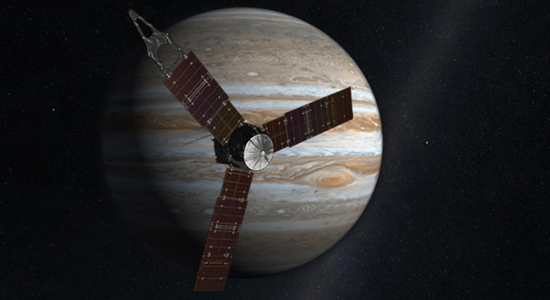
The Juno spacecraft. Credit: NASA.
The Planetary Society’s Emily Lakdawalla has more information on How to watch Juno’s orbit insertion at http://www.planetary.org/blogs/emily-lakdawalla/2016/07011514-how-to-watch-junos-orbit.html.
NASA also has an application in which you can see simulations of Juno’s orbital insertion. It’s called NASA’s Eyes and can be downloaded from http://eyes.nasa.gov/.
03/25/2014 – Ephemeris – The new Cosmos series
Ephemeris for Tuesday, March 25th. The sun will rise at 7:36. It’ll be up for 12 hours and 24 minutes, setting at 8:01. The moon, 2 days past last quarter, will rise at 4:52 tomorrow morning.
Unless you’ve been living under a rock for the past few months, you are aware of the new Cosmos series that’s been broadcast on Fox and National Geographic Channels. The title is Cosmos, a Spacetime Odyssey, and it’s hosted by New York’s Hayden Planetarium director Neil deGrasse Tyson. If the TV is not your thing there are free apps for the iPhone, iPad and Android devices to view the programs. Also there’s a website cosmosontv.com, where the episodes can be replayed. However it looks like each episode will be only be available for something like 8 weeks from the air date. It’s on Fox TV at 9 p.m. on Sundays, National Geographic Channel at 10 p.m. on Mondays. Cosmos: A Spacetime Odyssey is a really great series, a worthy successor to Carl Sagan’s original Cosmos series 34 years ago.
Times are for the Traverse City/Interlochen area of Michigan. They may be different for your location.
 Bob Moler's Ephemeris Blog