Archive
12/29/2015 – Ephemeris – Some space triumphs of 2015
Ephemeris for Tuesday, December 29th. The Sun will rise at 8:19. It’ll be up for 8 hours and 50 minutes, setting at 5:10. The Moon, half way from full to last quarter, will rise at 9:58 this evening.
This past year had several important events. Perhaps the biggest was the flyby of Pluto and its moons July 14th By the New Horizons spacecraft. The transmission of data and images will continue for most of 2016, but what has been revealed has been spectacular if puzzling. In other space news Blue Origin landed their New Shepard rocket vertically after sending it straight up 60 miles. In June the SpaceX Falcon 9 blew up while attempting to send its 7th resupply Dragon capsule to the International Space Station. Eight days ago The Falcon 9 returned to flight orbiting 11 satellites for Orbocomm, and flew the booster from over 100 miles up and 100 miles out over the Atlantic to land upright on its designated landing pad back at the cape.
Times are for the Traverse City/Interlochen area of Michigan. They may be different for your location.
Addendum
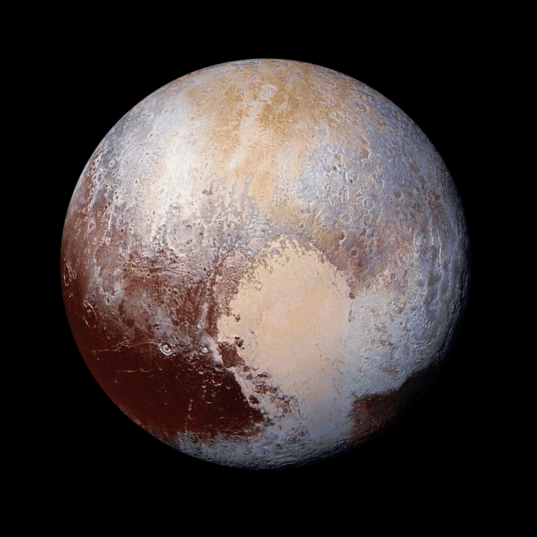
Enhanced color portrait of Pluto by the New Horizons spacecraft. Credit: NASA/JHUAPL/SwRI.

Blue Origin New Shepard rocket, with landing legs expended about to land. Credit: Blue Origin.
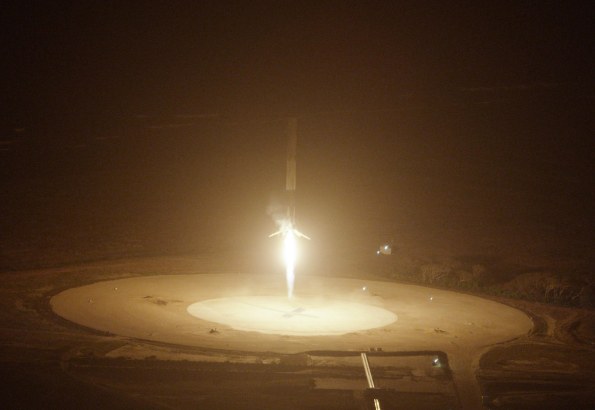
First stage of the SpaceX Falcon 9 descending on its center rocket engine to the center of the main landing pad at Cape Canaveral. Credit: SpaceX.
These weren’t the only highlights of 2015. Having only 45 seconds to devote to the story, I picked the three most important events. I consider the reuseability of rockets to be the Holy Grail of reducing the cost to access to space. The Space Shuttle was a partial, but ultimately failed solution. SpaceX had the most difficult task in refurbishment and reuse because the first stage had to endure a supersonic reentry, though it didn’t need a heat shield. We’ll have to see if the cost of recycling rocket boosters is cheaper than building one from scratch.
11/04/2014 – Ephemeris – Last week was a bad one for commercial space
Ephemeris for Election Day, Tuesday, November 4th. The sun will rise at 7:24. It’ll be up for 10 hours and 3 minutes, setting at 5:27. The moon, 2 days before full, will set at 5:46 tomorrow morning.
Last week was not a happy one for commercial space companies. First, last Tuesday the Orbital Science’s Antares blew up (or in space-talk: “Suffered an anomaly”) attempting to deliver it’s third contracted commercial cargo to the International Space Station. No one was killed because it was an unmanned rocket and the spectators were kept at a safe distance. Then on Friday an anomaly occurred during a test flight of Virgin Galactic’s SpaceShipTwo. In that mishap the co-pilot, Michael Alsbury, was killed. “Space is hard.” was the phrase heard quite often last week. And it’s true. I’ve found that the natural state of any mechanism is not to work. The more complicated the device is, like a rocket, the harder it is to get it to work.
Times are for the Traverse City/Interlochen area of Michigan. They may be different for your location.
Addendum
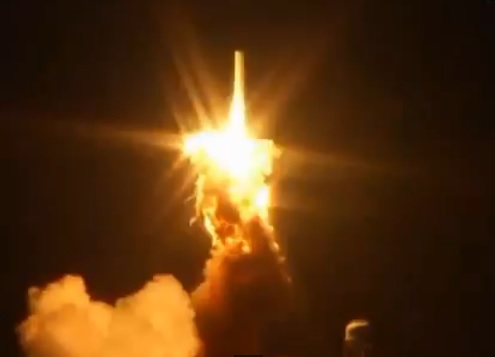
The initial signs that the Antares rocket was in trouble. Credit: Parabolic Arc.
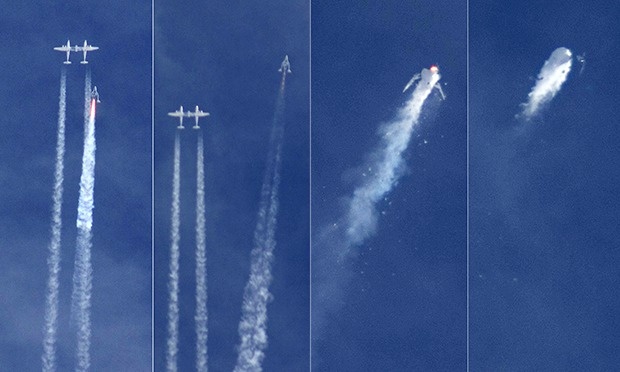
A sequence of photos of the flight and breakup of SpaceShipTwo. Credit: Kenneth Brown/Reuters.
04/23/2013 – Ephemeris – Orbital Sciences enters the race to supply the International Space Station
Ephemeris for Tuesday, April 23rd. The sun rises at 6:44. It’ll be up for 13 hours and 52 minutes, setting at 8:37. The moon, 2 days before full, will set at 5:49 tomorrow morning.
Sunday afternoon the second winner in the Commercial Orbital Transportation Services or COTS competition held by NASA flew its first test flight. Orbital Sciences Corporation, which has been in business since 1982 developed a new rocket for COTS, the Antares, named after the brightest red star in the constellation Scorpius. It flew flawlessly launching a dummy payload into low earth orbit along with some cube-sats. At least one of these tiny satellites is controlled, not by a specially built computer, but by an Android smart phone. Smart phones are incredibly versatile, but can they stand the rigors and radiation of space? And can they phone home? Orbital will have another test launch later this year with test cargo to the International Space Station.
Times are for the Traverse City/Interlochen area of Michigan. They may be different for your location.
Addendum
Orbital has been in the rocket and satellite business for just over 30 years. As far as rockets go, their expertise was in solid fueled rockets. The Antares is their first liquid fueled rocket first stage. The first stage engines are re-manufactured Russian engines that were destined for the ill-fated Soviet N1 moon rocket engines. The original engines were so unreliable that they couldn’t be tested and mounted on the rocket. The tolerances of the pumps were so bad that they couldn’t be run again. The design bureau for the N1 would order engines six at a time. If two of the tested OK, they would use the other 4. If one of the test engines failed, all the engines in that batch would be rejected.
The Russians marveled at the F-1 engines in the first stage of the Saturn V, which would be tested three times, including a full duration test before installed in the Saturn V first stage. Still the same Russian engines were perfected to become an extremely reliable engine that Orbital is using on their Antares rockets. United Launch Alliance also uses the same engines on their Atlas 5 rockets. It’s rather ironic that the latest members of the Atlas family, that was first built as a weapon against the Soviets are using Russian engines.
Source for the Russian engines: Rockets and People Volume 4, TheMoon Race by Boris Chertok, an ebook downloadable from NASA.
07/12/11 – Ephemeris – Dim prospects for the James Webb Space Telescope
Tuesday, July 12th. Today the sun will be up for 15 hours and 18 minutes, setting at 9:27. The moon, 3 days before full, will set at 4:24 tomorrow morning. Tomorrow the sun will rise at 6:09.
The US House Appropriation Committee is planning to cancel the Jame Webb Space Telescope. This follow on to the wildly successful Hubble Space Telescope, is, like its predecessor over budget and behind schedule. The Webb will gather over 6 times the light as the Hubble, and operate in the infrared where the action is in astronomy now a days. As it is currently funded the Webb telescope might not be launched by 2018. They are cutting NASA’s budget by 1.6 billion dollars and want to mandate instead the development of a heavy lift rocket, for which there is no immediate use. As it is the commercial SpaceX company supposedly can upgrade their current Falcon 9 rocket to a Falcon Heavy quicker and cheaper than NASA can produce their heavy rocket.
* Times are for the Traverse City/Interlochen area of Michigan. They may be different for your location.
Addendum

Artist's view of the James Webb Space Tellescope. Courtesy NASA.

Artist's conception of the Falcon Heavy rocket. Courtesy SpaceX.
SpaceX does it again!
Today SpaceX made their second successful launch out of two attempts of their Falcon 9 rocket. They put their Dragon capsule in orbit, and returned it to land on target in the Pacific Ocean. As always Emily Lakdawalla of the Planetary Society has the information. This is fantastic news.
While just about all NASA rockets are built by private companies, they are built to NASA specifications in cost plus bids, which often have cost overruns. The plus in cost plus means the contractors are guaranteed profits. The new commercial firms design and build their own systems based on the general requirements provided by NASA. Whatever they come up with must of course be certified by NASA. NASA’s also paying, but it’s a fixed amount, so the companies can make out like a bandit, or lose their shirt.
Congratulations SpaceX!
 Bob Moler's Ephemeris Blog