Archive
12/26/2014 – Ephemeris – Tragedies and triumphs of 2014
Ephemeris for Friday, December 26th. The sun will rise at 8:18. It’ll be up for 8 hours and 49 minutes, setting at 5:08. The moon, 2 days before first quarter, will set at 11:02 this evening.
2014 was a year of personal tragedy and also tragedy and triumph in space. The Space tragedies came in October with the destruction and loss of Orbital Science’s third supply mission to the International Space Station when the their Antares rocket blew up right after launch. A few days later Virgin Galactic’s SpaceShipTwo disintegrated on a test flight killing a pilot. In the Triumph department the European Space Agency’s Rosetta caught up and orbited its comet 67P, for short, in August and bounced down its lander Philae in November. It wasn’t supposed to bounce, but stick the landing. Bruised and battered Philae delivered its science before its batteries died. And this month an unmanned Orion capsule made its maiden voyage into space.
Times are for the Traverse City/Interlochen area of Michigan. They may be different for your location.
Addendum
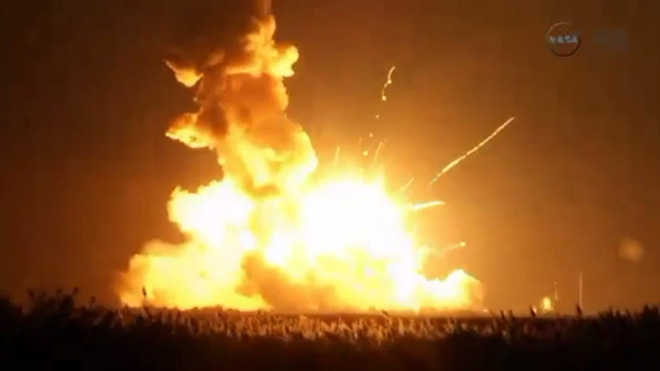
Orbital Sciences Antares rocket explodes seconds after liftoff on October 28, 2014. Credit NASA.
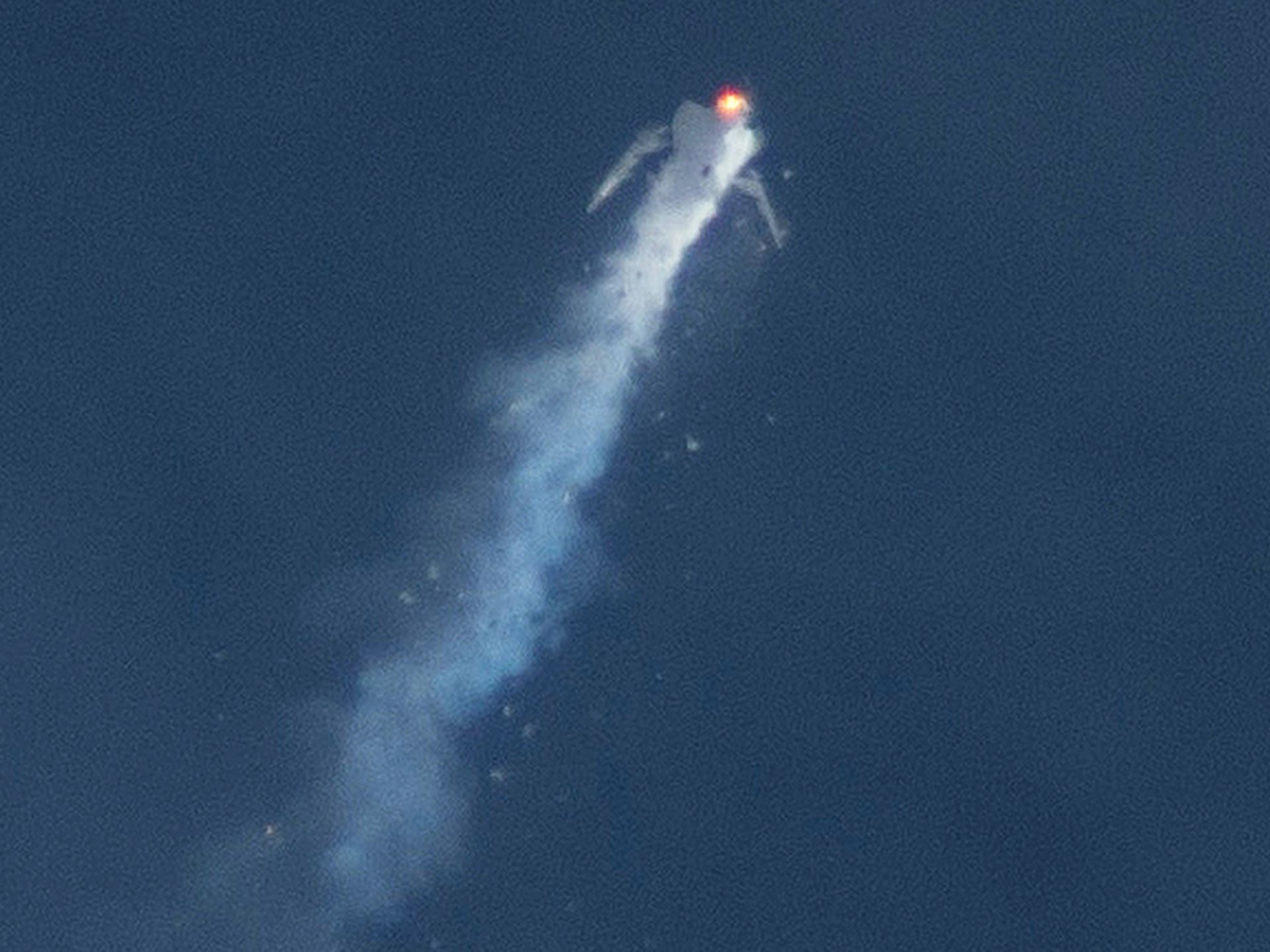
SpaceShipTwo disintegrates October 31, 2014 killing a pilot. Credit USA Today.
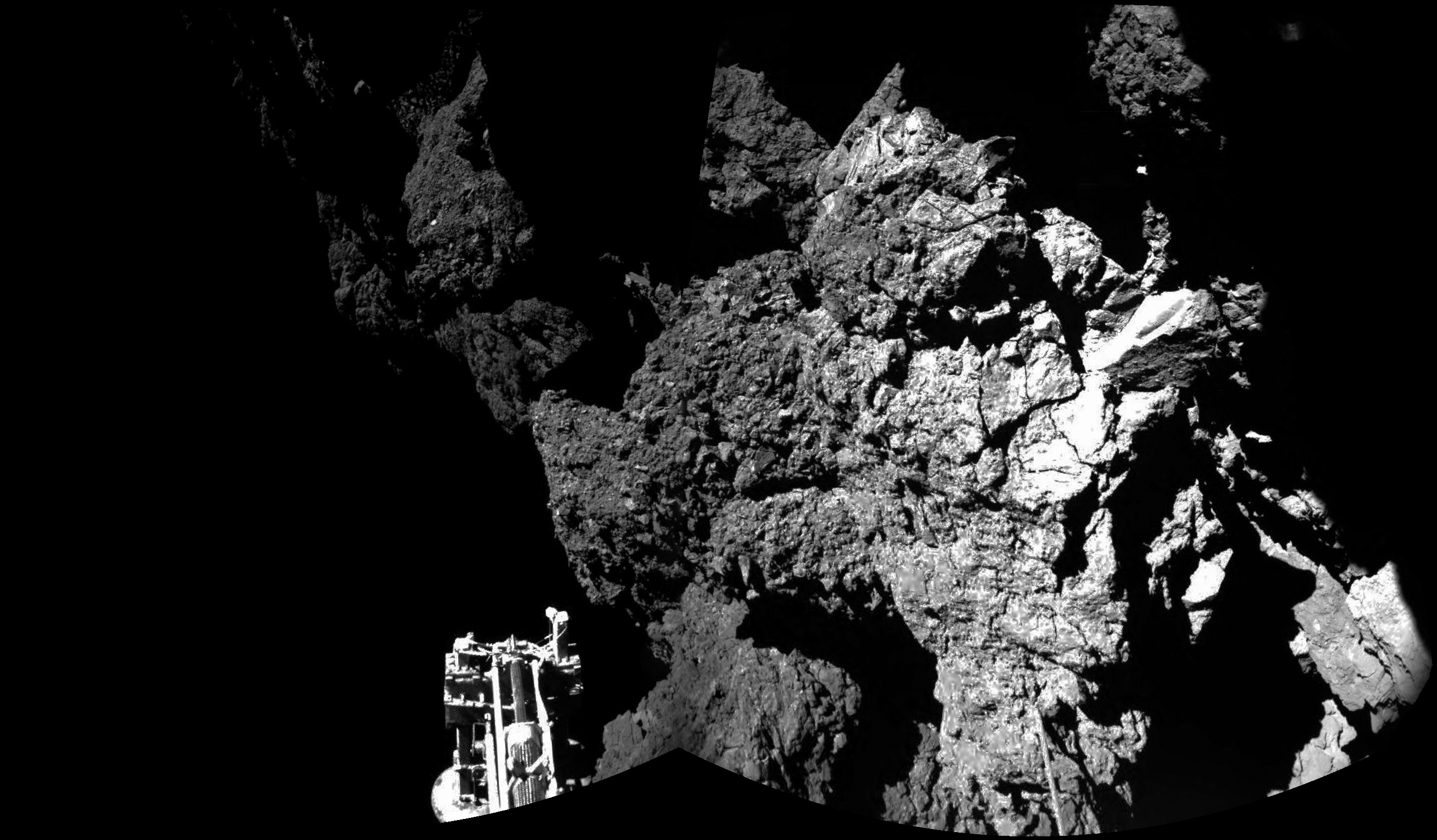
After a second bounce on the Comet 67P the Philae lander ended up sideways apparently on the base of a cliff. Researchers were able to get data from just about all the instruments before the battery discharged. The team hopes and the comet gets closer to the sun and the sun angle changes they can revive Philae. Credit: ESA.
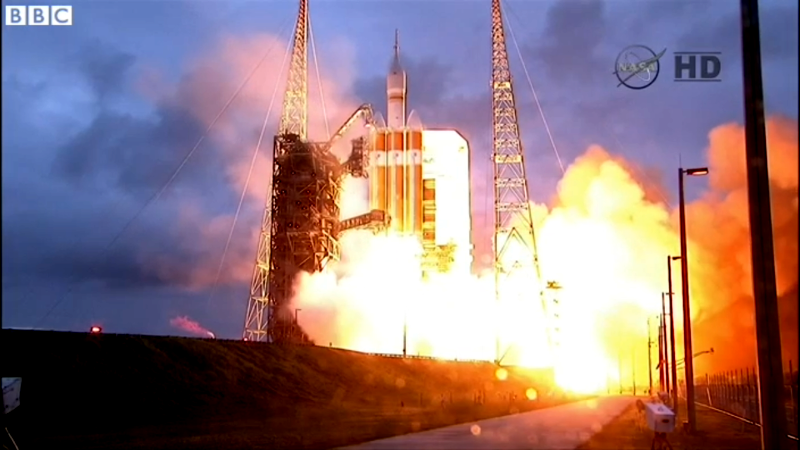
Screen capture of Delta IV Heavy rocket liftoff carrying the Orion test article into orbit on December 4, 2014. Credit .NASA via BBC
Ride back to the earth with Orion via a camera mounted in a window. The window is facing aft as the capsule re-enters the atmosphere heat shield first at 20,000 miles per hour. You’ll experience everything except the G forces. It comes with appropriate spacey music. It’s as close as I’ll ever get to ride in one of these things.
11/18/2014 – Ephemeris – Rosetta, Philae with Comet 67P and Maven’s discovery of the effects of it’s comet encounter
Ephemeris for Tuesday, November 18th. The sun will rise at 7:43. It’ll be up for 9 hours and 28 minutes, setting at 5:11. The moon, half way from last quarter to new, will rise at 4:31 tomorrow morning.
Last week the Philae lander bounced down on Comet 67P/Churyumov-Gerasimenko, its harpoons not able to fire to hold the lander down. “Where is Captain Ahab when you need him?” I Twittered at the time. We were lucky it didn’t bounce off the comet entirely. It ended against a cliff and in a shadow, so it couldn’t recharge its batteries from sunlight. The ESA controllers had it perform all its possible experiments quickly before its batteries died. Philae was still an amazing success. News from last month’s encounter Mars encounter with Comet Siding Spring. The Maven satellite detected the aftermath of a great martian meteor shower when it peaked around the planet from where it was hiding.
Times are for the Traverse City/Interlochen area of Michigan. They may be different for your location.
Addendum
Philae
If I’m understanding the spacecraft controllers at the European Space Agency (ESA) correctly Philae was launched toward the comet with a velocity of something like .7 meters per second (m/s). It would have accelerated to 1 m/s by the time it hit the comet. So it was pushed into the comet at more than the comet’s escape velocity. One meter per second is only 2.2 miles per hour. So to bounce and not escape the comet either the lander, the surface of the comet or both would have to have a lot of give to it. On this comet one could jump faster than escape velocity and go floating off into space.
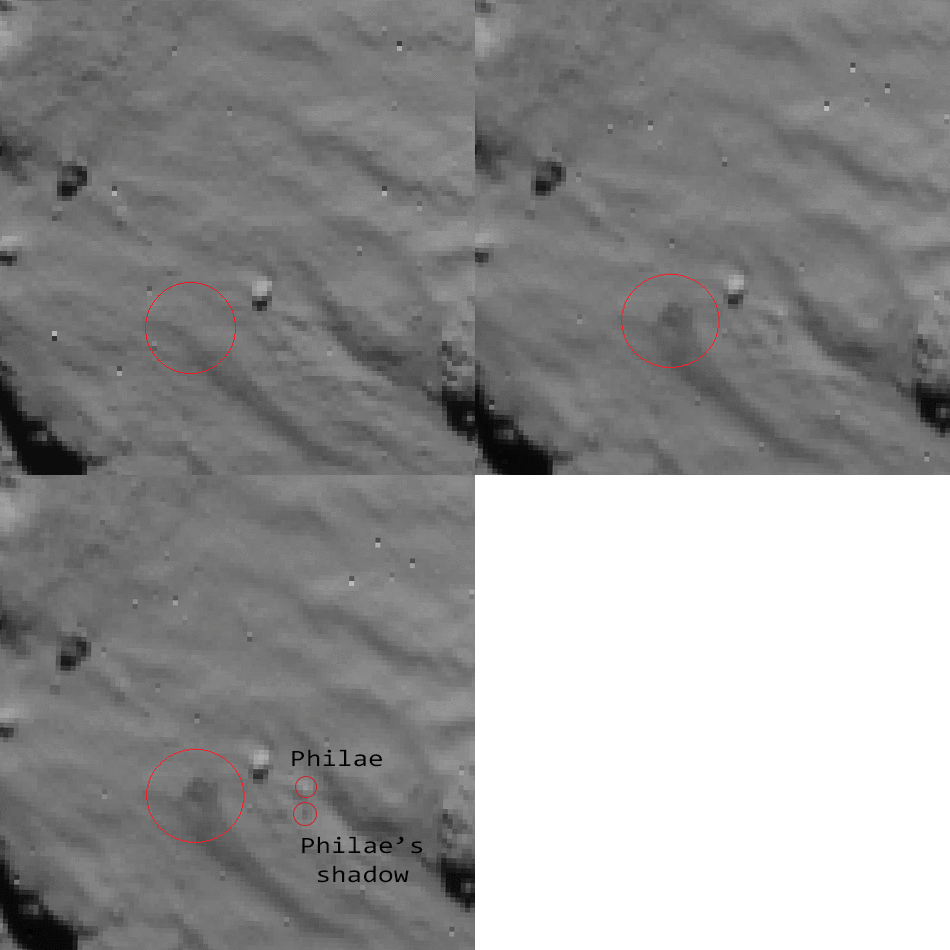
The Rosetta spacecraft spotted Philae and its shadow shortly after the lander touched down on Comet 67P/Churyumov–Gerasimenko and bounced up again. The first image is taken on Nov. 12, 2014 at 10:30 a.m. EDT (3:30 p.m. UTC) and the second five minutes later. Credit: ESA/Rosetta/NAVCAM; pre-processed by Mikel Catania. Hat tip to and credit for the caption to Universe Today.
Maven
Maven detected the aftermath of a meteor storm in the upper martian atmosphere with the signatures of eight metals. It looks like it was prudent to hide all the satellites when Mars came closest to the comet’s path. Here’s a link to Bob King’s post about it in Universe Today blog from 11 days ago.
Philae will attempt to land on comet 67P C-G today (updated)
Today’s the big event when the European Space Agency’s Rosetta spacecraft will release Philae the lander to land on the head of the rubber ducky shaped comet.
Go to the Rosetta landing mission site for links to the live stream feed and other blog and Twitter links.
The times given are CET (Central European Time) and GMT (Greenwich Mean Time or Universal time) Subtract 5 hours for Eastern Standard Time. I’ll convert them below.
Final Go/NoGo decision will be between 1:35 and 2:35 a.m. EST. As of the time of this posting that’s an hour and a half from now.
The release of Philae will be at 4:03 a.m. EST
Landing of Philae will occur around 11:02 a.m. EST. The Philae lander will fall over 7 hours to the comet.
Updated 8:46 EST: Philae has been released. Live update expected at 9 a.m.
Below is a link to the live feed from the Rosetta operations center
Also follow on Twitter #CometLanding
Update 11:05 a.m. EST: The Philae has landed! From the happy faces and celebration in he control center. No announcement yet.
Update 11:08 a.m. EST: The official announcement came from the flight director. The harpoons were fired and cables reeled back to attach the lander to the surface.
Update 11:48 a.m. EST: It is reported that Philae may not be anchored to the surface Stay tuned.
The Rubber Ducky turns out to be kind of an Ugly Duckling
The European Space Agency’s Rosetta spacecraft arrived at its target Comet 67p/Churyumov–Gerasimenko yesterday, August 6th, 2014. The smoothed image 30 pixels across of three weeks ago of a rubber ducky,
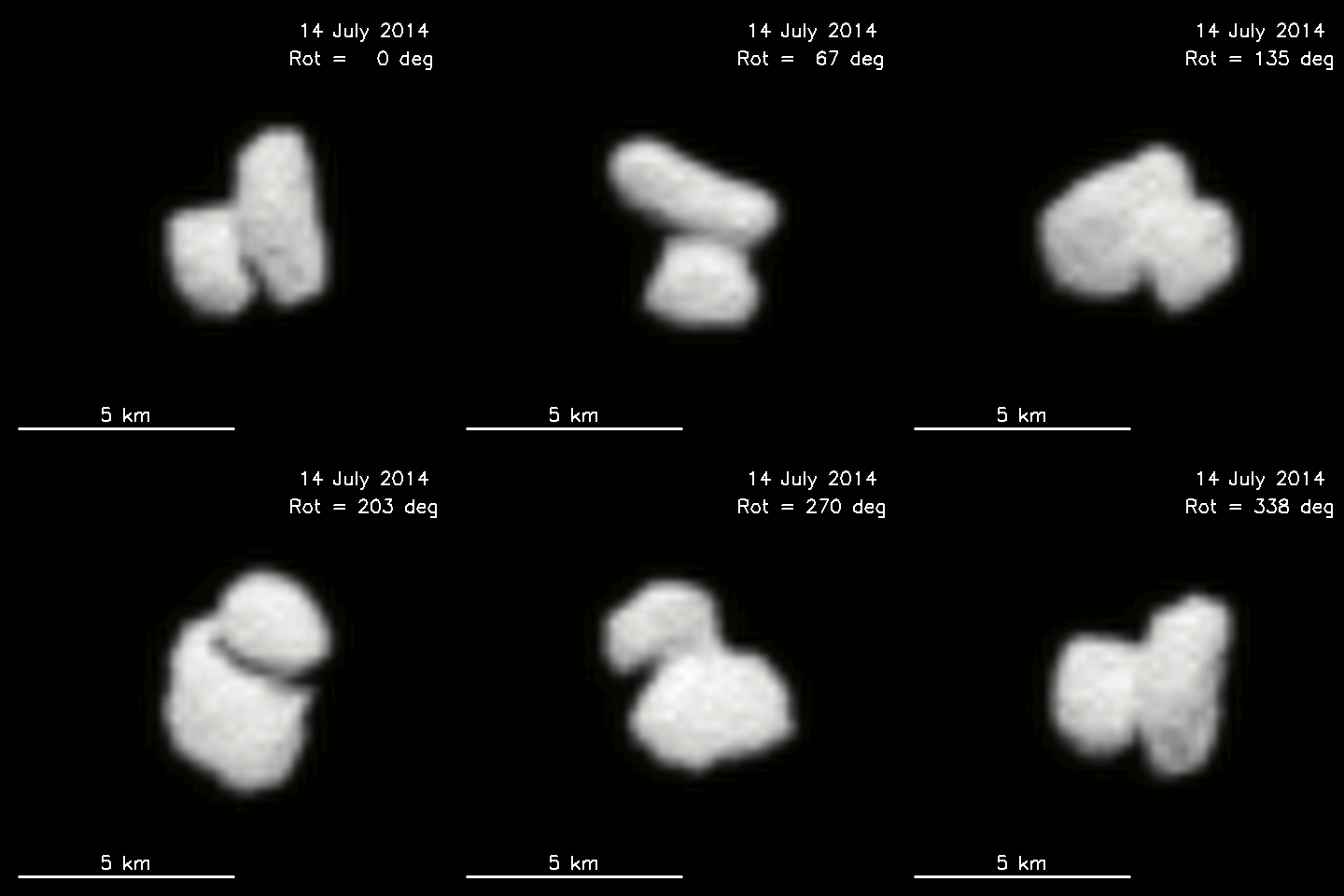
An animation of Comet 67p/Churyumov–Gerasimenko rotation on July 14, 2014. The 30 pixel wide image has been smoothed. The Rotation rate is 1 rotation every 12.4 hours. Credits: ESA/Rosetta/MPS for OSIRIS Team MPS/UPD/LAM/IAA/SSO/INTA/UPM/DASP/IDA
have been replaced by the mega-pixel images we see now of an Ugly Duckling comet, with much more character and battle scars. That’s what happens when you’ve been ’round the Sun to many times.
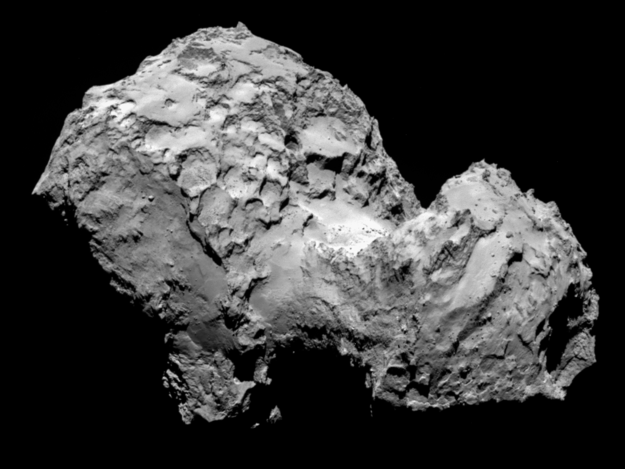
The comet on August 3rd, 2014, 3 days before arrival. Credit: ESA / Rosetta / MPS for OSIRIS Team MPS / UPD / LAM / IAA / SSO / INTA / UPM / DASP / IDA
See Emily Lakdawalla’s post from yesterday at http://www.planetary.org/blogs/emily-lakdawalla/2014/08060249-were-at-the-comet-rosetta.html. It contains lots of images and more information including a 3D image. Grab your red & blue 3D glasses for that one, or if you’ve mastered the techniques of crossed-eye, or parallel-eye stereo viewing.
Also go to ESA’s own Rosetta site at http://www.esa.int/Our_Activities/Space_Science/Rosetta.
I find Emily’s post much more comprehensive. So subscribe to the Planetary Society’s blog feed.
07/22/2014 – Ephemeris – Rosetta spies a cosmic rubber ducky
Ephemeris for Tuesday, July 22nd. Today the sun will be up for 15 hours even, setting at 9:18. The moon, half way from last quarter to new, will rise at 3:38 tomorrow morning. Tomorrow the sun will rise at 6:19.
The European Space Agency (ESA) Rosetta spacecraft is closing in on Comet 67P/Churyumov-Gerasimenko, also known as Comet Cherry-Gerry, or Comet C-G. After photos of the comet’s nucleus were published last week it has acquired a new nickname: Rubber Ducky. The nucleus may be a contact binary with two comet nuclei that stuck together after a slow speed collision. Further study may reveal the nature of the two pieces. Rosetta has more than a year to study the comet. It has a lander craft called Philae that can land on one of the pieces of the nucleus. No one expected the possibility of two possibly dissimilar comet nuclei to study. Rosetta will enter orbit of the comet August 6th.
Times are for the Traverse City/Interlochen area of Michigan. They may be different for your location.
Addendum
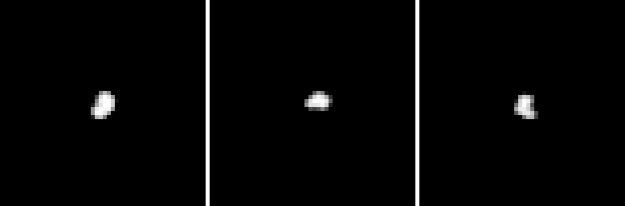
A hint of strangeness appears on July 4, 2014. What’s that lump on the side in that third image? Credits: ESA/Rosetta/MPS for OSIRIS Team MPS/UPD/LAM/IAA/SSO/INTA/UPM/DASP/IDA
An animation of Comet C-G rotation on July 14, 2014. The 30 pixel wide image has been smoothed. The actual rotation rate is 1 rotation every 12.4 hours. Credits: ESA/Rosetta/MPS for OSIRIS Team MPS/UPD/LAM/IAA/SSO/INTA/UPM/DASP/IDA
For more information go to http://sci.esa.int/rosetta/, or search: esa rosetta.
The post that explains this image more fully is here.
ESA has a policy of weekly releases, so expect a new one this Wednesday, Thursday or Friday.
01/20/2014 – Ephemeris – Wake up Rosetta!
Ephemeris for Dr. Martin Luther King Day, Monday, January 20th. The sun will rise at 8:12. It’ll be up for 9 hours and 22 minutes, setting at 5:34. The moon, 4 days before last quarter, will rise at 10:22 this evening.
Wake up Rosetta! That’s the message The that the European Space Agency or ESA wants sent to the Rosetta spacecraft to wake it up after 33 months of hibernation when it was too far from the sun for its solar panels to provide adequate power. The wake up call is ESA’s way of gaining the public’s attention for the events later this year when the spacecraft will rendezvous with a comet. Actually the probe will have to wake itself up. It set three alarm clocks, er… timers to wake it up today, find the sun and charge its batteries and phone home. The comet is 67P/Churyumov-Gerasimenko. After orbiting the comet’s nucleus the main spacecraft will release a probe called Philae to land, or actually grapple it. [the two and a half mile [4 km] diameter nucleus, which is known to be of an odd non-round shape.]
Times are for the Traverse City/Interlochen area of Michigan. They may be different for your location.
Addendum
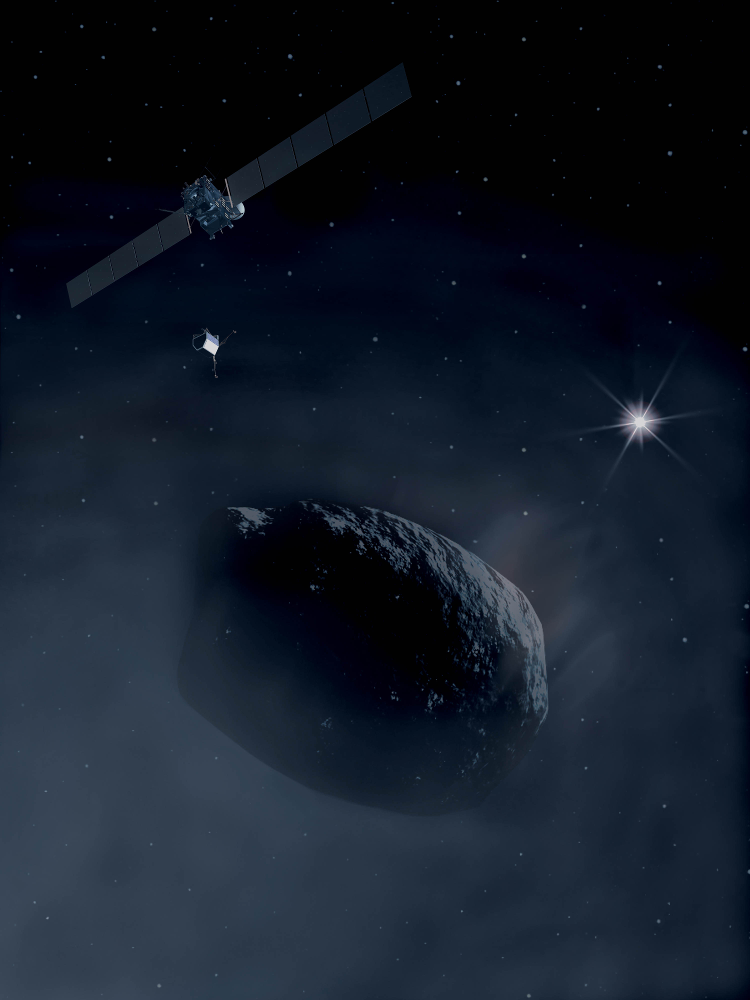
Artist’s rendering of Rosetta orbiting comet 67P/Churyumov–Gerasimenko and sending the Philae lander to the comet’s surface. Credit: ESA
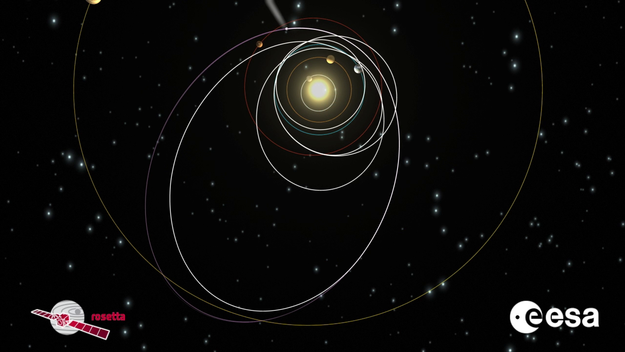
12 years of orbital maneuvers of Rosetta to match orbits with the comet. Credit ESA.
 Bob Moler's Ephemeris Blog