Archive
Ephemeris: 06/09/2025 – Ephemeris illustrated
This is Bob Moler with Ephemeris for Monday, June 9th. Today the Sun will be up for 15 hours and 30 minutes, setting at 9:27, and it will rise tomorrow at 5:57. The Moon, 2 days before full, will set at 4:53 tomorrow morning.
Did you know that the Ephemeris program has a blog where the scripts of these programs are posted daily along with illustrations? It’s located at bobmoler.wordpress.com. (If you are reading this, you’re already here!) I may end up with a shorter address, but this address will always work. I post the scripts of the program, unedited for time, along with illustrations where appropriate. For instance, in talking about constellations, I will illustrate how to find it, how it looks in the sky, and perhaps even with the mythical figures that it’s supposed to represent. I also post Ephemeris Extras, articles which I’ve written for other publications. Just about all the Ephemeris programs since September 13, 2010, are posted here.
The astronomical event times given in this blog are for the Traverse City/Interlochen area of Michigan (Lat 44.7° N, Long 85.7° W; EDT, UT – 4 hours) unless stated otherwise. Times will be different for other locations.
Addendum
Ephemeris: 06/02/2025 – 50th anniversary: What’s an ephemeris anyway?
This is Ephemeris for Monday, June 2nd. Today the Sun will be up for 15 hours and 22 minutes, setting at 9:22, and it will rise tomorrow at 5:59. The Moon, at first quarter today, will set at 2:25 tomorrow morning.
Today I embark on the Ephemeris program’s 51st trip around the Sun. The purpose of this program is more than giving the sunrise and sunset times, which was the station’s original request. Nowadays, one can get that from the weather app on a smartphone much more accurately than I can. From the beginning I’ve included some fact of astronomy or something visible in the sky with the naked eye or at least find to it using the naked eye stars as a guide, and visible in binoculars. That is the essence of this program. The title Ephemeris comes from the Greek and Latin meaning diary or journal. In astronomy, it is a tabular list of planet, asteroid or comet positions, as they change with time.
The astronomical event times given in this blog are for the Traverse City/Interlochen area of Michigan (Lat 44.7° N, Long 85.7° W; EDT, UT – 4 hours) unless stated otherwise. Times will be different for other locations.
Addendum
Ephemeris: 06/03/2024 – We begin our 50th orbit of the Sun
This is Ephemeris for Monday, June 3rd. Today the Sun will be up for 15 hours and 24 minutes, setting at 9:23, and it will rise tomorrow at 5:58. The Moon, 3 days before new, will rise at 4:20 tomorrow morning.
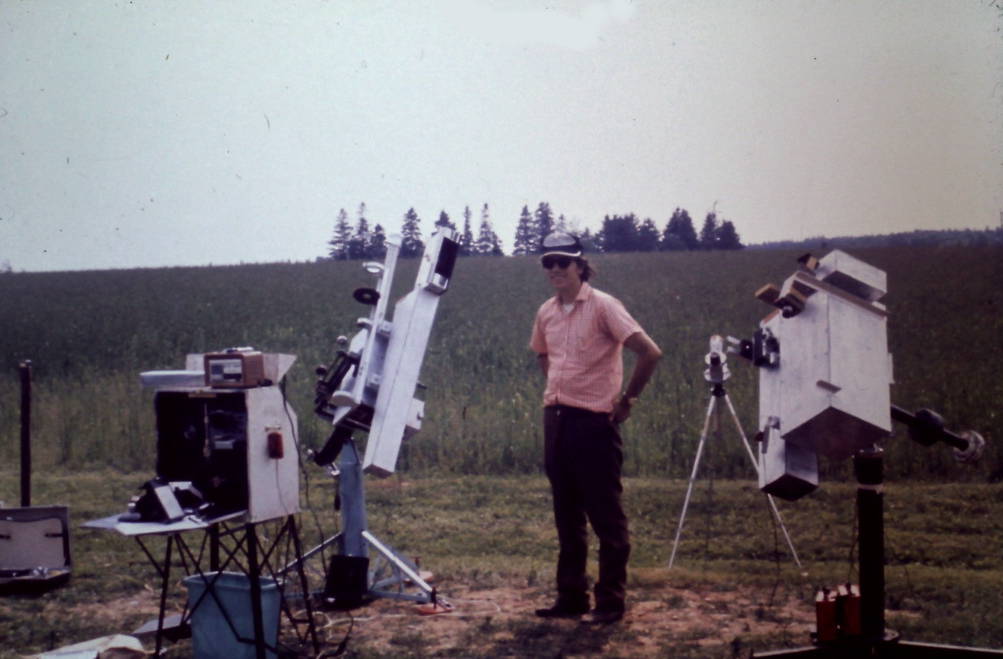
Today begins Ephemeris’ 50th circuit of the Sun having completed 49 last Friday. Next month will be the 50th anniversary of my stint as a volunteer program producer for IPR, but that’s another story. So already having produced a weekly program for Interlochen Public Radio, which back then was simply, to me anyway, WIAA. I was asked to come up with a week daily program giving out the sunrise and sunset times. Well I really didn’t want to do just that. Back then I had to come into the station to record them. So what I did was add the Moon rise or set times and a little bit of astronomical trivia. By the way an Ephemeris is a table of celestial body positions over time.
The astronomical event times given are for the Traverse City/Interlochen area of Michigan (EDT, UT–4 hours). They may be different for your location.
Addendum
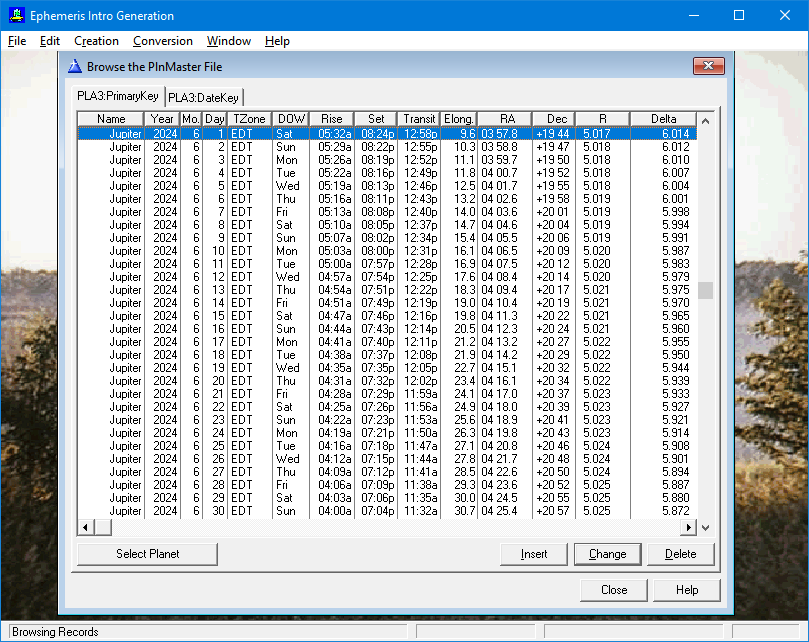
My programming background is not that of scientific coding, but that of the financial industry which is completely different. So I had to pretty much learn on my own and use references for the coding and algorithms for the calculation of astronomical positions, times, and events.
12/30/2022 – Ephemeris – About Ephemeris
This is Bob Moler with Ephemeris for Friday, December 30th. Today the Sun will be up for 8 hours and 51 minutes, setting at 5:11, and it will rise tomorrow at 8:20. The Moon, 1 day past first quarter, will set at 2:09 tomorrow morning. | This is the last Ephemeris program of 2022. We’ve been going around the Sun together, observing the universe from spaceship Earth 47 and a half times so far. It’s been an eventful journey. And I hope to go around a few more times with you. The title of the program is Ephemeris, a word from the Greek which means diary. But to astronomers is a table of planetary positions at set intervals. The plural of ephemeris is not ephemerises, or ephemeri, but ephemerides, which sounds kind of cool. Each December, I crank up a program I wrote back in the 90s and produce ephemerides of Sun and Moon rise and set times for the next year. Also, the same for all the naked-eye planets.
The astronomical event times given are for the Traverse City/Interlochen area of Michigan (EST, UT –5 hours). They may be different for your location.
Addendum
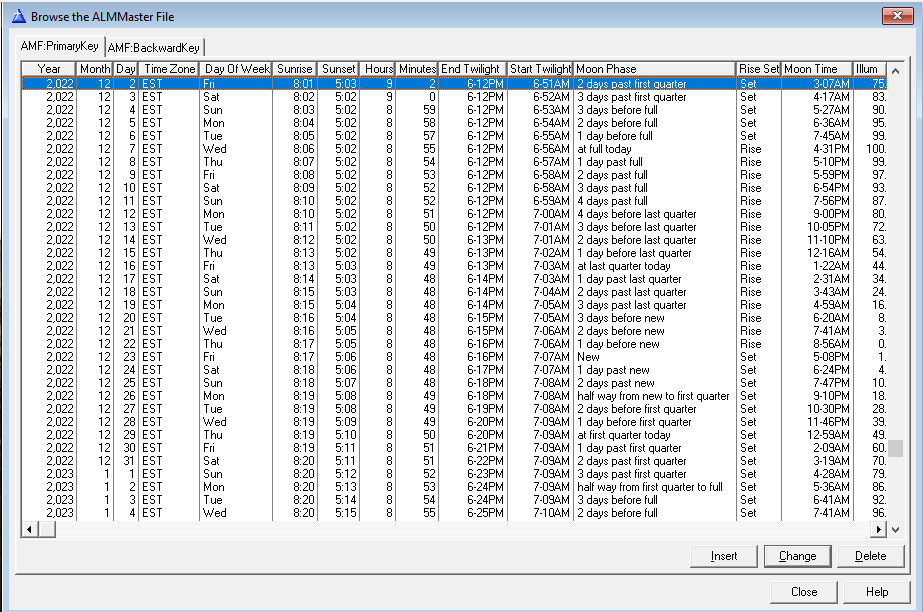
Almanac Master database table. This is created from a file created annually by my LookingUp for MS-DOS program. The moon phase verbiage is created during the conversion process from the comma delimited file in the Ephemeris Helper program. I use this database table to create the intro to each day’s radio program.
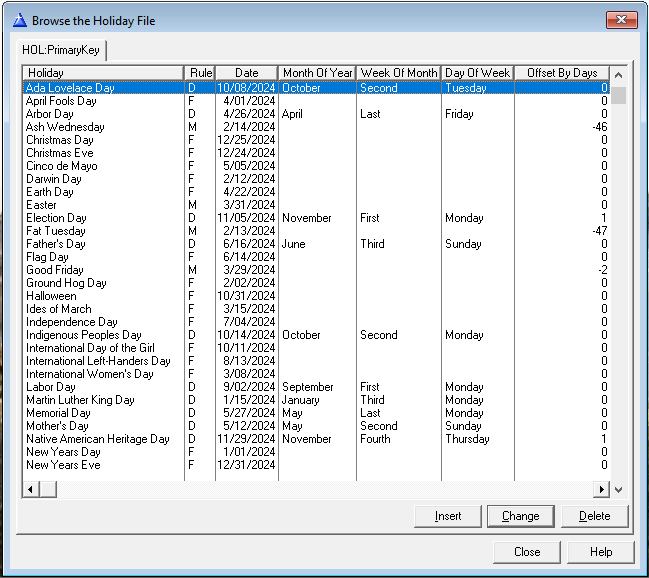
The Holiday table is used in the intro to acknowledge that today is a special day or holiday. The Rule determines how the date is determined. F is for fixed date, D for day of week and week of month, and M for movable feast for dates based on Easter.
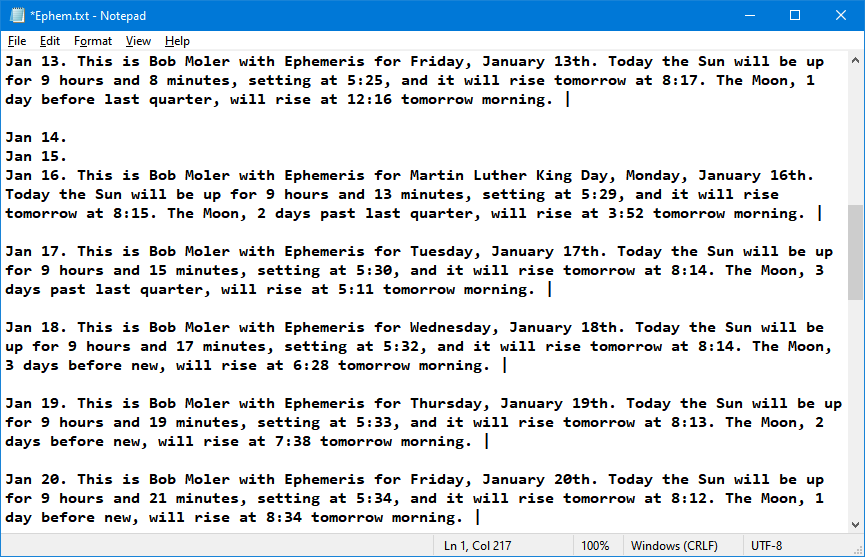
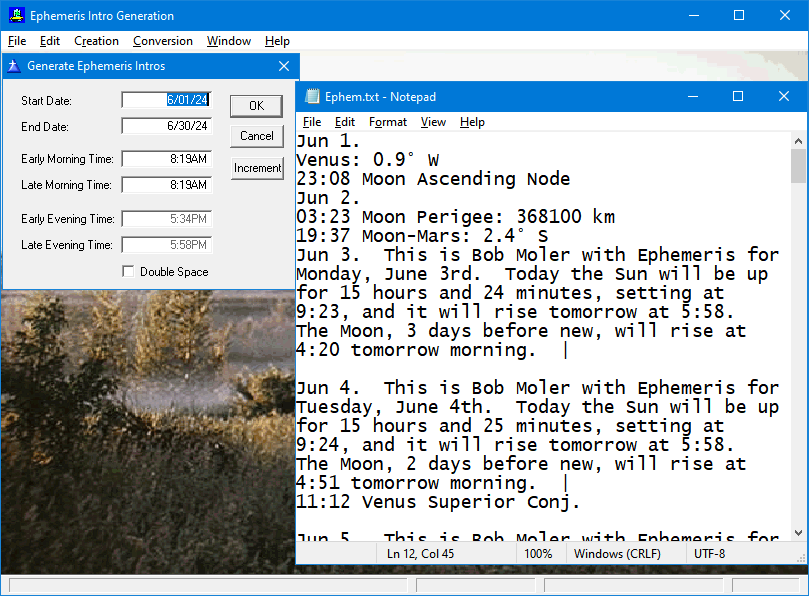
This is a text file produced by the Intro generated function of the Ephemeris Helper program. This file is pasted into the Ephemeris document, where I add the rest of the content. The dates with no intros are Saturday and Sunday. I also use two more files of astronomical events, which I add after the intros to help me with program topics. The intro has two formats, depending on whether the Sun rises before or after the start of the last airing of Ephemeris that day.
The intros take approximately 15 seconds, which gives me 44 seconds for the topic of the day. This gives me 59 seconds to fill a break in NPR’s Morning Edition. As far as topics go, I can’t dig deep. As far as things that can be seen in the sky: It has to be visible to the naked eye. I may talk about what might be seen in binoculars or a small telescope, but it has to be a naked eye object. You don’t need binoculars or a telescope to find it.
06/02/2022 – Ephemeris – What’s an ephemeris?
This is Ephemeris for Thursday, June 2nd. Today the Sun will be up for 15 hours and 22 minutes, setting at 9:22, and it will rise tomorrow at 5:59. The Moon, 3 days past new, will set at 12:34 tomorrow morning.
Yesterday, I was too busy on this program to mention that that program was the 47th anniversary of the Ephemeris program and was embarking on its 48th orbit of the Sun. At this juncture, you might be wondering: What’s an ephemeris? According to Wikipedia: Quote “In astronomy and celestial navigation, an ephemeris (plural: ephemerides; from Latin ephemeris, meaning ‘diary’, from the Greek, … meaning ‘diary, or journal’) gives the positions of… astronomical objects… at a given time or times. Historically, positions were given as printed tables of values, given at regular intervals of date and time.” enquote. My tables are now databases which I generate for the year during the prior December from published algorithms. I will show all on my blog today: (You are already here). I used to have to interpolate values from printed ephemerides for the first 5 or so years of the program.
The astronomical event times given are for the Traverse City/Interlochen area of Michigan (EDT, UT – 4 hours). They may be different for your location.
Addendum
An Ephemeris Example – Comet 73P-B/Schwassmann-Wachmann 3 nuclear fragment B
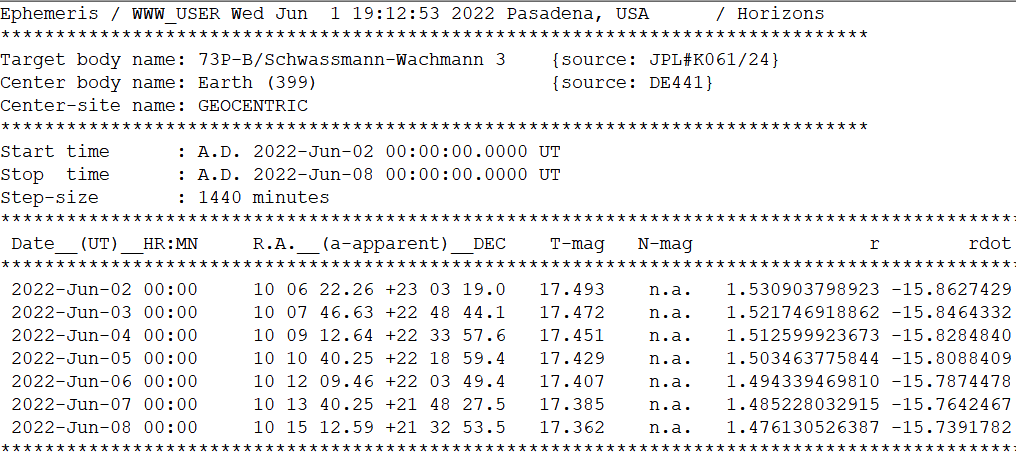
Here’s an ephemeris for Comet Schwassmann-Wachmann 3 nuclear fragment B from the Jet Propulsion Laboratory’s (JPL) Horizons system. The listing has been truncated for width. Click on it to enlarge it.
R.A. is right ascension – East-west position in the sky, like longitude on the Earth, only it’s in hours, minutes and seconds. One hour = 15 degrees.
DEC is declination – North-south position, in the sky, exactly like latitude on the Earth in degrees, minutes and seconds.
(a-apparent) means that the above coordinates are based on where the vernal equinox point in the sky is at that date and time, and for the observer’s location. Since I didn’t specify one, it’s the center of the Earth.
T-mag – Predicted total magnitude of the comet. Magnitudes are like golf scores. The higher magnitude, the dimmer the object. It’s really, really dim.
N-mag – Predicted magnitude of the nucleus. No estimate is made here.
r – Distance from the Sun in terms of Astronomical Units (AU). 1 AU is Earth’s mean distance from the Sun.
rdot – The change in r. It’s in kilometers per second. If negative, it’s moving toward the Sun.
For more information on how I produce ephemerides for this program, go here: https://bobmoler.wordpress.com/2019/01/22/
05/29/2020 – Ephemeris is completing 45 trips around the Sun
This is Bob Moler with Ephemeris for Friday, May 29th. Today the Sun will be up for 15 hours and 17 minutes, setting at 9:19, and it will rise tomorrow at 6:01. The Moon, at first quarter today, will set at 2:55 tomorrow morning. This is the last program of Ephemeris’ 45th orbit of the Sun. Monday we start the 46th orbit. In case you’re confused, one orbit of the Sun equals one year. I consider the Earth a space station orbiting the Sun in roughly 365 and a quarter days. The orbital time is also marked by the seasons due to the Earth’s axial tilt, seeing the Sun from different directions, and also looking out in space at night to the procession of stars and constellations that slowly change throughout the year giving us the parade of the seasonal constellations. Now in the evening the winter stars have moved behind the Sun. The spring constellations are in the south in the evening, and some of the summer stars are rising in the eastern sky at the same time. The planets that orbit the Sun with us are the wild card: their complex gyrations baffled the ancients who thought the Earth to be stationary.
The event times given are for the Traverse City/Interlochen area of Michigan. They may be different for your location.
Addendum
I got extremely busy Thursday evening getting our astronomy club newsletter out that I forgot to post this item, which is why this post is a day late. Not much astro news in it anyway. However at this moment the SpaceX dragonship Endeavour is on its way to the International Space Station.
01/09/2020 – Ephemeris – What is Ephemeris about?
Ephemeris for Thursday, January 9th. Today the Sun will be up for 9 hours and 1 minute, setting at 5:20, and it will rise tomorrow at 8:18. The Moon, 1 day before full, will set at 8:15 tomorrow morning.
The Ephemeris program has been a labor of love of mine for going on 45 orbits of the Sun this June. The topics are astronomy and space. What can be seen with the naked eye, binoculars or a small telescope. We look at constellations visible in the evening, their stories, both of western civilization and of the native peoples of our land. We look at the planets, especially the naked-eye planets on Wednesday, and whenever the Moon appears close to one to point it out. We also give heads up on upcoming events like eclipses and meteor showers, plus local events like viewing opportunities we call star parties. I have a companion blog, often illustrated: It’s at bobmoler dot wordpress dot com.
The times given are for the Traverse City/Interlochen area of Michigan. They may be different for your location.
Addendum
When the Moon is in the evening sky I will talk about what can be seen on its surface that night, usually near the terminator, which in the evening is the sunrise line, where the shadows are longest. I don’t cover the Moon every month. Search “Moon” to find all the posts that I do. I just might have a post on the phase you are interested in. Otherwise when the bright Moon overpowers the constellations, I talk about what we know about the bright stars visible, astronomical news or concepts, whatever can be explained in 45 seconds. Sometimes I can only whet your appetite. Click the about button above for more information about the Ephemeris program and me.
01/07/2020 – Ephemeris – What the heck is an ephemeris? Plus my Betelgeuse update
Ephemeris for Tuesday, January 7th. Today the Sun will be up for 8 hours and 58 minutes, setting at 5:18, and it will rise tomorrow at 8:19. The Moon, 3 days before full, will set at 6:09 tomorrow morning.
What the heck is an ephemeris? According to Wikipedia: “In astronomy and celestial navigation, an ephemeris (plural: ephemerides; from Latin ephemeris, meaning ‘diary’, from the Greek,… meaning ‘diary, <or> journal’) gives the positions of… astronomical objects… at a given time or times. Historically, positions were given as printed tables of values, given at regular intervals of date and time.” My tables are now databases which I generate for the year during the prior December from published algorithms. I will show all on my blog today: It’s at bobmoler<dot>wordpress<dot>com. (You are already here) I used to have to interpolate values from printed ephemerides for the first 5 or so years.
The times given are for the Traverse City/Interlochen area of Michigan. They may be different for your location.
Addenda
An Ephemeris Example
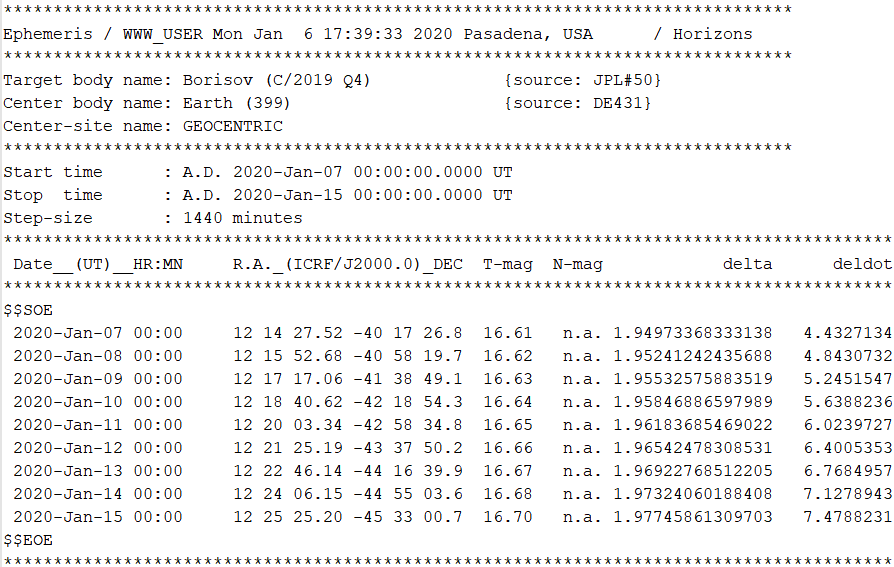
Here’s an ephemeris for the Interstellar comet for 2I/Borisov AKA C/2019 Q4 (Borisov) from the Jet Propulsion Laboratory’s (JPL) Horizons system.
R.A. is right ascension – East-west position in the sky, like longitude on the Earth, only it’s in hours, minutes and seconds. One hour = 15 degrees.
DEC is declination – North-south position, in the sky, exactly like latitude on the Earth in degrees, minutes and seconds.
J2000.0 means that the above coordinates are based on where the vernal equinox point in the sky was on January 1, 12:00 Terrestrial Time, 2000. Or January 1, 2000, 11:58:55.816 UTC as reported in Wikipedia.
APmag – Apparent visual magnitude. Magnitudes are like golf scores. The higher magnitude the dimmer the object. It’s really, really dim.
delta – Distance from the Earth in terms of Astronomical Units (AU). 1 AU is Earth’s mean distance from the Sun.
deldot – The change in delta. It’s in kilometers per second. If positive, it’s going away.
For more information on how I produce ephemerides for this program go here: https://bobmoler.wordpress.com/2019/01/22/
The dimming of Betelgeuse
I finally got a clear evening. However snow and freezing rain the rest of the week.
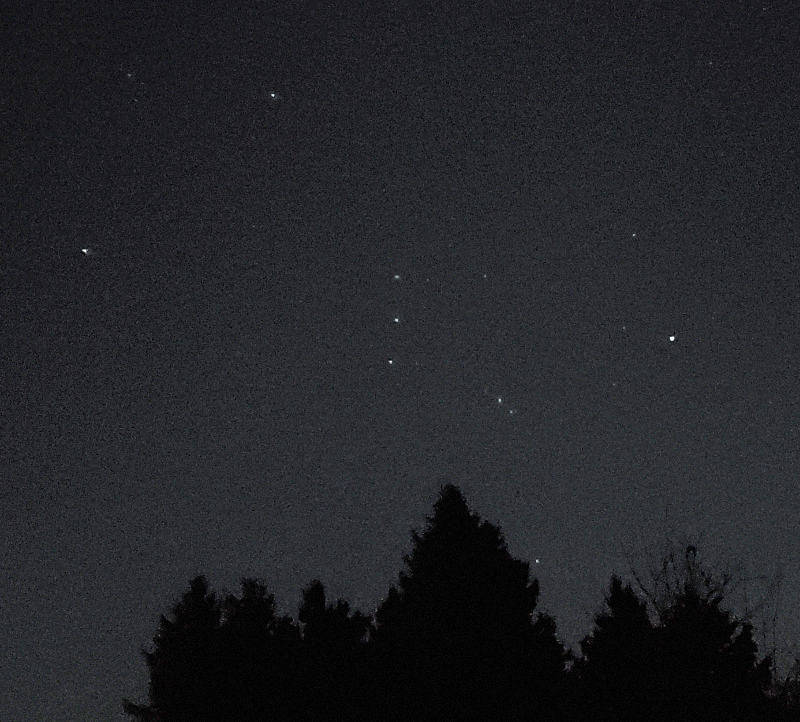
Betelgeuse in Orion at 7:07 p.m. January 6, 2020. Taken with my Samsung Galaxy S10+ in the moonlight. Compare the brightness of Betelgeuse with Rigel, Bellatrix and the belt stars.
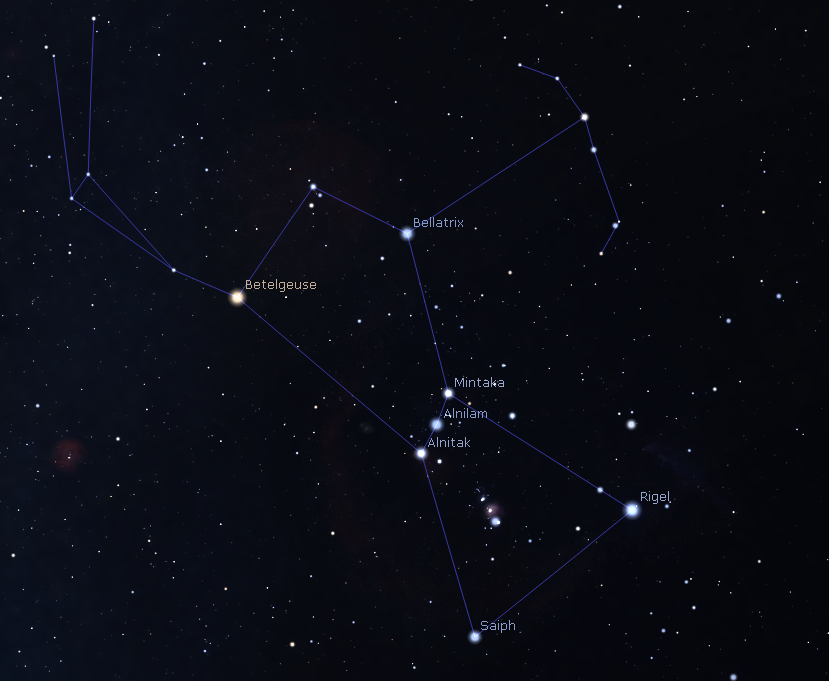
Orion’s brightest stars with their names for 9 p.m. January 7, 2019. Click on the image to make Orion a giant hunter. Created using Stellarium.
See last Thursday’s post on the dimming of Betelgeuse: https://bobmoler.wordpress.com/2020/01/02/
06/03/2019 – Ephemeris – We’re starting Ephemeris’ 45th journey around the Sun
Ephemeris for Monday, June 3rd. Today the Sun will be up for 15 hours and 23 minutes, setting at 9:22, and it will rise tomorrow at 5:59. The Moon is new today, and won’t be visible.
With this program Ephemeris begins its 45th journey around the Sun. While this short program mostly covers the wonders visible in the heavens with the naked eye, binoculars or small telescope, as last week has shown we also cover news developments, hopefully whetting your appetite to dig deeper. Over the last 44 years we’ve seen the rise and demise of the Space Shuttle program, the fantastic images and data brought back by the Hubble Space Telescope, the planetary probes Viking, Voyager, Galileo, Cassini, MESSENGER, New Horizons, Rosetta, Dawn and others to visit all the planets in the solar system plus asteroids, dwarf planets, and comets. Discoveries beyond the solar system boggle the mind. Let’s go for another orbit around the Sun on spaceship Earth.
The times given are for the Traverse City/Interlochen area of Michigan. They may be different for your location.
01/22/2019 – Ephemeris – What the heck is an ephemeris?
Ephemeris for Tuesday, January 22nd. Today the Sun will be up for 9 hours and 25 minutes, setting at 5:37, and it will rise tomorrow at 8:11. The Moon, 1 day past full, will rise at 7:41 this evening.
What the heck is an ephemeris? According to Wikipedia: “In astronomy and celestial navigation, an ephemeris (plural: ephemerides; from Latin ephemeris, meaning ‘diary’, from the Greek,… meaning ‘diary, <or> journal’) gives the positions of… astronomical objects… at a given time or times. Historically, positions were given as printed tables of values, given at regular intervals of date and time.” My tables are now databases which I generate for the year during the prior December from published algorithms. I will show all on my blog today: It’s at bobmoler.wordpress.com. (You are already here) I used to have to interpolate values from printed ephemerides.
The times given are for the Traverse City/Interlochen area of Michigan. They may be different for your location.
Addendum
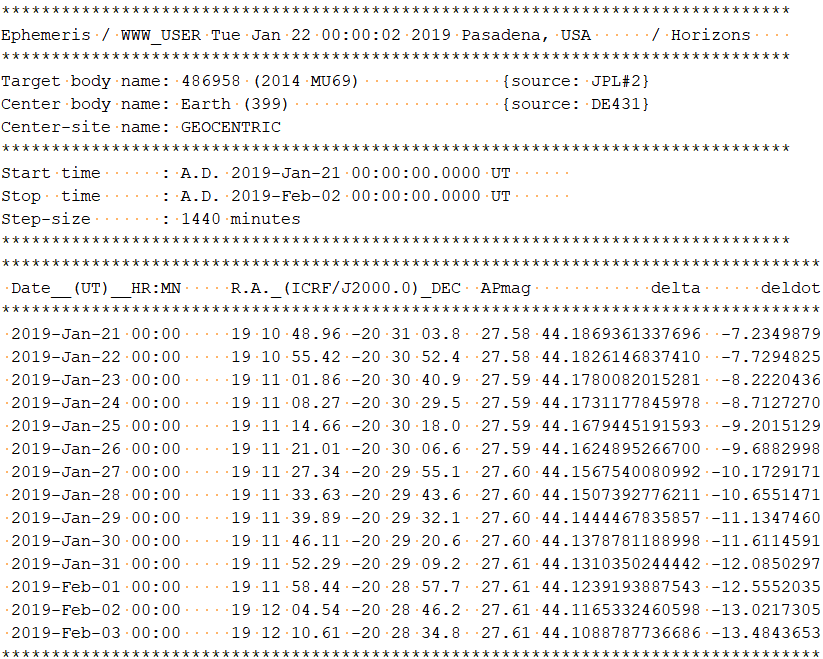
Here are sections of an ephemeris of the positions of 2014 MU69, Ultima Thule that the New Horizons flew past on New Years day. Created by JPL’s Horizons web site.
R.A. is right ascension – East-west position in the sky, like longitude on the Earth, only it’s in hours, minutes and seconds. One hour = 15 degrees.
DEC is declination – North-south position, in the sky, exactly like latitude on the Earth in degrees, minutes and seconds.
J2000.0 means that the above coordinates are based on where the vernal equinox point in the sky was on January 1, 12:00 Terrestrial Time, 2000. Or January 1, 2000, 11:58:55.816 UTC as reported in Wikipedia.
APmag – Apparent visual magnitude. Magnitudes are like golf scores. The higher magnitude the dimmer the object. It’s really, really, really dim.
delta – Distance from the Earth in terms of Astronomical Units (AU). 1 AU is Earth’s mean distance from the Sun.
deldot – The change in delta. Note that is negative. 5 days after New Horizons passed Ultima Thule that spacecraft and Ultima Thule passed behind the Sun. Now the Earth in its orbit is approaching Ultima as we are coming around the Sun.
How my data is created
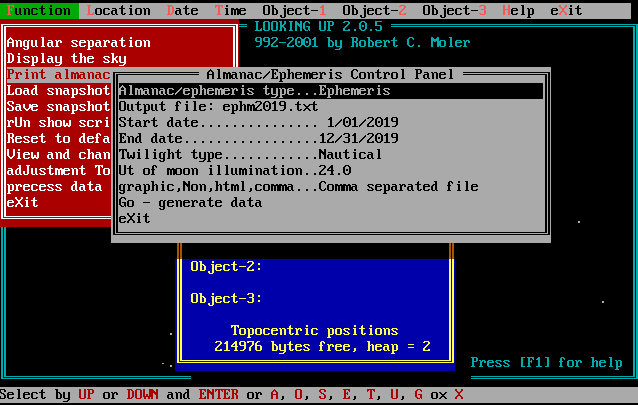
I use my LookingUp for DOS program to generate sunrise/sunset, moonrise/moonset tables for the year. I also create planetary ephemeris tables here.
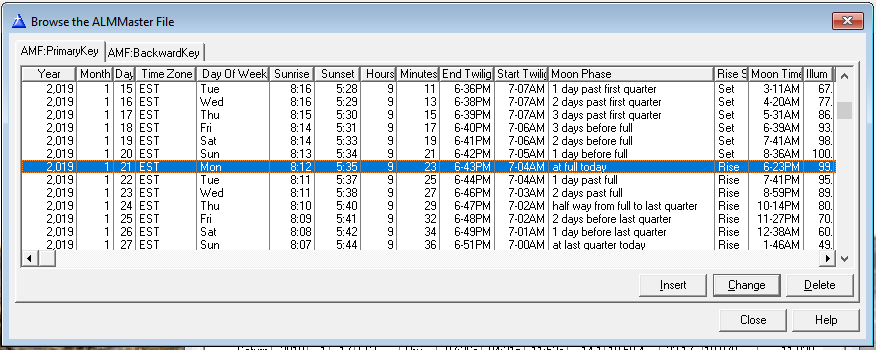
My Ephemeris Helper program massages the raw data from the above program to create this Almanac Master table.
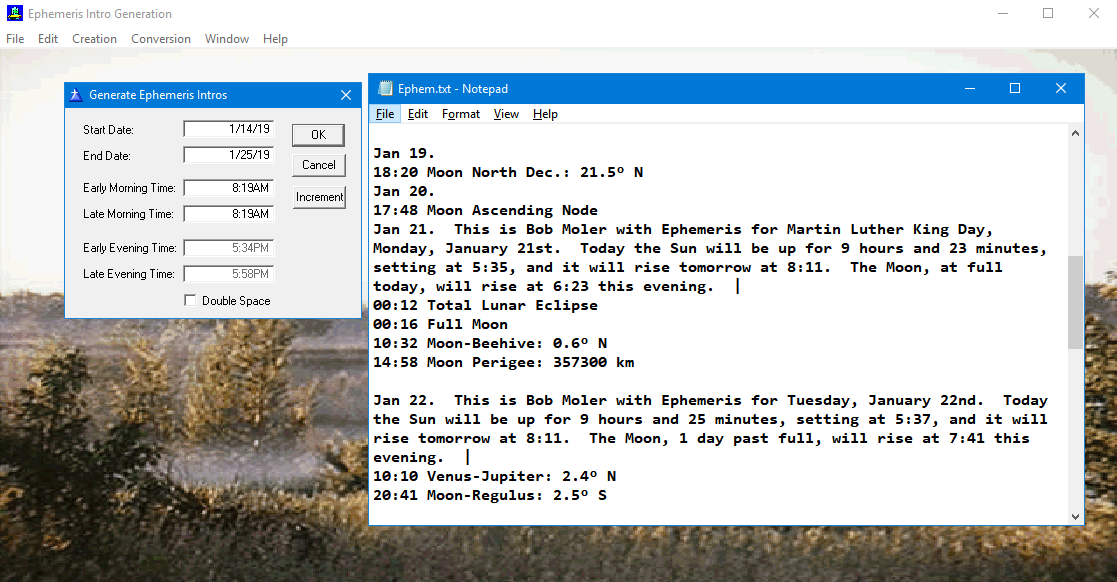
The first 15 or so seconds of the Ephemeris program is created by the Ephemeris Helper program from the Almanac Master, a Holiday Table, A One Time Event Table created from NASA’s SKYCAL Calendar Table, and Reoccurring Events Table.
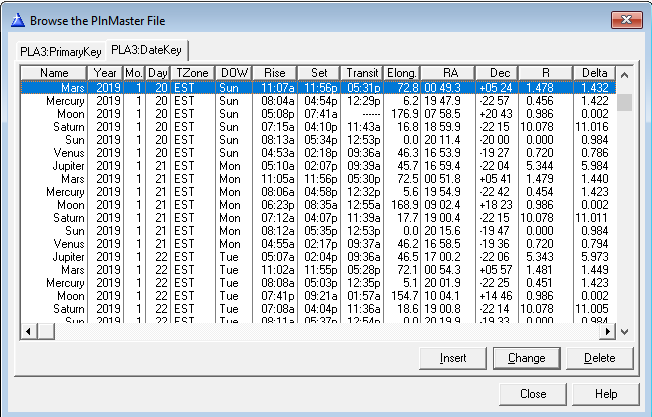
The Planet Master table in the Ephemeris Helper program which I use each Wednesday for planet positions.
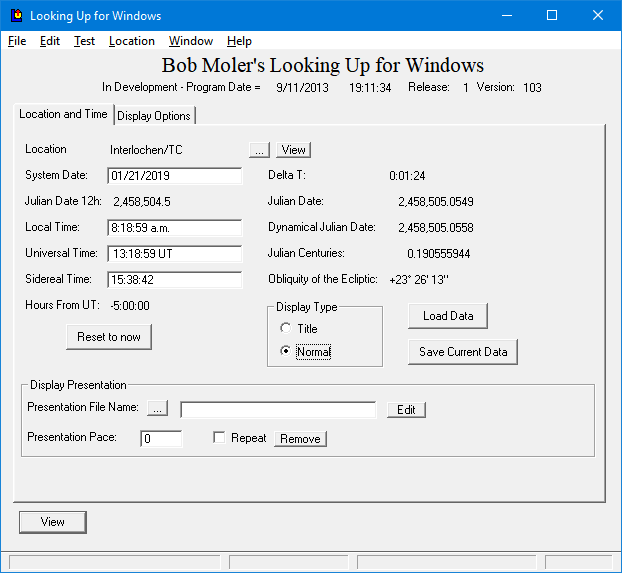
First tab of the LookingUp for Windows program which I don’t use much for the radio program but has uses on this blog and for illustrations for the Stellar Sentinel, the newsletter for the Grand Traverse Astronomical Society, that I edit, which is sent to members and distributed free via email to educators.
Source for the algorithms that I use is Astronomical Algorithms by Jean Meeus, Willmann-Bell 1991.
 Bob Moler's Ephemeris Blog