Archive
08/31/2015 – Ephemeris – Previewing the skies of September – Part 1
Ephemeris for Monday, August 31st. The Sun will rise at 7:03. It’ll be up for 13 hours and 18 minutes, setting at 8:21. The Moon, 2 days past full, will rise at 9:31 this evening.
Let’s look forward to the skies of September. The sun will moving at its greatest speed in its retreat to the south. Daylight hours in the Interlochen/Traverse City area and will drop from 13 hours and 15 minutes tomorrow the 1st. to 11 hours 46 minutes on the 30th. The altitude of the sun above the southern horizon at local noon will be 54 degrees tomorrow, and will descend to 42 degrees on the 30th. The Straits area will see the sun a degree lower. The season of summer is getting short, so enjoy it while you can. Summer ends and autumn begins at 4:20 a.m. on September 23rd. Saturn is setting before midnight now, but Venus and Mars are appearing in the morning sky soon. Tomorrow we’ll look at September’s lunar eclipse.
Times are for the Traverse City/Interlochen area of Michigan. They may be different for your location
Addendum
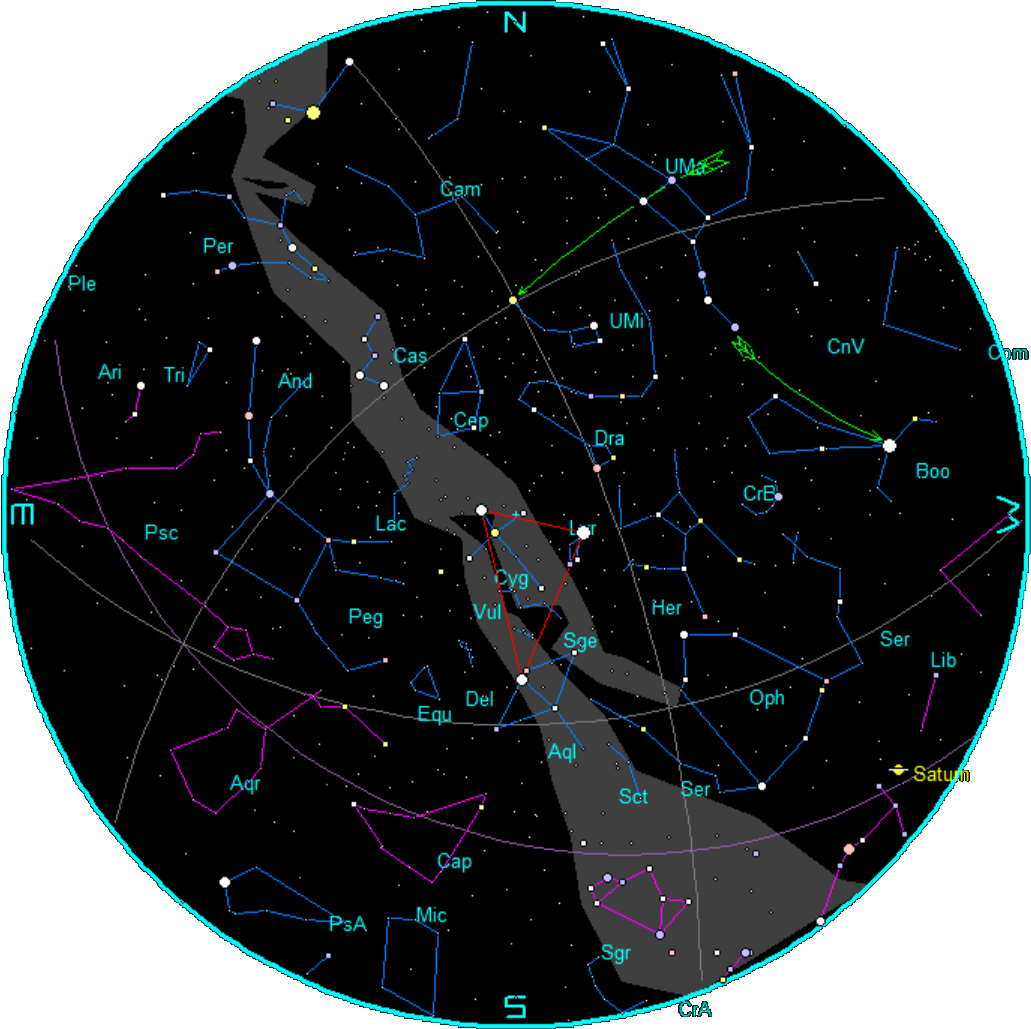
Star Chart for September 2015. Created using my LookingUp program.
The planets and stars are plotted for the 15th at 10 p.m. EDT. That is chart time. Note, Traverse City is located 1 hour 45 minutes behind our time meridian. To duplicate the star positions on a planisphere you may have to set it to 1 hour 45 minutes earlier than the current time.
Evening astronomical twilight ends at 10:04 p.m. EDT on August 1st, decreasing to 9:02 p.m. EDT on the 30th..
Morning astronomical twilight starts at 5:19 a.m. EDT on August 1st, and increasing to 6:01 a.m. EDT on the 30th.
Add a half hour to the chart time every week before the 15th and subtract and hour for every week after the 15th.
For a list of constellation names to go with the abbreviations click here.
The green pointer from the Big Dipper is:
- Pointer stars at the front of the bowl of the Big Dipper point to Polaris the North Star.
- Follow the arc of the Big Dipper’s handle to Arcturus.
- The Summer Triangle is shown in red.
Calendar of Planetary Events
Credit: Sky Events Calendar by Fred Espenak and Sumit Dutta (NASA’s GSFC)
To generate your own calendar go to http://eclipse.gsfc.nasa.gov/SKYCAL/SKYCAL.html
Times are Eastern Daylight Time on a 24 hour clock. Some additions made to aid clarity.
Conjunctions like the Mars-Regulus: 0.8° N means Regulus will appear 0.8° north of Mars.
| Sep | 01 | Tu | Venus: 25° W | |
| 04 | Fr | 05:59 | Mercury Elongation: 27.1° E | |
| 05 | Sa | 01:09 | Moon-Aldebaran: 0.6° S Occultation?* | |
| 05 | Sa | 05:54 | Last Quarter | |
| 06 | Su | 13:06 | Moon North Dec.: 18.2° N | |
| 10 | Th | 01:53 | Moon-Venus: 2.9° S | |
| 13 | Su | 02:41 | New Moon | |
| 13 | Su | 02:55 | Partial Solar Eclipse (Southern tip of Africa to Antarctica) | |
| 14 | Mo | 00:38 | Moon Ascending Node | |
| 14 | Mo | 07:28 | Moon Apogee: 406500 km | |
| 18 | Fr | 22:54 | Moon-Saturn: 3.1° S | |
| 21 | Mo | 04:59 | First Quarter | |
| 21 | Mo | 08:02 | Moon South Dec.: 18.1° S | |
| 23 | We | 04:20 | Autumnal Equinox | |
| 24 | Th | 15:38 | Mars-Regulus: 0.8° N | |
| 27 | Su | 17:04 | Moon Descending Node | |
| 27 | Su | 21:46 | Moon Perigee: 356900 km – Super moon | |
| 27 | Su | 22:48 | Total Lunar Eclipse | |
| 27 | Su | 22:50 | Full Moon – Harvest Moon | |
| 30 | We | 10:36 | Mercury Inferior Conjunction with the Sun | |
| Oct | 01 | Th | Venus: 43.6° W |
* For the Grand Traverse Region the Moon will rise at 12:10 a.m. occulting Aldebaran. Aldebaran will appear at the Moon’s unilluminated top right edge at approximately 12:40 a.m.
Note: All lunar conjunctions in the table above are geocentric. Double check with a program like Stellarium to check on the position of the body with respect to the moon for your location.
03/18/2014 – Ephemeris – Thursday a.m. many folks including New Yorkers will see a bright star wink out
Ephemeris for Tuesday, March 18th. The sun will rise at 7:49. It’ll be up for 12 hours and 3 minutes, setting at 7:52. The moon, 2 days past full, will rise at 10:15 this evening.
On Thursday morning the 20th around 2 a.m. the star Regulus, the brightest star in the constellation Leo the lion will wink out for up to 14 seconds for observers in New York City. That will be exceptionally cool, because Regulus is one of the few stars actually bright enough to be visible from that metropolis. Regulus will not be at fault, but for a narrow band of the earth running northwest of there the asteroid 163 Erigone will pass in front of Regulus in an extremely rare occultation of a bright star. This will allow observers on the ground to time the duration of the event and put together the silhouette of the asteroid, which is thought to be 45 miles wide. Observers have in the past spotted secondary occultations of another asteroid and discovered an asteroid satellite.
Times are for the Traverse City/Interlochen area of Michigan. They may be different for your location.
Addendum
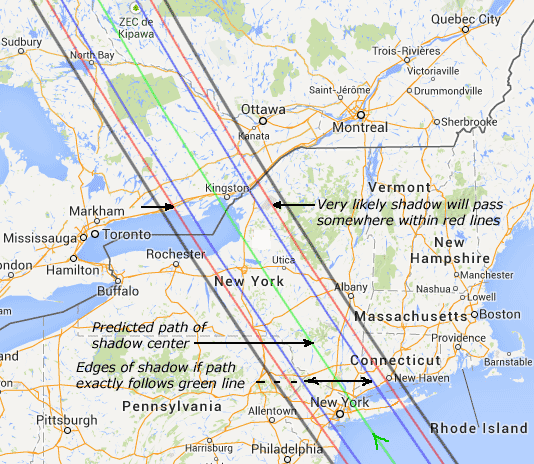
Part of the occultation path of Regulus. See link below. Credit: Geoff Hitchcox / IOTA and Sky & Telescope magazine
Here’s a link to the Sky and Telescope site with lots more information. Clicking on their map will bring up an interactive Google earth map.
 Bob Moler's Ephemeris Blog