Archive
07/15/2016 – Ephemeris – The end is near for ESA’s Rosetta spacecraft
Ephemeris for Monday, August 15th. The Sun rises at 6:45. It’ll be up for 14 hours and 1 minute, setting at 8:47. The Moon, 3 days before full, will set at 4:49 tomorrow morning.
In a month and a half the European Space Agency’s Rosetta spacecraft will end its mission to comet 67/P Churyumov-Gerasimenko or just 67/P for short. The end will come as the Rosetta spacecraft will make a slow crash onto the comet. A week ago the spacecraft shut down its link to the Philae lander, which itself didn’t stick its landing and bounced three times and found itself between ice and a hard place with no way for the Sun to reach it to recharge its batteries, and so had an abbreviated science mission before the batteries failed. The comet was closest to the Sun a year ago, and is heading back out to near the orbit of Jupiter. Last time it was out this far Rosetta had just been woken up out of a three-year slumber. This time though it will sleep forever after a job well done.
Times are for the Traverse City/Interlochen area of Michigan. They may be different for your location.
Addendum
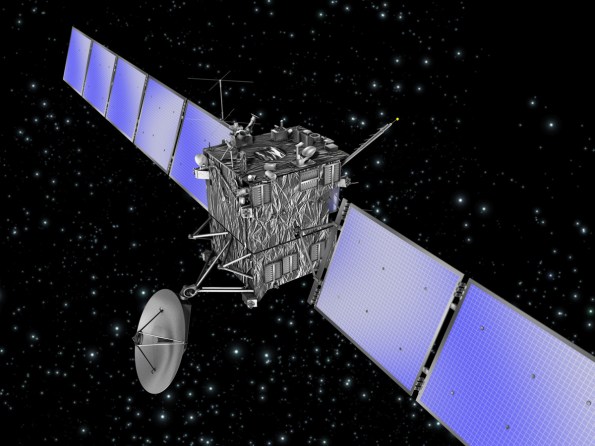
An artist’s illustration of the European Space Agency’s comet-chasing Rosetta spacecraft. Credit: ESA – C. Carreau
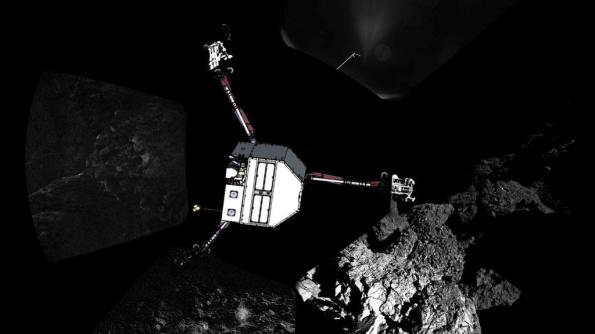
An image of the Philae lander superimposed on its panorama photographs where it was wedged between ice and a hard place in the shadows November 2014. Credit: ESA/Rosetta.
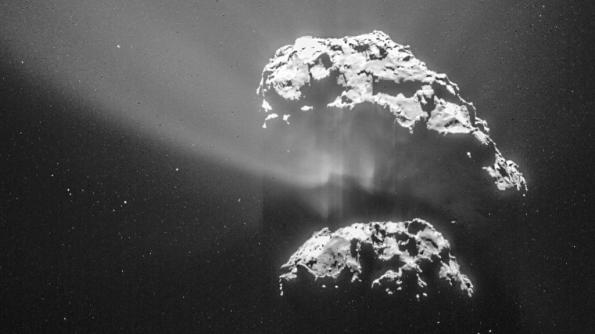
Comet 67P and jets of dust, carried by sublimating ices. Credit: ESA/Rosetta
10/16/2015 – Ephemeris – The topic this Saturday will be comets (Updated)
Ephemeris for Friday, October 16th. The Sun will rise at 7:59. It’ll be up for 10 hours and 57 minutes, setting at 6:56. The Moon, half way from new to first quarter, will set at 9:20 this evening.
Tomorrow I have a treat for youngsters of all ages. From 10 a.m. to noon ( Update: noon to 2 p.m.) I’ll be talking about and helping to make comets at the Betsie Valley District Library in Thompsonville. First we’ll explore comets as seen in our skies then travel along with the Rosetta space mission to get up close to Comet 67P/Churyumov–Gerasimenko to see what it’s made of and what happens when it comes close to the Sun. Then we’ll make our own comet nucleus using many of the ingredients that are found in actual comets, though we’ll leave out all the poisonous ones, and we’ll see if it survives this close to the Sun. If you want to help make a comet, bring your winter gloves. I do have extras, but yours will probably work better.
Times for astronomical events are for the Traverse City/Interlochen area of Michigan. They may be different for your location.
06/16/2015 – Ephemeris – Philae phones home
Ephemeris for Tuesday, June 16th. Today the Sun will be up for 15 hours and 33 minutes, setting at 9:30. The Moon is new today, and won’t be visible.
Tomorrow the Sun will rise at 5:56. | As Comet 67P/Churyumov-Gerasimenko (Comet 67P for short, or the Rubber Duckie Comet) nears the orbit of Mars a couple of months from perihelion, its closest to the Sun, the Rosetta spacecraft, which has been orbiting it received welcome news from its lander Philae which fell silent 5 months ago. The lander woke up and has enough power to take measurements and transmit data to the Rosetta spacecraft. This is something the folks at the European Space Agency had hoped for. The comet has moved in its orbit around the Sun, so the Sun’s light now can fall on Philae’s solar panels long enough during the comet’s daily rotation to recharge its batteries. They are hoping that Philae can resume its surface mission. This is just amazing!
Times are for the Traverse City/Interlochen area of Michigan. They may be different for your location.
Addendum
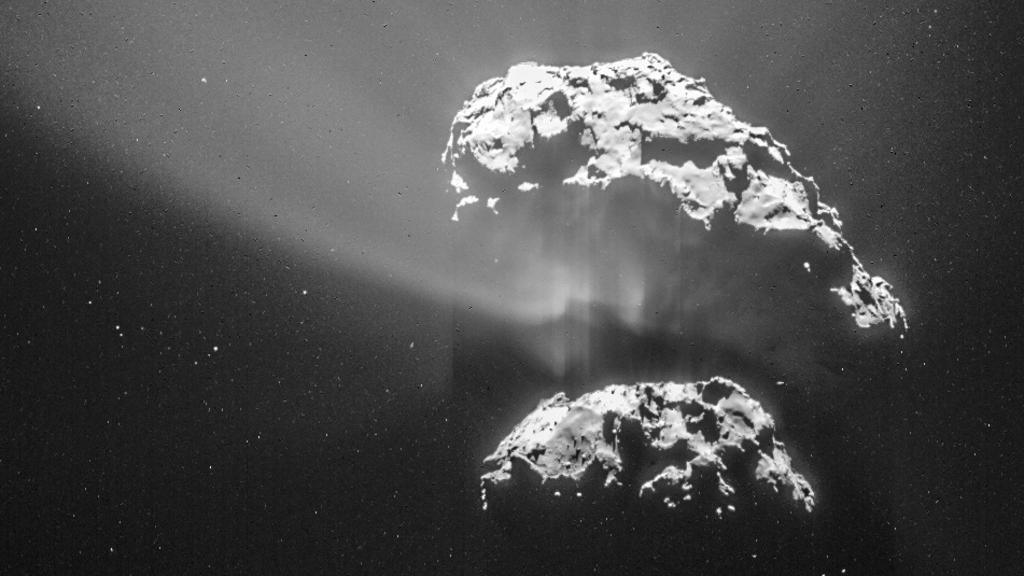
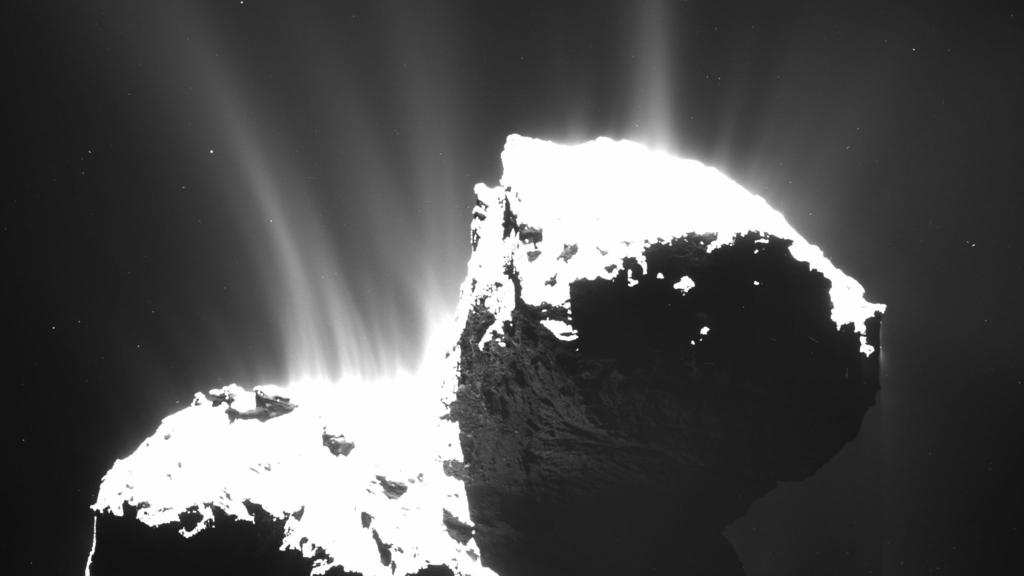
Comet 67P and jets of dust, carried by sublimating ices. Credit: ESA/Rosetta
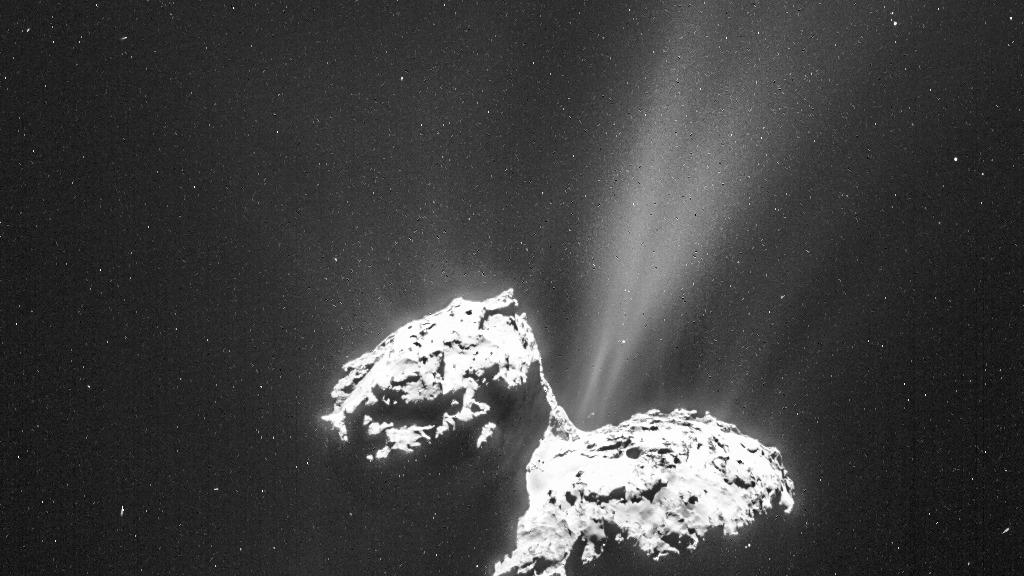
Comet 67P and jets of dust, carried by sublimating ices from another angle. Credit: ESA/Rosetta
Comet 67P and jets of dust, carried by sublimating ices from yet another angle. Credit: ESA/Rosetta
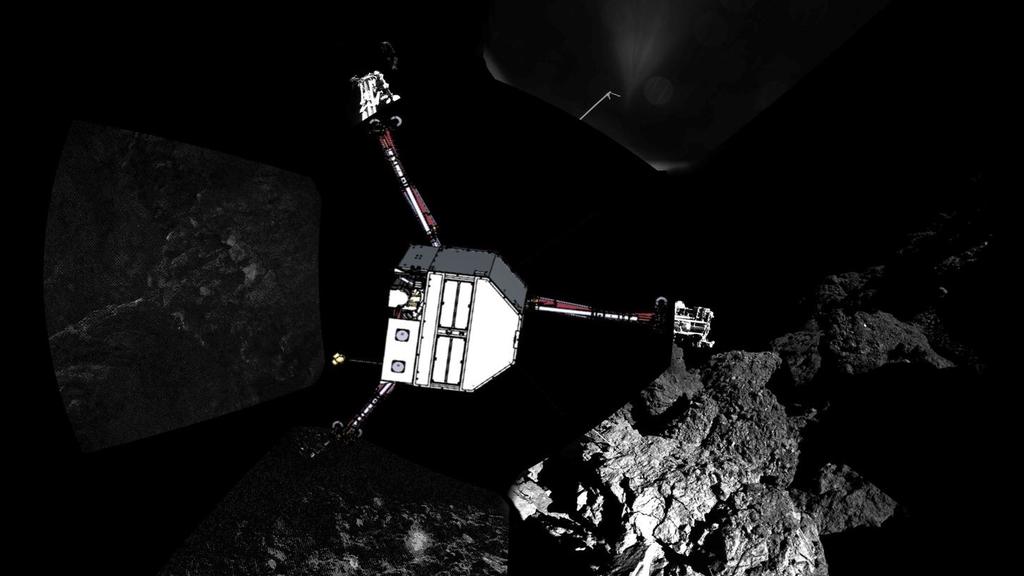
An image of the Philae lander superimposed on its panorama photographs where it was wedged between ice and a hard place in the shadows last November. Credit: ESA/Rosetta.
Philae will attempt to land on comet 67P C-G today (updated)
Today’s the big event when the European Space Agency’s Rosetta spacecraft will release Philae the lander to land on the head of the rubber ducky shaped comet.
Go to the Rosetta landing mission site for links to the live stream feed and other blog and Twitter links.
The times given are CET (Central European Time) and GMT (Greenwich Mean Time or Universal time) Subtract 5 hours for Eastern Standard Time. I’ll convert them below.
Final Go/NoGo decision will be between 1:35 and 2:35 a.m. EST. As of the time of this posting that’s an hour and a half from now.
The release of Philae will be at 4:03 a.m. EST
Landing of Philae will occur around 11:02 a.m. EST. The Philae lander will fall over 7 hours to the comet.
Updated 8:46 EST: Philae has been released. Live update expected at 9 a.m.
Below is a link to the live feed from the Rosetta operations center
Also follow on Twitter #CometLanding
Update 11:05 a.m. EST: The Philae has landed! From the happy faces and celebration in he control center. No announcement yet.
Update 11:08 a.m. EST: The official announcement came from the flight director. The harpoons were fired and cables reeled back to attach the lander to the surface.
Update 11:48 a.m. EST: It is reported that Philae may not be anchored to the surface Stay tuned.
The Rubber Ducky turns out to be kind of an Ugly Duckling
The European Space Agency’s Rosetta spacecraft arrived at its target Comet 67p/Churyumov–Gerasimenko yesterday, August 6th, 2014. The smoothed image 30 pixels across of three weeks ago of a rubber ducky,
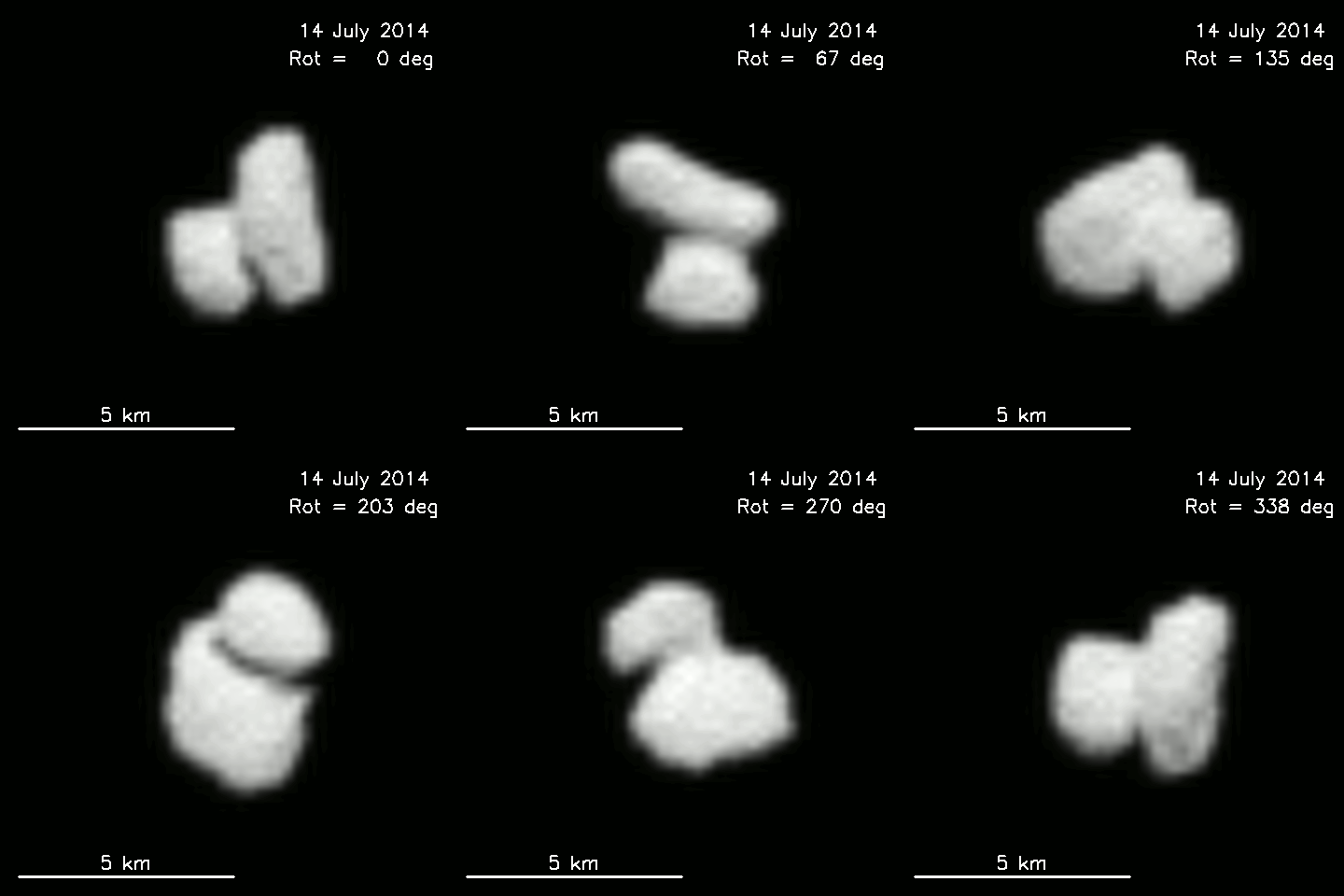
An animation of Comet 67p/Churyumov–Gerasimenko rotation on July 14, 2014. The 30 pixel wide image has been smoothed. The Rotation rate is 1 rotation every 12.4 hours. Credits: ESA/Rosetta/MPS for OSIRIS Team MPS/UPD/LAM/IAA/SSO/INTA/UPM/DASP/IDA
have been replaced by the mega-pixel images we see now of an Ugly Duckling comet, with much more character and battle scars. That’s what happens when you’ve been ’round the Sun to many times.
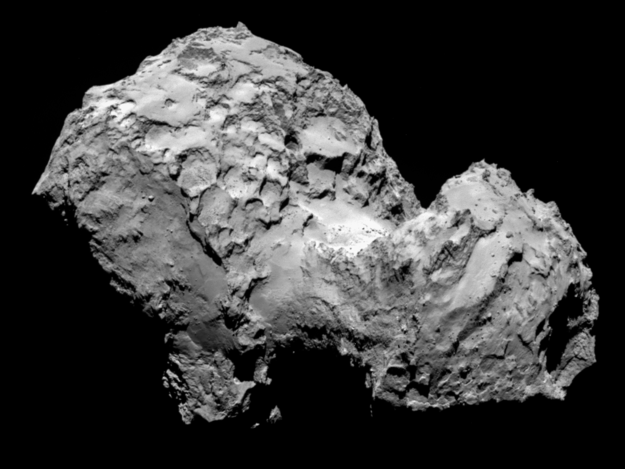
The comet on August 3rd, 2014, 3 days before arrival. Credit: ESA / Rosetta / MPS for OSIRIS Team MPS / UPD / LAM / IAA / SSO / INTA / UPM / DASP / IDA
See Emily Lakdawalla’s post from yesterday at http://www.planetary.org/blogs/emily-lakdawalla/2014/08060249-were-at-the-comet-rosetta.html. It contains lots of images and more information including a 3D image. Grab your red & blue 3D glasses for that one, or if you’ve mastered the techniques of crossed-eye, or parallel-eye stereo viewing.
Also go to ESA’s own Rosetta site at http://www.esa.int/Our_Activities/Space_Science/Rosetta.
I find Emily’s post much more comprehensive. So subscribe to the Planetary Society’s blog feed.
 Bob Moler's Ephemeris Blog