Archive
12/24/10 – Ephemeris – Musings on the Star of Bethlehem
Friday, December 24th. The sun will rise at 8:17. It’ll be up for 8 hours and 49 minutes, setting at 5:06. The moon, half way from full to last quarter, will rise at 9:21 this evening.
Before the moon rises tonight the planet Jupiter will shine brightly as our Christmas star. The actual Star of Bethlehem, if it was a natural phenomenon, was not the bright star that we imagine. The Chinese, who were excellent observers and catalogers of novae and comets recorded nothing unusual in the time period of the Nativity. The Magi, if that’s the correct translation of the visitors, were astrologers who saw significance in the mundane movement and patterns of the planets. They were the only ones who did. The Chinese had a whole other system of astrology. The Jews themselves had Biblical prohibitions against astrology. So the Star remains a mystery. Have a merry Christmas.
* Times are for the Traverse City/Interlochen area of Michigan. They may be different for your location.
12/17/10 – Ephemeris – My favorite explanation for the Star of Bethlehem
Friday, December 17th. The sun will rise at 8:13. It’ll be up for 8 hours and 49 minutes, setting at 5:03. The moon, half way from first quarter to full, will set at 5:34 tomorrow morning.
For over 400 years astronomers have wondered and looked through ancient Chinese records, ran the positions of planets back 2000 years, and still no one knows for sure what the Star of Bethlehem really was, but here’s my favorite scenario. On August 13th of 3 BC Jupiter and Venus briefly merged in the pre-dawn skies against the constellation of Leo the lion. A month later Jupiter was in conjunction with Regulus the bright star in Leo, the little king star. Then 9 months later, after sunset on June 16th of 2 BC the two planets again joined as one in Leo. The king of the planets twice mating with Venus as Ishtar the Babylonian goddess of fertility against the constellation of the lion signifying Judah in Genesis? The Magi not being Jewish might have found meaning in all that.
* Times are for the Traverse City/Interlochen area of Michigan. They may be different for your location.
12/16/10 – Ephemeris – Who were the Magi?
Thursday, December 16th. The sun will rise at 8:13. It’ll be up for 8 hours and 49 minutes, setting at 5:03. The moon, 3 days past first quarter, will set at 4:28 tomorrow morning.
The Star of Bethlehem is one of the great mysteries of Christmas. The Chinese of that time were the only ones that recorded the happenings in the heavens and there were no bright stars that appeared near the time of Christ’s birth. That leads us to the Magi themselves, if that’s who they were. Magi were astrologer priests of the Zoroastrian religion in Persia. They could see signs in the positions of the planets that would go unnoticed to the Jews to which astrology was forbidden. Conjunctions where to or more planets gathered together were the most powerful of these configurations. There was a triple conjunction of Jupiter and Saturn in seven BC that’s the most famous, but I have another set of conjunctions in mind to tell you about tomorrow.
* Times are for the Traverse City/Interlochen area of Michigan. They may be different for your location.
How the Search for the Star of Bethlehem Began
For this December’s meeting of the GTAS I will present my biennial program In Search of the Star of Bethlehem. I’ve been alternating this program with Biblical Cosmology, as a change of pace.
This posting will supplement and illuminate the presentation, not replace it. Here we’ll look at the origins of the search for what became known as the Star of Bethlehem and of the search for what the star was. We’ll start at the beginning with the only reference to the star found in the Bible, in the second chapter of Matthew. The translation here is from the New American Bible.
The story
After Jesus’ birth in Bethlehem of Judea during the reign of King Herod, astrologers from the east arrived one day in Jerusalem inquiring, “Where is the newborn King of the Jews? We observed his star at its rising and have come to pay him homage.” At the news King Herod became greatly disturbed, and with him all Jerusalem. Summoning all of the chief priests and scribes of the people, he inquired of them where the Messiah was to be born. “In Bethlehem of Judea”, they informed him. “Here is what the prophet has written: And you, Bethlehem, land of Judah, are by no means least among the princes of Judah, since from you shall come a ruler who is to shepherd my people Israel”. Herod called the astrologers aside and found out the exact time of the star’s appearance. Then he sent them to Bethlehem after having instructed: “Go and get detailed information about the child. When you have found him, report it to me so that I may go and offer him homage too.” After their audience with the king, they set out. The star, which they had observed at its rising went ahead of them until it came to a standstill over the place where the child was. They were overjoyed at seeing the star, and on entering the house, found the child with Mary his mother.
The story teller
The story is told in the Gospel of Matthew. Who was Matthew? We don’t know. Scholars are quite sure that he wasn’t the apostle Matthew. Much of the material of the Gospel of Matthew is taken from the Gospel of Mark, written by John Mark, a young associate of St. Paul. A source for Mark, and possibly Matthew and Luke was a now lost source, called by Biblical scholars called Q, from the German word Quelle, which means simply Source. It could have been written or even an oral tradition of the sayings of Jesus.
Mark’s Gospel is dated to about AD 70. While Matthew’s is somewhat later. He seemed cognizant of the destruction of Jerusalem in AD 70. Matthew’s audience for his Gospel seems to be Jewish Christians, and he emphasizes that Jesus is the fulfillment of Biblical prophesy.
The only other nativity narrative in the Gospels is that of Luke. Though not contradictory, the nativity stories of Matthew and Luke are completely different with few points in common. One wonders how Luke could omit the visit of the magi or the flight to Egypt, had he known. Maybe he didn’t. Luke’s audience was more non Jewish and not as interested in Jesus as fulfillment of biblical prophesy.
Most Biblical scholars agree that the Gospels are not biographies in the modern sense of the word, and may not be, I hate saying this, the Gospel truth. Where did the writer of Matthew get the goings on in King Herod’s court some 70 years after the fact? I suppose there were leaks, just like there’s leaks in our President George III’s recent administration. Even so there’s bound to be some alteration and embellishment over time. This tendency to embellish stories more with time is seen with the apocryphal or “hidden” gospels written later on which relate, rather fanciful accounts of Jesus’ childhood.
The search begins
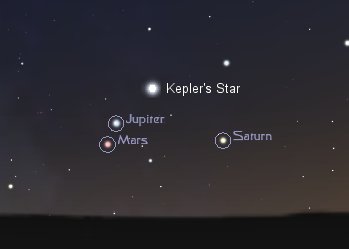
Kepler's Star and the planets
The search for the Star of Bethlehen began in 1604, with the appearance of a supernova in the constellation of Ophiuchus. At the bottom of this page is a representation of the sky near the end of twilight on the night Johannes Kepler discovered the supernova, October 9, 1604. It was near a close grouping of the three planets Jupiter Saturn and Mars. He calculated a similar grouping of the same three planets in 6 B.C. after Jupiter and Saturn pass three times in a triple conjunction the previous year.
He speculated that a nova appeared near that grouping too, and that the appearance of the planets and the “New” star prompted the magi to journey to Judea to pay homage to the newborn King of the Jews. The question is: was there a “new” star or a nova or supernova visible near the planets in 6 BC?
This is an excerpt of my December 2005 article in the GTAS publication the Stellar Sentinel
 Bob Moler's Ephemeris Blog