Archive
Ephemeris: 12/30/2025 – 2026 a year of eclipses
This is Bob Moler with Ephemeris for Tuesday, December 30th. Today the Sun will be up for 8 hours and 51 minutes, setting at 5:11, and it will rise tomorrow at 8:20. The Moon, 3 days past first quarter, will set at 5:28 tomorrow morning.
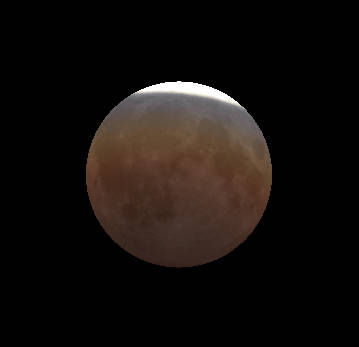
In each calendar year there are at least 4 eclipses. Two of the Sun and two of the moon. Usually we see one or maybe 2 or none. However, in 2026 we get to see three of the four eclipses, 2 lunar eclipses and a solar eclipse. The first eclipse is on March 3rd it is a total lunar eclipse, which we get to see most of. It actually ends in its final partial phase at sunrise. The next eclipse is a solar eclipse, The Moon just grazes the Sun. That will be on August 12th just before the peak of the Perseid meteor shower that night. Last on August 27th late that evening and morning of the 28th there will be a very deep partial eclipse of the Moon where 93% of its disk will be covered by the Earth’s inner shadow.
The astronomical event times given in this blog are for the Traverse City/Interlochen area of Michigan (Lat 44.7° N, Long 85.7° W; EST, UT – 5 hours) unless stated otherwise. Times will be different for other locations.
Addendum
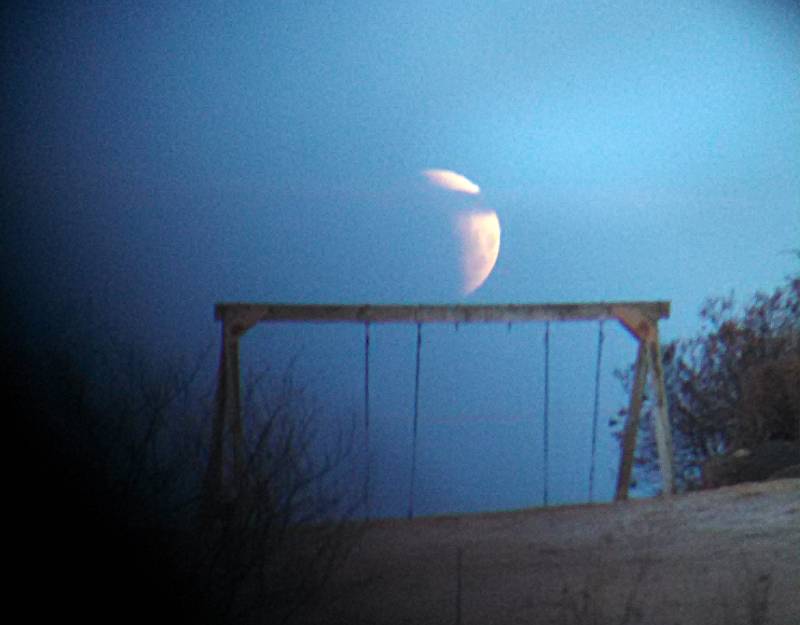
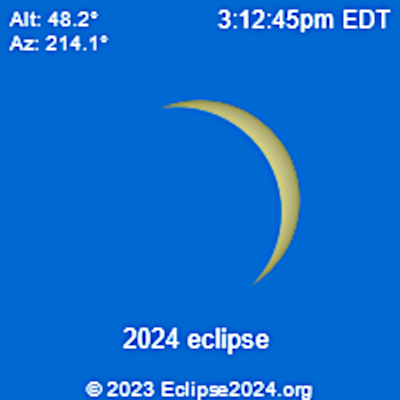
The end of the March 3rd eclipse will look something like this. The totally eclipsed Moon will disappear in twilight. Later the partially illuminated parts of the Moon will appear out of the blue before moonset.
Ephemeris Extra: 01/02/2024 – Two remarkable astronomical events for 2024
Ephemeris Extra posts are freestanding posts not tied to a specific Ephemeris radio program on Interlochen Public Radio
Total Solar Eclipse, April 8th
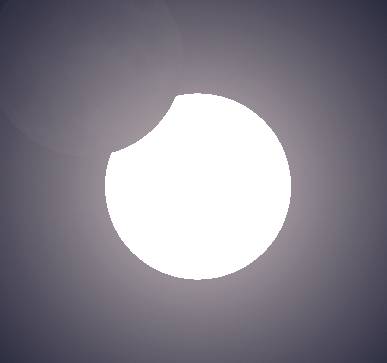
The big astronomical event of 2024, for us in Michigan, will be the total eclipse of the Sun, on the afternoon of Monday, April 8th. The path of totality will just clip the southeastern corner of Michigan by a few miles, so if you want to see the best of totality you need to leave the state. Totality is when the Moon completely covers the brilliant face of the Sun and allows the Sun’s silvery corona to be seen. Totality is the only part of the eclipse that can be viewed without eye protection or by projection.
Two relatively nearby large cities that will see totality are Indianapolis and Cleveland. Parts of Indianapolis will get to see more than 4 minutes of totality. Cleveland will see a little less. The closer you are to the center line of that path the longer totality will last.
For an interactive map of the eclipse path on the Internet, go to eclipse2024.org/eclipse_cities/statemap.html
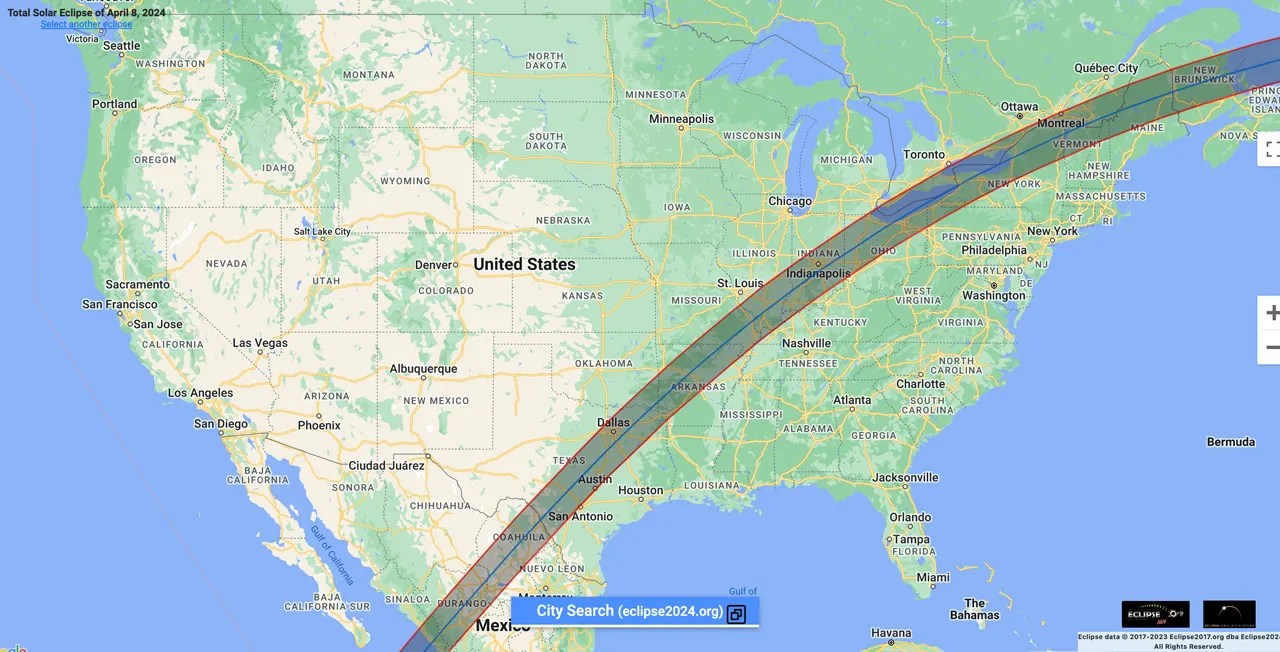
Weather is always a concern for eclipses. In general the farther south one goes the better the chances there are for clear skies. But all bets are off for eclipse day: It’s gonna be is what it’s gonna be. My current inclination is to head southwest along the eclipse path.
For those staying home and not chasing the shadow of the Moon will see a partial eclipse here with up to 87% of the Sun being blocked by the Moon.
Comet Tsuchinshan-ATLAS
We expect to see a new bright comet in October: C/2023 A3 (Tsuchinshan-ATLAS), otherwise known in this article as A3 for short. It may be the brightest comet to appear in our Northern Michigan skies since Comet Hale-Bopp in 1997, and a good deal brighter than 2020’s Comet NEOWISE. At least we’re hoping.
This comet was discovered last January by the station Xi Yi of the Purple Mountain Observatory in China, and a month later by the ATLAS search program on Maui. ATLAS is an acronym for the apocalyptic sounding Asteroid Terrestrial-Impact Last Alert System.
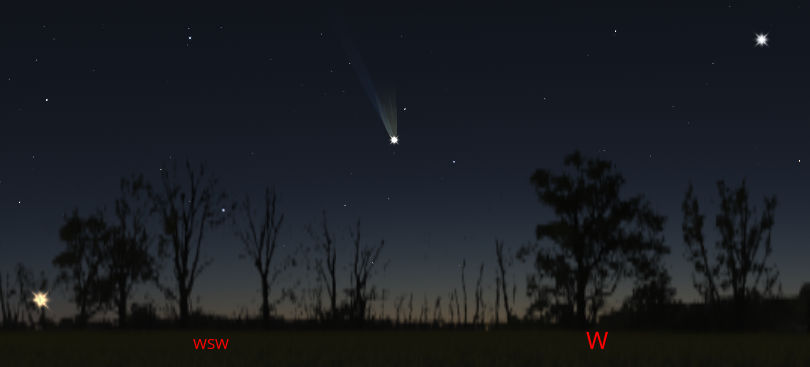
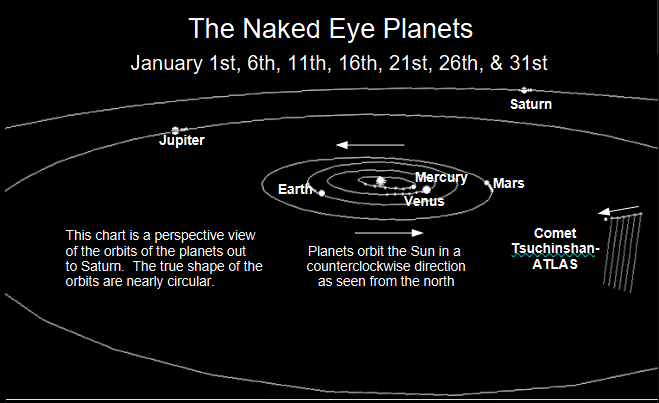
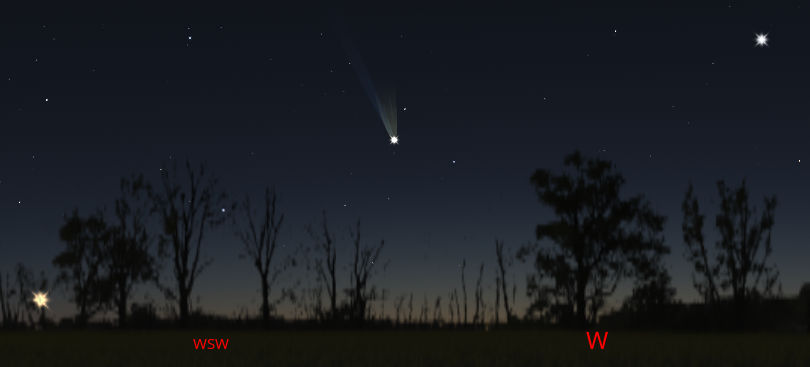
A3 will best be visible from Northern Michigan toward mid-October in the evening, not long after sunset. The comet is expected to reach magnitude 0 at it’s closest to the Sun in late September. However, we will be seeing it best as it’s leaving the vicinity of the Sun. By mid-October its magnitude will have dropped to magnitude 1 which is still pretty bright, and it will be moving at a high angle away from the setting Sun, so it will rapidly increase its distance from the Sun and the horizon faster than it fades in the latter part of October. That is, if it behaves itself. Comets are notoriously fickle in their brightness so we won’t know until we actually see it how bright it’ll be, or how bright or long its tail will be. As of this writing (Mid-December) A3’s brightness is tracking as predicted, at about 16th magnitude. As of January 1st its distance from the Sun was 4.24 AU, about 1 AU inside Jupiter’s orbit. 1 AU (Astronomical Unit) is the mean distance between the Earth and the Sun. The comet can be followed on Seiichi Yoshida’s Weekly Information about Bright Comets webpage: http://www.aerith.net/comet/catalog/2023A3/2023A3.html
Ephemeris: 12/29/2023 – Two great celestial events for 2024
This is Ephemeris for Friday, December 29th. Today the Sun will be up for 8 hours and 50 minutes, setting at 5:10, and it will rise tomorrow at 8:19. The Moon, 3 days past full, will rise at 7:43 this evening.
The year 2024 should give us two great events. The first is a total solar eclipse whose path will pass close to Michigan. It actually clip it by a few miles in the southeast corner of our state on April 8th. The eclipse will be even better here than the August 21st, 2017 eclipse by several percent. About 87% of the Sun will be covered by the Moon in Northern Michigan. In the US the path of totality will run from Texas to Maine, and will pass over the cities of Indianapolis and Cleveland. Then in October a new comet will be in our evening sky, and it might be quite bright. It’s Comet Tsuchinshan-ATLAS. If, and it’s a big IF, its brightness tracks as it has been since its discovery, nearly a year ago, it will rival the average first magnitude star, like Betelgeuse by October, and be easily visible in the west after sunset by mid-month. It won’t be as bright as Comet Hale-Bopp, for those old enough to have seen it in 1997, but hopefully brighter than Comet NEOWISE in the summer of 2020.
The astronomical event times given are for the Traverse City/Interlochen area of Michigan (EST, UT –5 hours). They may be different for your location.
Addendum
01/01/2017 – Happy Ephemeris New Year
Since the month and year starts on a Sunday, and the Ephemeris program is not broadcast on the weekend I will give you some information that will be part of the January preview program that will run on Monday.
NASA Calendar of Planetary Events
Credit: Sky Events Calendar by Fred Espenak and Sumit Dutta (NASA’s GSFC)
To generate your own calendar go to http://eclipse.gsfc.nasa.gov/SKYCAL/SKYCAL.html
Times are Eastern Time and follow the time change dates.
    Date   Time  Event
Jan 01  Su       Venus: 46.8° E
    02  Mo 04:20 Moon-Venus: 2° S
    02  Mo 13:14 Moon Descending Node
    03  Tu 01:47 Moon-Mars: 0.3° S
    03  Tu 09:10 Quadrantid Meteor Shower: ZHR = 120
    04  We 05:59 Perihelion: 0.9833 AU
    05  Th 14:47 First Quarter
    09  Mo 04:03 Mercury-Saturn: 6.7° N
    09  Mo 09:07 Moon-Aldebaran: 0.4° S
    10  Tu 01:07 Moon Perigee: 363200 km
    11  We 04:32 Moon North Dec.: 18.9° N
    12  Th 06:34 Full Moon
    12  Th 07:59 Venus Greatest Elongation: 47.1° East
    14  Sa 23:07 Moon-Regulus: 0.9° N
    15  Su 05:45 Moon Ascending Node
    19  Th 00:26 Moon-Jupiter: 3° S
    19  Th 04:59 Mercury Greatest Elongation: 24.1° West
    19  Th 17:14 Last Quarter
    21  Sa 19:14 Moon Apogee: 404900 km
    24  Tu 05:37 Moon-Saturn: 4° S
    25  We 06:59 Moon South Dec.: 18.9° S
    25  We 19:46 Moon-Mercury: 4° S
    27  Fr 19:07 New Moon
    29  Su 17:21 Moon Descending Node
    31  Tu 01:12 Jupiter-Spica: 3.5° N
    31  Tu 09:34 Moon-Venus: 4.2° N
    31  Tu 20:09 Moon-Mars: 2.4° N
Feb 01  We       Venus: 45.5° E
January 2017 Calendar
LU                  Ephemeris of Sky Events for Interlochen/TC
January, 2017    Local time zone: EST
+-----------------------------------------------------------------------+
| DATE |  SUN     SUN  DAYLIGHT|   TWILIGHT*    |MOON  RISE OR    ILLUM |
|      |  RISE    SET    HOURS |  END    START  |PHASE SET** TIME FRACTN|
+=======================================================================+
|Sun  1| 08:20a  05:13p  08:53 | 06:23p  07:09a |      Set  08:55p   13%|
|Mon  2| 08:20a  05:14p  08:54 | 06:24p  07:09a |      Set  10:00p   21%|
|Tue  3| 08:20a  05:15p  08:55 | 06:25p  07:10a |      Set  11:06p   31%|
|Wed  4| 08:20a  05:16p  08:56 | 06:26p  07:10a |      Set  12:14a   41%|
|Thu  5| 08:19a  05:17p  08:57 | 06:27p  07:10a |F Qtr Set  01:24a   52%|
|Fri  6| 08:19a  05:18p  08:58 | 06:28p  07:09a |      Set  02:35a   63%|
|Sat  7| 08:19a  05:19p  08:59 | 06:29p  07:09a |      Set  03:47a   74%|
+------+-----------------------+----------------+-----------------------+
|Sun  8| 08:19a  05:20p  09:01 | 06:30p  07:09a |      Set  04:58a   83%|
|Mon  9| 08:19a  05:21p  09:02 | 06:31p  07:09a |      Set  06:07a   91%|
|Tue 10| 08:18a  05:22p  09:04 | 06:32p  07:09a |      Set  07:11a   97%|
|Wed 11| 08:18a  05:23p  09:05 | 06:33p  07:09a |      Set  08:07a  100%|
|Thu 12| 08:17a  05:25p  09:07 | 06:34p  07:08a |Full  Rise 06:04p  100%|
|Fri 13| 08:17a  05:26p  09:08 | 06:35p  07:08a |      Rise 07:12p   97%|
|Sat 14| 08:16a  05:27p  09:10 | 06:36p  07:08a |      Rise 08:20p   92%|
+------+-----------------------+----------------+-----------------------+
|Sun 15| 08:16a  05:28p  09:12 | 06:37p  07:07a |      Rise 09:26p   85%|
|Mon 16| 08:15a  05:30p  09:14 | 06:38p  07:07a |      Rise 10:31p   77%|
|Tue 17| 08:15a  05:31p  09:16 | 06:39p  07:06a |      Rise 11:33p   68%|
|Wed 18| 08:14a  05:32p  09:18 | 06:40p  07:06a |      Rise 12:33a   59%|
|Thu 19| 08:13a  05:33p  09:20 | 06:42p  07:05a |L Qtr Rise 01:32a   49%|
|Fri 20| 08:13a  05:35p  09:22 | 06:43p  07:05a |      Rise 02:30a   40%|
|Sat 21| 08:12a  05:36p  09:24 | 06:44p  07:04a |      Rise 03:27a   31%|
+------+-----------------------+----------------+-----------------------+
|Sun 22| 08:11a  05:37p  09:26 | 06:45p  07:03a |      Rise 04:23a   23%|
|Mon 23| 08:10a  05:39p  09:28 | 06:46p  07:03a |      Rise 05:18a   15%|
|Tue 24| 08:09a  05:40p  09:30 | 06:47p  07:02a |      Rise 06:09a    9%|
|Wed 25| 08:08a  05:42p  09:33 | 06:49p  07:01a |      Rise 06:57a    4%|
|Thu 26| 08:07a  05:43p  09:35 | 06:50p  07:00a |      Rise 07:41a    1%|
|Fri 27| 08:06a  05:44p  09:37 | 06:51p  07:00a |New   Set  05:43p    0%|
|Sat 28| 08:05a  05:46p  09:40 | 06:52p  06:59a |      Set  06:45p    1%|
+------+-----------------------+----------------+-----------------------+
|Sun 29| 08:04a  05:47p  09:42 | 06:54p  06:58a |      Set  07:51p    4%|
|Mon 30| 08:03a  05:49p  09:45 | 06:55p  06:57a |      Set  08:58p   10%|
|Tue 31| 08:02a  05:50p  09:47 | 06:56p  06:56a |      Set  10:06p   17%|
+-----------------------------------------------------------------------+
* Nautical Twilight
** Moonrise or moonset, whichever occurs between sunset and sunrise
12/30/2014 – Ephemeris – Looking ahead at some local and space astronomical events in 2015
Ephemeris for Tuesday, December 30th. The sun will rise at 8:19. It’ll be up for 8 hours and 51 minutes, setting at 5:11. The moon, 2 days past first quarter, will set at 3:38 tomorrow morning.
Let’s look ahead at a few astronomical and space events that will take place in 2015. Visible for us will be the partial phase of a lunar eclipse in morning twilight of April 4th, plus there’s a total lunar eclipse visible during the evening hours of September 27th. Out in space in the asteroid belt the Dawn spacecraft will enter orbit of Ceres, the largest asteroid and dwarf planet Ceres, a spherical world of rock and ice in April. Further out past the last planet the New Horizons spacecraft will fly by the dwarf planet Pluto and its system of at least 5 satellites: Charon, Nix, Hydra, Styx, and Kerberos on July 14th. It will take several months to transmit the data and images back to Earth after which the spacecraft will be redirected to a new target.
Times are for the Traverse City/Interlochen area of Michigan. They may be different for your location.
Addendum
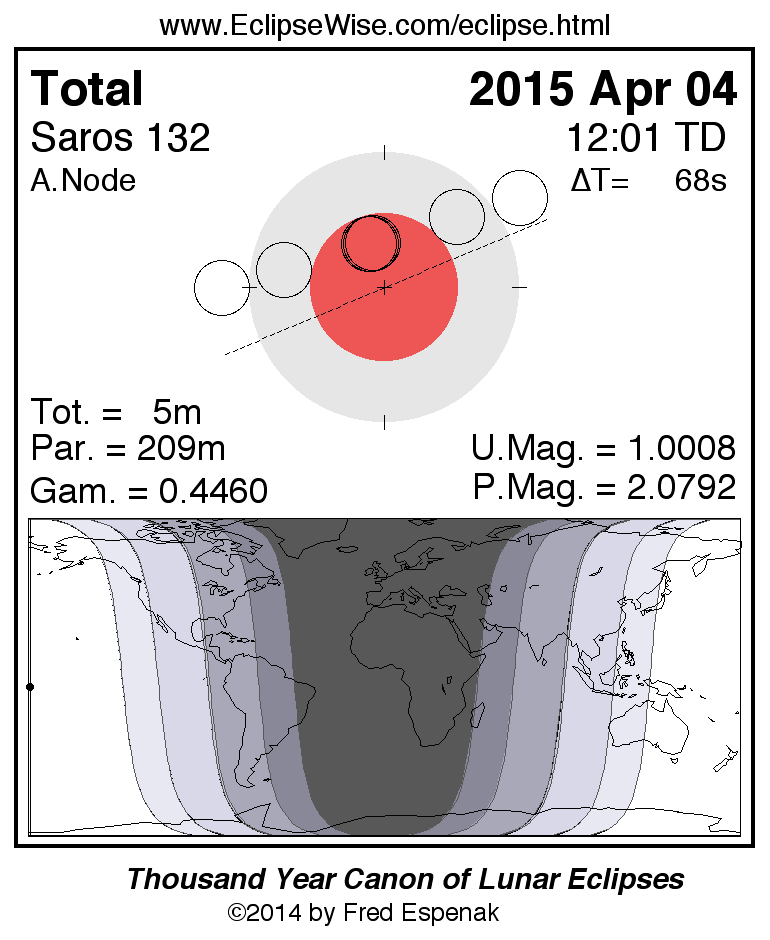
Chart for the total lunar eclipse of April 4, 2015. In Michigan we will see on;y the beginning partial phase in morning twilight. Credit: Fred Espenak, NASA/GSFC
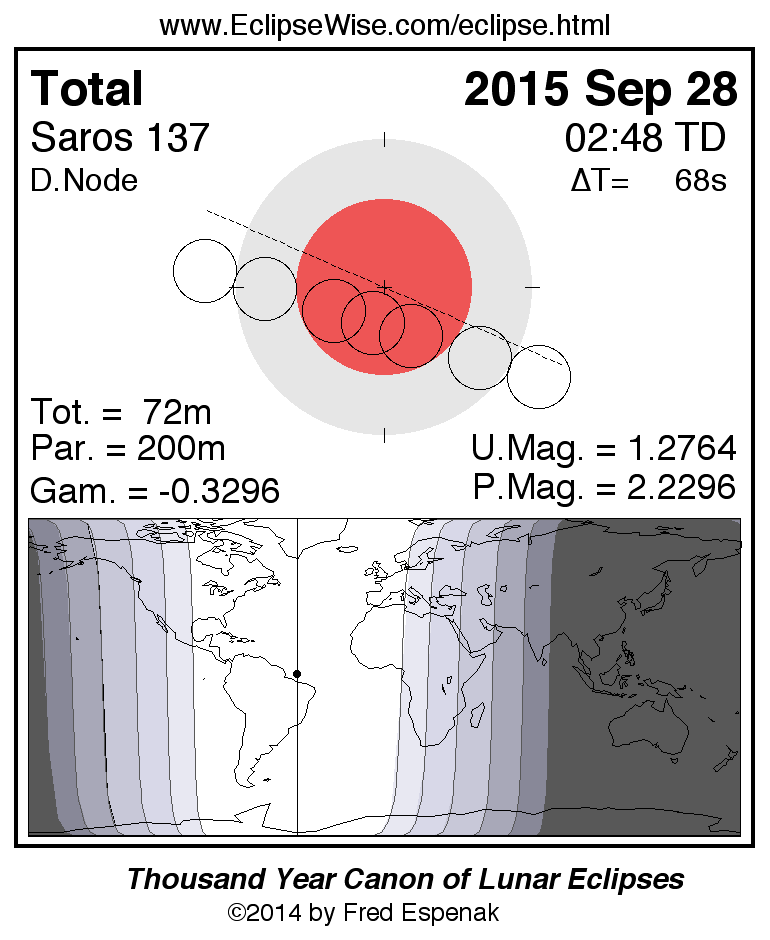
Chart for the total lunar eclipse of September 28, 2015. This is the evening of the 27th, EDT in Michigan. Credit: Fred Espenak, NASA/GSFC.
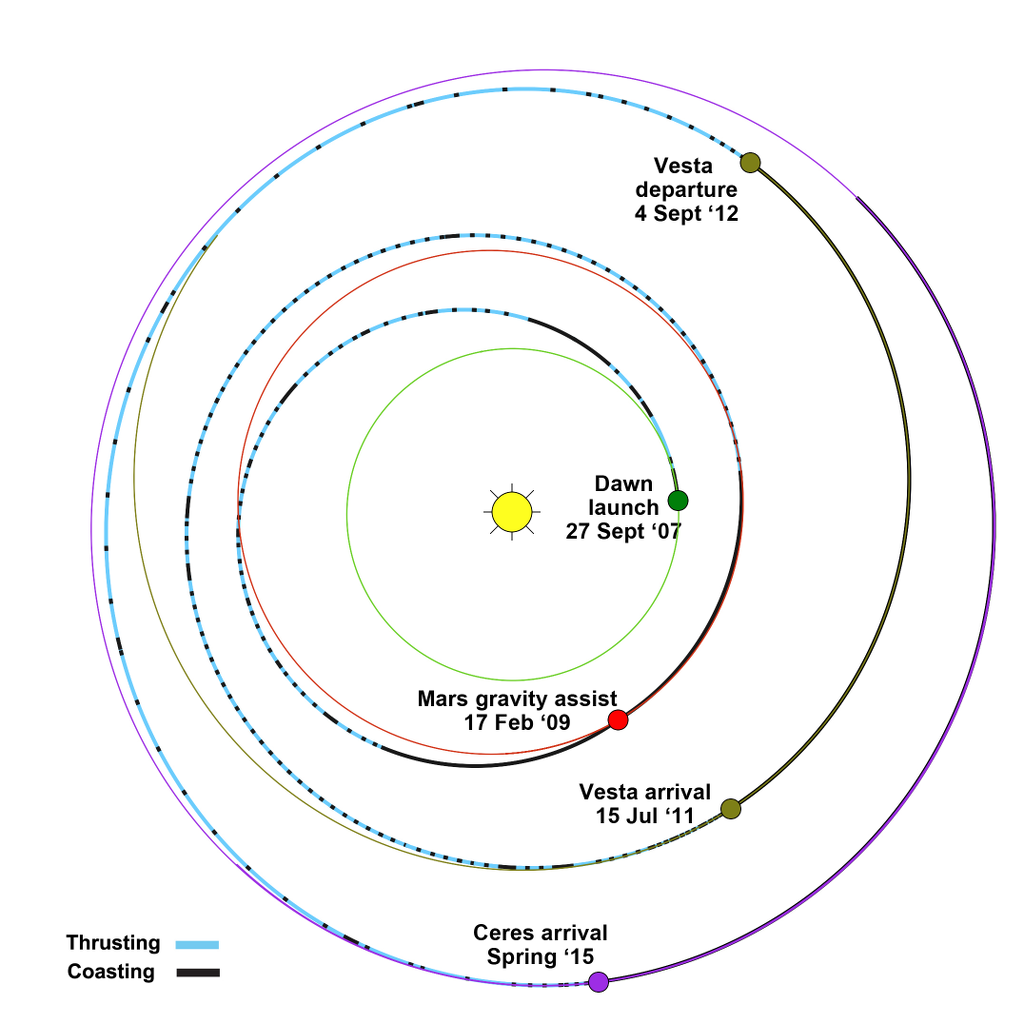
Dawn orbital track past Mars, stopping at Vesta and continuing to Ceres. Credit: NASA/JPL.
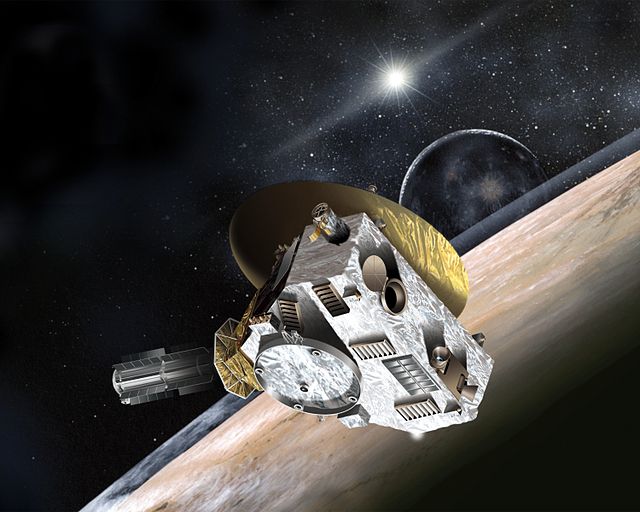
Artist conception of the New Horizons spacecraft at Pluto. Credit: NASA/Johns Hopkins University Applied Physics Laboratory/Southwest Research Institute
01/06/2014 – Ephemeris – It will be a year of eclipses for northern Michigan!
Ephemeris for Monday, January 6th. The sun will rise at 8:19. It’ll be up for 8 hours and 58 minutes, setting at 5:18. The moon, 1 day before first quarter, will set at 12:07 tomorrow morning.
The year 2014 will be a year of eclipses. World wide it will have the minimal number of eclipses possible, four. However, lucky us, we will see three of them if it’s clear, that is. The first is a total eclipse of the moon in the wee morning of Tax Day, April 15th. It will be the best of the three because we will see it from beginning to end. On October 8th we will have another lunar eclipse is the morning. This one will start closer to dawn, so the kids can see this one by getting up early. The total phase will be visible, but the moon will set as the moon is leaving the earth’s shadow. The last will be a partial solar eclipse on October 23rd. when the eclipse will be interrupted by sunset.
Times are for the Traverse City/Interlochen area of Michigan. They may be different for your location.
Addendum
My Article in January’s Stellar Sentinel, the newsletter of the Grand Traverse Astronomical Society.
After a drought in visible eclipses seen from our part of the planet last year and a single partial solar eclipse the year before, we have a chance, weather permitting, to view two total lunar eclipses and the first half of a partial solar eclipse this year. OK, we did have a penumbral lunar eclipse last year, but I usually don’t count penumbral eclipses, since the casual observer may look at the moon and not know they are occurring. They’re what I call a 5 o’clock shadow eclipse, where parts of the moon are illuminated by a partially blocked sun. There is no obvious dragon or Cookie Monster nibbling at the moon.
Eclipse Seasons
In 2014 the two eclipse seasons are in April and again in October. These are about six months apart centered around the moon’s ascending and descending nodes, where the plane of the Moon’s orbit crosses the Earth’s orbital plane when the new moon’s shadow can fall upon the earth and the earth’s shadow can fall on the full moon.
The line of nodes regresses westward or clockwise slowly in an 18.6 year period. That means that the eclipse seasons slowly move backward through the calendar. Every time the sun passes a node there are either two or rarely, three eclipses. Either one each of lunar and solar separated by two weeks from the other. Or, rarely, a central eclipse with 2 weeks before and two weeks later a very partial eclipse near the poles in the case of solar eclipses or penumbral eclipses in the case of lunar eclipses. 2014 is a year of two total lunar eclipses and two partial solar eclipses near the poles.
Saros
A means of predicting eclipses was developed by the Chaldeans in what is now Iraq some centuries before the common era (BC or BCE). The Greeks learned of it. Hipparchus and Ptolemy knew of it. Solar and lunar eclipses repeat every 18 years 11 1/3 days. This cycle was called the Saros by Sir Edmund Halley of Halley’s Comet fame, then Astronomer Royal in England.
The saros is the near coincidence of 3 lunar “months”: the Synodic Month, or lunation the period between new moons; the Draconic Month, the period between the moon’s passage of the ascending node of its orbit as explained above; and the Anomalistic Month, the period between passages of the moon through perigee, the closest point in its orbit to the earth.
The synodic month is on average 29.530589 days, and the basis for the Jewish and Islamic lunar calendars.
The draconic month is 27.212220 days long on average. The ascending node regresses westward, so meets the moon, traveling eastward than the synodic month, where it has to catch up with the eastward moving sun. Remember the dragon eating the sun image from above. The ancients thought a dragon lived at the nodes to devour the Sun or Moon in eclipses. The symbol for the ascending node: is called the Dragon’s Head. For the descending node the symbol is inverted and called the Dragon’s Tail. These symbols may be seen on orbital diagrams.
The anomalistic month is 27.554551 days. In celestial mechanics an anomaly doesn’t means anything is wrong, it’s the angle between, in the case of the moon, the perigee of its orbit and the position of the moon as seen from the earth. It has to do with the perigee and that’s why it’s used.
It turns out that:
223 Synodic Months = 6585.322 days
242 Draconic Months = 6585.8 days
239 Anomalistic months = 6585.5 days
Thus the Saros cycle is 6585.322 days long, or 18 years 11 1/3 days, meaning that the next eclipse of that Saros occurs a third of the earth in longitude west of the previous eclipse. It takes three saros cycles for an eclipse to repeat near the same longitude. For instance, my first total solar eclipse was viewed from Quebec on July 20, 1963. The third Saros of that eclipse will occur on August 21, 2017. I expect to be around to see that, my 5th total solar eclipse. The path will shift southward and be seen across the continental United States.
There are something like 40 Saros cycles active at one time. Eclipses at the descending node head southward each eclipse, while those at the ascending node move northward.
The Eclipses of 2014
Here are the dates of the eclipses:
Total Lunar Eclipse April 15, 2014
Total Lunar Eclipse October 8, 2014
Partial Solar Eclipse October 23, 2014
Interestingly, all these eclipses will occur in the western part of the sky for us in northern Michigan. Both October eclipses will end with the eclipsed body setting before the official end of the eclipse. This means that both lunar eclipses are early morning eclipses and the solar eclipse will be a late afternoon eclipse.
Lunar eclipses start and end with the moon traveling through the earth’s penumbral shadow. It’s been my experience that this shadow only becomes visible in the half hour before and after the partial phases of the eclipse. The partial phase of the Tuesday April 15th lunar eclipse will start at 1:58 a.m., totality starts at 3:06 and ends at 4:24; with the partial phase ending at 5:33 as twilight begins to brighten.
The Wednesday October 8th lunar eclipse will start later in the morning. The partial phase will start at 5:14 a.m. Totality will run from 6:25 to 7:24 a.m. all in the growing morning twilight. Sunrise and moonset will interrupt the eclipse by 7:57.
The partial solar eclipse is on Thursday October 23. The eclipse will begin around 5:33 p.m. for Traverse City with sunset at 6:44. Times and whether the eclipse is visible at all depend on the location of the observer.
NASA diagrams, maps, and more information on these eclipses can be found here.
12/31/2012 – Ephemeris – Looking at the prospective comets of 2013
Ephemeris for New Years Eve, Monday, December 31st. The sun will rise at 8:19. It’ll be up for 8 hours and 53 minutes, setting at 5:12. The moon, 3 days past full, will rise at 8:51 this evening.
As we enter a new year tonight, let\s look ahead at what we expect to see in the skies in 2013. The big events next year will be two comets that could be quite bright. Mid-March will bring Comet PanSTARRS to the evening sky. This is a first time comet for astronomers, so its behavior may be unpredictable, but it is currently sticking to brightness projections and may be as bright as the brightest stars at its brightest. The second comet is Comet ISON. This will fly close to the sun on November 28th. It could disintegrate, its nucleus could split into multiple pieces, or it could survive intact. The last two scenarios will give us a bright morning comet in early December. So may we have a happy comet new year.
Times are for the Traverse City/Interlochen area of Michigan. They may be different for your location.
Addendum
Here are two links to the website of Seiichi Yoshida for each of the comets. Most revealing at this point are the magnitudes graphs showing the actual brightness measurements as black dots with the predicted magnitudes as an orange line, The vertical line is the perihelion date, the date the comet is closest to the sun. Comet ISON has a second magnitude graph for when the comet is closest the sun and may become bright enough to be seen in the daytime.
Magnitudes are like golf scores, the lower the number the better, or in this case brighter the comet is. the Faintest star visible to the naked eye is 6th magnitude. Jupiter is usually around -2, Venus -4, and the sun -26. As you can see from the scatter of the actual brightness estimates, pinning down the brightness of a fuzzy comet is rather difficult. Comets generally appear dimmer than their magnitudes would suggest.
Here are the ;inks:
12/30/11 – Ephemeris – The best 2012 astronomical events
Friday, December 30th. The sun will rise at 8:19. It’ll be up for 8 hours and 51 minutes, setting at 5:10. The moon, 2 days before first quarter, will set at 12:02 tomorrow morning.
Let’s look ahead at next year’s astronomical events for this last Ephemeris of 2011. What won’t happen will be the end of the world on December 21st. There is no planet Nibiru. The closest alignment of the sun at the winter solstice and the center of the galaxy was in 1997. What will happen is partial eclipse of the sun, or about a half hour of it, before sunset on May 20th. An extremely rare transit of Venus, that is the planet Venus will cross the face of the sun on June 5th for us. We’ll see about 3 hours of it before sunset that day. The sun will continue to be more active next year with more sunspots and more displays of the northern lights. It will also be a good year for the Perseid meteor shower of August and the Geminids of December.
* Times, as always are for the Traverse City/Interlochen area of Michigan.
 Bob Moler's Ephemeris Blog