Archive
01/14/2019 – Ephemeris – New Horizons returned first images of Ultima Thule
Ephemeris for Monday, January 14th. The Sun will rise at 8:17. It’ll be up for 9 hours and 9 minutes, setting at 5:26. The Moon, at first quarter today, will set at 2:04 tomorrow morning.
On January 1st, just after midnight eastern time the New Horizons spacecraft made its closest pass of the small Kuiper Belt Object 2014 Mu69, nicknamed Ultima Thule. At just about 10:30 that morning the expected phone home came back over 4 billion miles, and 6 hours travel time from a 15 watt transmitter on the spacecraft. New Horizons was in perfect health an its data recorders were full. It will take 20 months at a thousand bits per second to relay all that information back to Earth. Though we’ll get better pictures to come, Ultima Thule is a contact binary of two nearly spherical bodies that collided very gently. It looks like a snowman of reddish-brown snow. It fits the silhouette made by it passing in front of a star back in 2017.
The times given are for the Traverse City/Interlochen area of Michigan. They may be different for your location.
Addendum
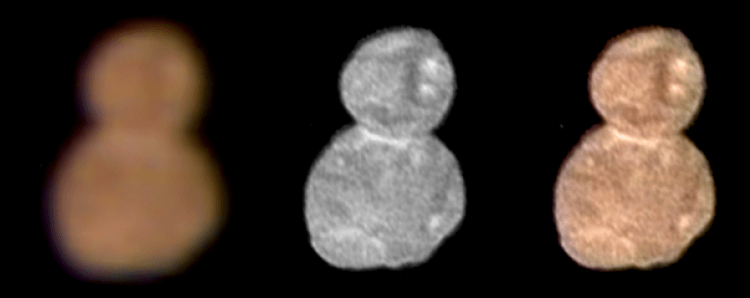
Ultima Thule on approach combing a low resolution color image with the high resolution monochromatic image shows the body in almost true color. Credit NASA/JHUAPL/SwRI
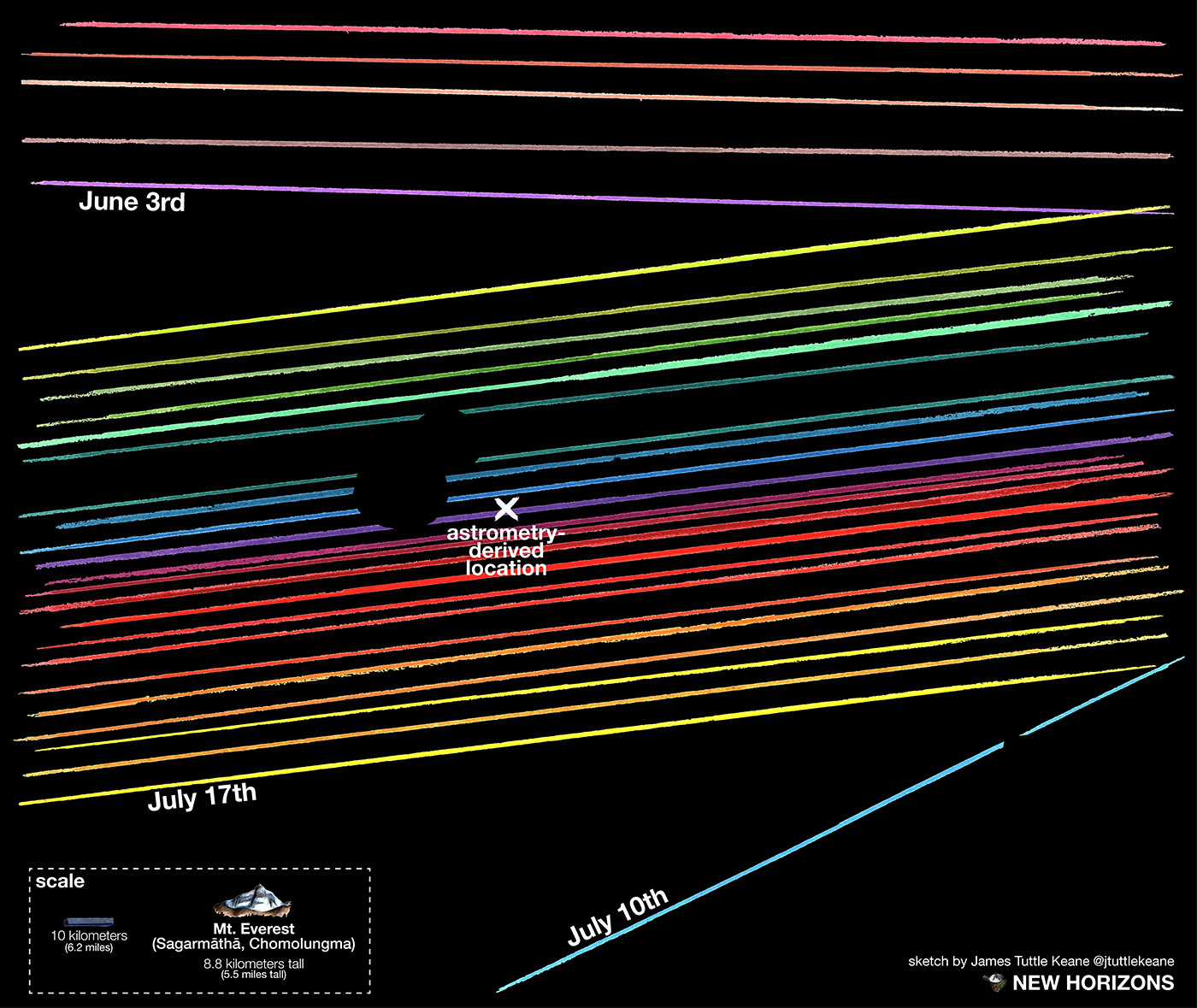
Pre-encounter occultation attempts of Ultima Thule. Continued caption from the Vatican Observatory Foundation Blog: “The colored lines mark the path of a star as seen from different telescopes on each day; the blank spaces on those lines indicate the few seconds when MU69 blocked the light from the star. Credit: NASA / JHUAPL / SwRI / James Tuttle Keane”
Note from the image: The term “astrometry” (pronounced as-trom-e-try) is the science of measuring the precise positions and motions of celestial bodies.
The New Horizons spacecraft went into solar conjunction from January 4th to the 9th. Meaning it was too close to the direction of the Sun to send of receive data due to the Sun’s radio interference. On the night of the 9th I noticed that on the DNS-Now website that the big antenna at Canberra Australia was in contact with it. So more data is flowing down!
12/31/2018 – Ephemeris – New Year 2019 – A new solar system body is being explored right now!
Ephemeris for New Years Eve, Monday, December 31st. The Sun will rise at 8:20. It’ll be up for 8 hours and 51 minutes, setting at 5:11. The Moon, 2 days past last quarter, will rise at 3:54 tomorrow morning.
Later tonight the New Horizons spacecraft, which flew by Pluto and its retinue of moons, will fly by Kuiper Belt Object (KBO) 2014 MU69, nicknamed Ultima Thule. It’s probably an odd looking contact binary body with lobes 12 ½ and 11 miles (20 & 18 km) in diameter. That’s the guess as of a week ago. It will pass this body by 1,366 miles (2200 km), traveling at over 32 thousand miles an hour (52,000 kph). The spacecraft will pass closest approach at 33 minutes after the ball drops in Times Square. Nearly 4 hours later it will phone home. We won’t receive that message here on Earth until 10:28 a.m. due to the over 6 hours of time it takes the radio signal to reach Earth. We should get the first images by tomorrow night. The New Horizons spacecraft was built and is flown by Johns Hopkins Applied Physics Laboratory (JHAPL) is collaboration with NASA and the Southwest Research Institute (SwRI).
The times given are for the Traverse City/Interlochen area of Michigan. They may be different for your location.
Addendum
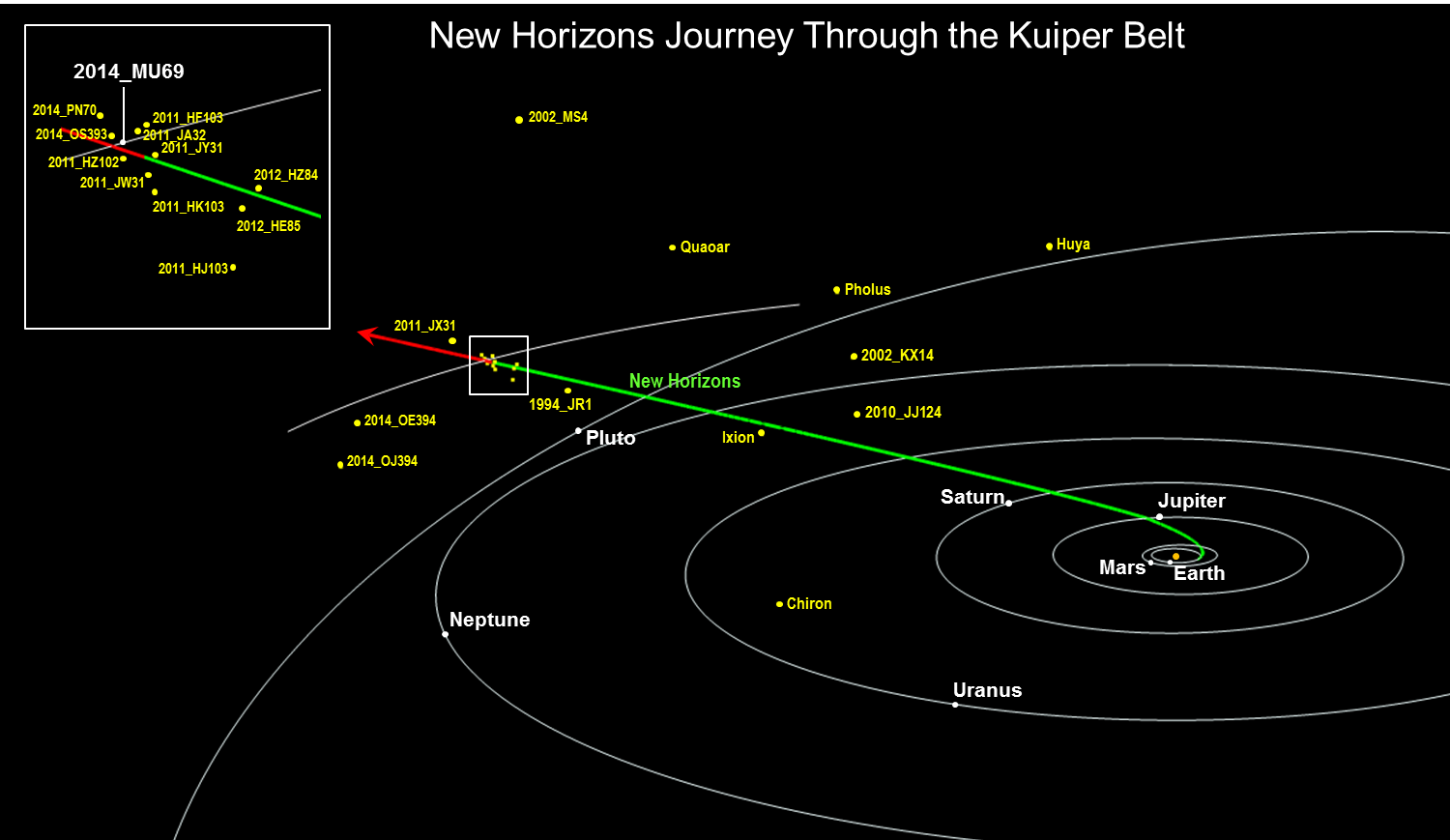
The Trajectory and position of New Horizons as it approached 2014 MU69 two months ago showing some of the KBOs recently discovered near its path. Credit JHAPL.
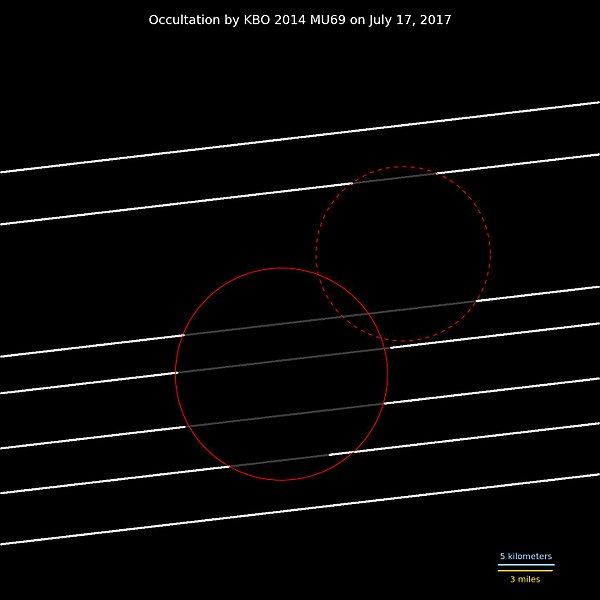
Silhouette of KBO 2014 MU69 (Ultima Thule) created by occultation timings on July 17, 2017 from southern Argentina. Credit NASA/JHUAPL/SwRI/Alex Parker.
Links to information can be found here: http://pluto.jhuapl.edu/News-Center/Where-to-Watch.php.
A cool app to follow New Horizons in real-time or to preview its passage of Ultima Thule is NASA’s Eyes: https://eyes.nasa.gov/.
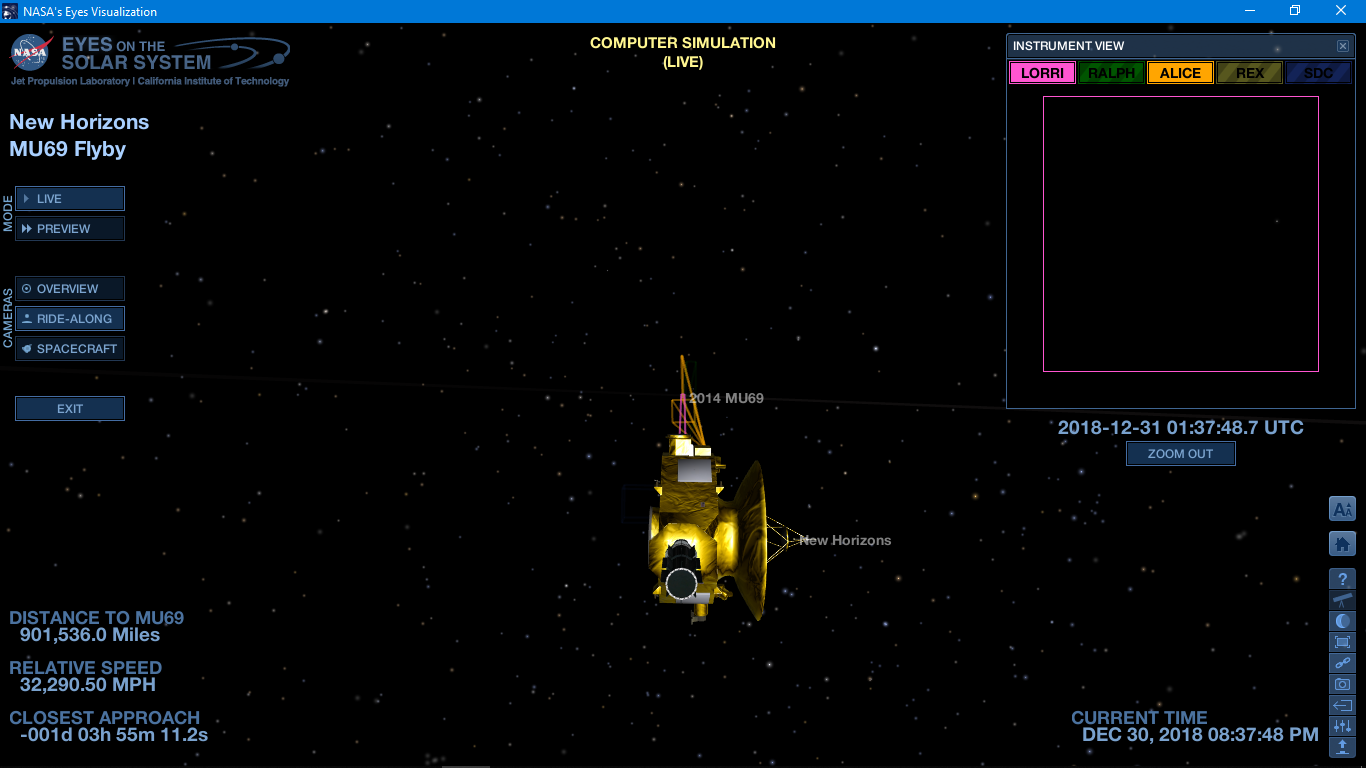
NASA’s Eyes screen Captured as a real-time simulation as I write this post. At this time two instruments are active, LORRI the long-range imager and ALICE the Ultraviolet imaging spectrometer. Click on the image to enlarge. Credit NASA/JPL
 Bob Moler's Ephemeris Blog