Archive
Ephemeris: 07/10/2025 – More news about potentially hazardous asteroid 2024 YR4
This is Ephemeris for Thursday, July 10th. Today the Sun will be up for 15 hours and 21 minutes, setting at 9:28, and it will rise tomorrow at 6:08. The Moon, at full today, will rise at 9:58 this evening.
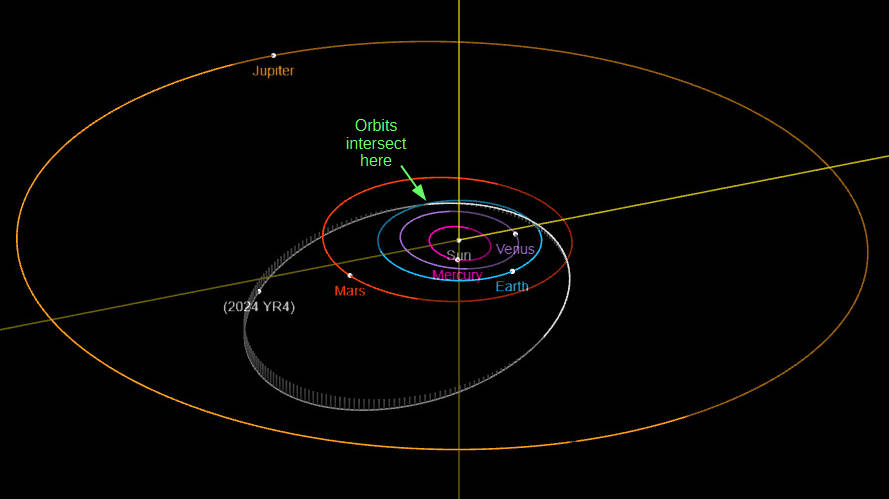
In recent programs I’ve talked about an asteroid, 2024 YR4, that has a 4% chance of hitting the Moon in 2032, and the possibility that debris from the lunar impact would make it all the way back to the Earth and cause problems with our satellites. The asteroid is too far away now to for further observations, so that’s where the probability stands. The asteroid has a four-year orbit of the Sun so toward the latter part of the year 2028 it should again be in range for astronomers to observe and refine its orbit to see if the probability of striking the Moon increases or even decreases. According to a recent paper about the ejecta from the impact, there seems a better chance of earthward debris if the asteroid hits the trailing part of the Moon, that is its right side as we see it.
The astronomical event times given in this blog are for the Traverse City/Interlochen area of Michigan (Lat 44.7° N, Long 85.7° W; EDT, UT – 4 hours) unless stated otherwise. Times will be different for other locations.
Addendum
Ephemeris: 06/30/2025 – Asteroid hitting the Moon in 2032 may cause spectacular meteor shower and danger to satellites
This is Ephemeris for International Asteroid Day, Monday, June 30th. Today the Sun will be up for 15 hours and 31 minutes, setting at 9:32, and it will rise tomorrow at 6:01. The Moon, 2 days before first quarter, will set at 12:46 tomorrow morning.
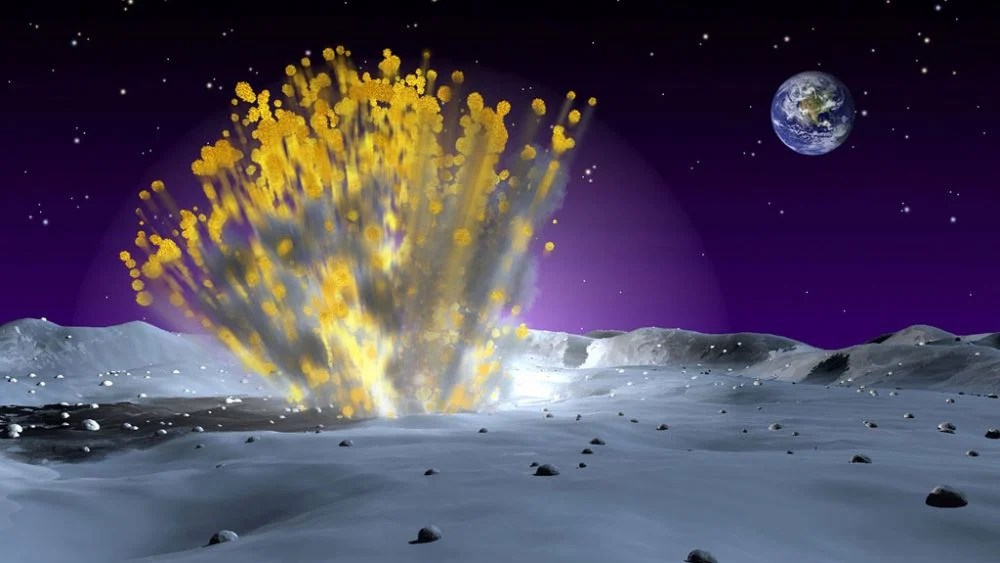
This is the 117th anniversary of the Tunguska Event, an asteroid strike that hit Siberia in 1908. An asteroid, thought to be of similar size, will pass close to the Earth, but has a 4% chance of hitting the Moon on December 22nd 2032. The asteroid was discovered near the end of last year and has the designation 2024 YR4. For a while there was a fear that this asteroid might hit the Earth. However, it was soon found that the asteroid would not hit the Earth but had a chance of hitting the Moon. Recently a paper was written that looked at what would happen to the ejecta of an impact of this asteroid on the Moon. It could be a hazard to the satellites orbiting the Earth.
The astronomical event times given in this blog are for the Traverse City/Interlochen area of Michigan (Lat 44.7° N, Long 85.7° W; EDT, UT – 4 hours) unless stated otherwise. Times will be different for other locations.
Addendum
Further reading
The Mother of All Meteor Showers Could Threaten Satellites By Evan Gough, Universe Today
Original paper: The Potential Danger to Satellites due to Ejecta from a 2032 Lunar Impact by Asteroid 2024 YR4 by Paul Wiegert et al.
Ephemeris: 03/04/2025 – Looks like asteroid 2024 YR4 will miss the Earth
This is Ephemeris for Fat Tuesday, March 4th. Today the Sun will be up for 11 hours and 20 minutes, setting at 6:35, and it will rise tomorrow at 7:12. The Moon, 2 days before first quarter, will set at 1:02 tomorrow morning.
I’ve got some good news for a change. The recently discovered small asteroid with the provisional designation 2024 YR4 it’s not going to hit the Earth on December 22nd, 2032. More precisely the percentage chance of hitting the Earth is now down to four thousandths of a percent. The recalculation was due to observations from the Subaru Telescope in Hawaii. Three separate organizations calculated the chances of the asteroid to hit. That means this number is of very high confidence. The new center of the locus that they calculated for the asteroid’s passage by the Earth now comes closer to the orbit of the Moon than it does the Earth. So that’s one less thing to worry about, although astronomers will be keeping tabs on it.
The astronomical event times given are for the Traverse City/Interlochen area of Michigan (EST, UT – 5 hours). Times will be different for other locations.
Addendum
Ephemeris: 02/11/2025 – Newly discovered asteroid may have our number
This is Ephemeris for Tuesday, February 11th. Today the Sun will be up for 10 hours and 17 minutes, setting at 6:06, and it will rise tomorrow at 7:47. The Moon, 1 day before full, will set at 8:06 tomorrow morning.
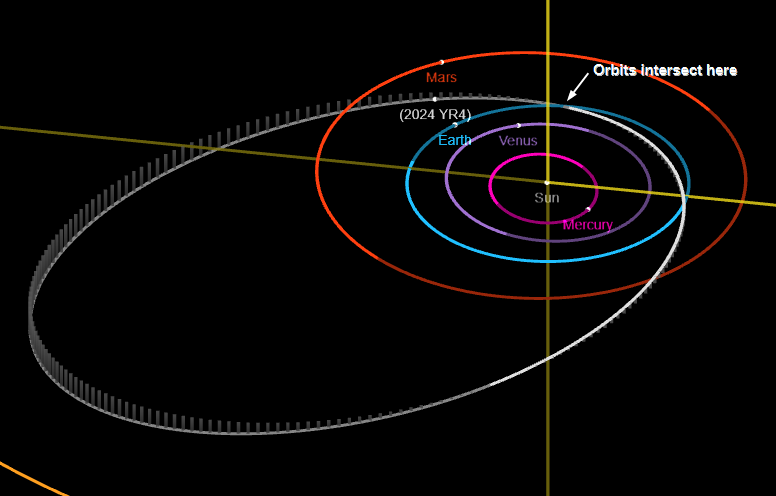
Late last year a tiny asteroid was found because it was close to the Earth and given the designation 2024 YR4. After observing it for a month it was discovered that it had a 1½ % chance of hitting the Earth when it came around again in 2032. Remember the fireball that exploded over Chelyabinsk Russia almost exactly 10 years ago? It exploded high in the air, and caused flying glass injuries to over a thousand people who saw the flash and rushed to the windows to see it when the atmospheric shock wave arrived. This object appears to be about 3 times the size of that object, nearly a football field in diameter, and thus could be 27 times the mass and volume. It’s four year orbit of the Sun will bring it back close to Earth in 2028 for us to get a better look at it and its orbit, and the last chance to alter its orbit.
The astronomical event times given are for the Traverse City/Interlochen area of Michigan (EST, UT – 5 hours). Times will be different for other locations.
Addendum
 Bob Moler's Ephemeris Blog