Archive
03/18/2013 – Ephemeris – Comet PanSTARRS, the view from Stereo B
Ephemeris for Monday, March 18th. The sun will rise at 7:48. It’ll be up for 12 hours and 3 minutes, setting at 7:52. The moon, 1 day before first quarter, will set at 2:54 tomorrow morning.
Comet PanSTARRS is now a prominent part of our twilight after sunset. It should be visible from maybe 8:40 until 9:41 p.m. when it sets, clear skies and a low horizon willing. Photographs are coming in from all over, including a time lapse movie from the satellite Stereo B, which is now nearly behind the sun looking back at the comet and the earth in the background. The dust tail of the comet was being ejected in sheets, possibly due to the rotation of the comet’s nucleus. Comets generally eject gas and dust from one of more hot spots. When rotated toward the sun they become active and begin to spew gas and dust. When rotated away, they become quiet once again. It looks like Comet PanSTARRS is matching its original brightness estimates.
Times are for the Traverse City/Interlochen area of Michigan. They may be different for your location.
Addendum
The video from Stereo B can be found here:
and here:
http://stereo.gsfc.nasa.gov/gallery/item.php?id=selects&iid=182
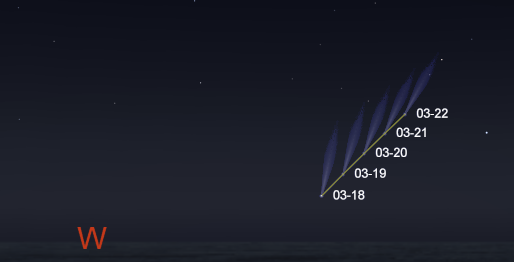
Comet PanSTARRS in the next 5 days at 9:15 p.m. Created using Stellarium and Cartes du Ciel.
03/01/2013 – Ephemeris – Astronomical events in Traverse City tonight
Ephemeris for Friday, March 1st. The sun will rise at 7:19. It’ll be up for 11 hours and 11 minutes, setting at 6:30. The moon, 3 days before last quarter, will rise at 11:16 this evening.
Yours truly will present a talk, about the prospects for viewing Comet PanSTARRS at this evening’s meeting of the Grand Traverse Astronomical Society at Northwestern Michigan College’s Rogers Observatory starting at 8 p.m. Comet PanSTARRS will appear low in the western sky starting about March 11th. It is turning out at this point in time to be somewhat dimmer than expected. But one thing about comets is that the do the unexpected. I’ll also look at the asteroid close approach and the destructive Russian meteor. Starting at 9 p.m. Is our February star party at the observatory. Highlights, if its clear will be the planet Jupiter and the wonders of the winter sky including the Great Orion Nebula. All are welcome.
Times are for the Traverse City/Interlochen area of Michigan. They may be different for your location.
02/28/2013 – Ephemeris – Previewing March Skies
Ephemeris for Thursday, February 28th. The sun will rise at 7:21. It’ll be up for 11 hours and 8 minutes, setting at 6:29. The moon, 3 days past full, will rise at 10:06 this evening.
Let’s preview the month of March which begins tomorrow. This month the increase in daylight hours is at its greatest, with Spring 3 weeks away. Daylight hours will increase from 11 hours and 11 minutes tomorrow to 12 hours and 44 minutes on the 31st. Along with that the altitude of the sun at noon will increase from 38 degrees today to 49 ½ degrees at month’s end. Local noon, by the way for Interlochen and Traverse City is about 12:50 p.m, which is mainly due to the fact that our standard time meridian happens to run through Philadelphia. That’s before daylight time starts next week. The big astronomical event this month be the appearance of Comet PanSTARRS in the evening. Spring starts on the 20th.
Times are for the Traverse City/Interlochen area of Michigan. They may be different for your location.
Addendum
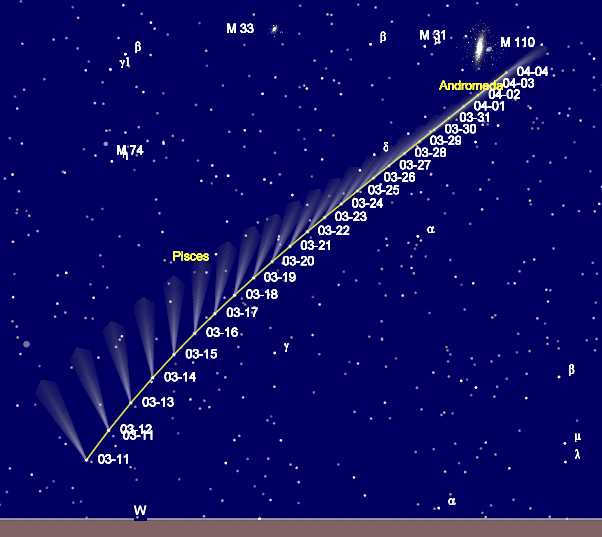
Comet PanSTARRS path in the March evening sky. Created using Cartes duCiel.
Cartesn duCiel doesn’t do twilight. The comet will be in twilight through out March.
12/31/2012 – Ephemeris – Looking at the prospective comets of 2013
Ephemeris for New Years Eve, Monday, December 31st. The sun will rise at 8:19. It’ll be up for 8 hours and 53 minutes, setting at 5:12. The moon, 3 days past full, will rise at 8:51 this evening.
As we enter a new year tonight, let\s look ahead at what we expect to see in the skies in 2013. The big events next year will be two comets that could be quite bright. Mid-March will bring Comet PanSTARRS to the evening sky. This is a first time comet for astronomers, so its behavior may be unpredictable, but it is currently sticking to brightness projections and may be as bright as the brightest stars at its brightest. The second comet is Comet ISON. This will fly close to the sun on November 28th. It could disintegrate, its nucleus could split into multiple pieces, or it could survive intact. The last two scenarios will give us a bright morning comet in early December. So may we have a happy comet new year.
Times are for the Traverse City/Interlochen area of Michigan. They may be different for your location.
Addendum
Here are two links to the website of Seiichi Yoshida for each of the comets. Most revealing at this point are the magnitudes graphs showing the actual brightness measurements as black dots with the predicted magnitudes as an orange line, The vertical line is the perihelion date, the date the comet is closest to the sun. Comet ISON has a second magnitude graph for when the comet is closest the sun and may become bright enough to be seen in the daytime.
Magnitudes are like golf scores, the lower the number the better, or in this case brighter the comet is. the Faintest star visible to the naked eye is 6th magnitude. Jupiter is usually around -2, Venus -4, and the sun -26. As you can see from the scatter of the actual brightness estimates, pinning down the brightness of a fuzzy comet is rather difficult. Comets generally appear dimmer than their magnitudes would suggest.
Here are the ;inks:
11/02/2012 – Ephemeris – Astronomy tonight!
Ephemeris for Friday, November 2nd. The sun will rise at 8:22. It’ll be up for 10 hours and 7 minutes, setting at 6:29. The moon, half way from full to last quarter, will rise at 9:10 this evening.
Previewing the comets of 2013 will be the topic at the Grand Traverse Astronomical Society’s monthly meeting at 8 p.m. at Northwestern Michigan College’s Rogers Observatory. The program will be given by yours truly. Next year we may be treated by the possibility of two bright comets: PanSTARRS and ISON The questions isn’t will they arrive, they will; but how bright will they be. ISON in particular, could be spectacular. Starting at 9 p.m. will be the monthly viewing night at the observatory. On tap if its clear will be the galaxies of fall along with Jupiter and the moon rising. The Observatory is located south of Traverse City on Birmley Road off either Garfield or Keystone roads.
Times are for the Traverse City/Interlochen area of Michigan. They may be different for your location.
10/02/2012 – Ephemeris – Two bright comets next year, maybe?
Ephemeris for Tuesday, October 2nd. The sun will rise at 7:42. It’ll be up for 11 hours and 38 minutes, setting at 7:20. The moon, 3 days past full, will rise at 8:23 this evening.
It looks like we’ll have possibly two comets to grace our skies next year. These are first time comets and there is trouble with predicting their brightness. We can make a guess when we see them far from the sun, but that doesn’t always pan out. The first comet to be seen will be Comet 201l L4, named PANSTARRS. It will reach its closest to the sun on April 17th. It was discovered with the Pan-STARRS telescope in Haleakala, Hawaii. It could optimistically be as bright as the star Vega. The second was Comet 2012 S1 ISON (I hope that’s how it’s pronounced) discovered on September 21st, 10 days ago. This comet has the added problem. On November 29th, 2013 it will pass a million miles from the center of the sun, and may not survive.
Times are for the Traverse City/Interlochen area of Michigan. They may be different for your location.
Addendum
Here’s some information on these comets from Gary Kronk’s Cometography: http://cometography.com/current_comets.html
 Bob Moler's Ephemeris Blog