Archive
04/24/2015 – Ephemeris – The Dawn spacecraft is descending to dwarf planet Ceres’ day side
Ephemeris for Arbor Day, Friday, April 24th. Today the Sun will be up for 13 hours and 54 minutes, setting at 8:38. The Moon, 1 day before first quarter, will set at 2:26 tomorrow morning. Tomorrow the Sun will rise at 6:42.
The Dawn spacecraft with its ion engine is descending into orbit of that other dwarf planet Ceres, the largest body in the asteroid belt. Over the past month Dawn has been maneuvering over Ceres’ night side to descend into a polar orbit to better survey the planet. Last week the Jet Propulsion Laboratory team that has been operating the spacecraft released a video of several photographs of Ceres’ pole as it rotated. It was still a crescent view, but soon we’ll see Ceres up close and very personal. We’ll get a closer look at those enigmatic white spots. Are they just white ice patches on the surface, or are they ice cryovolcanoes spewing water, or something else? Stay tuned.
Times are for the Traverse City/Interlochen area of Michigan. They may be different for your location.
Addendum
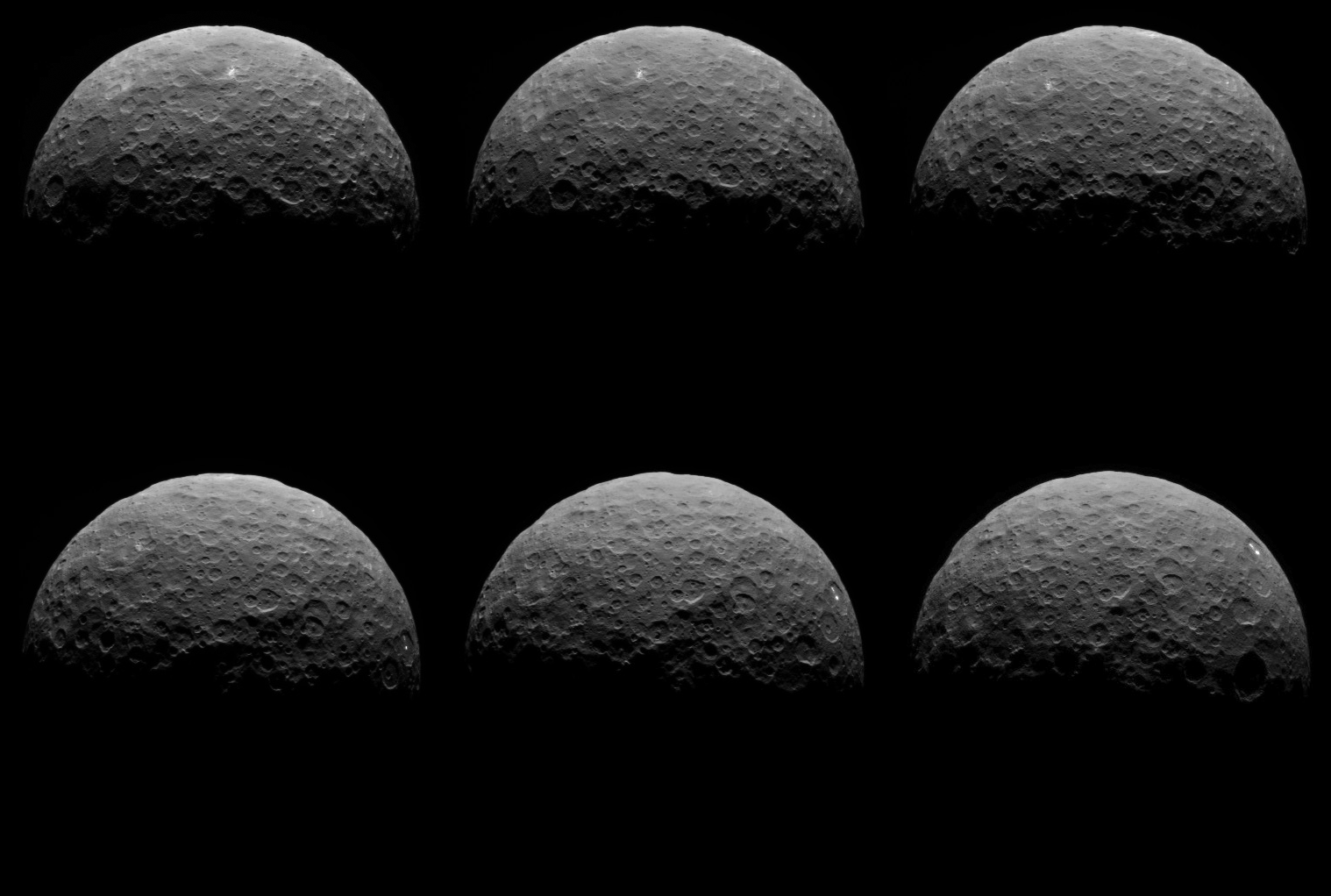
Ceres animation from April 14-15, 2015. Dawn was 14,000 miles (22,000 km) from Ceres. Credit: NASA/JPL-Caltech/UCLA/MPS/DLR/IDA. Click the image to enlarge.
This is a newer animation than the one mentioned in the transcript above that was actually written on the 19th. Here’s a link to the NASA page that describes the image. It also has a link to an enlarged frame containing the double bright spot.
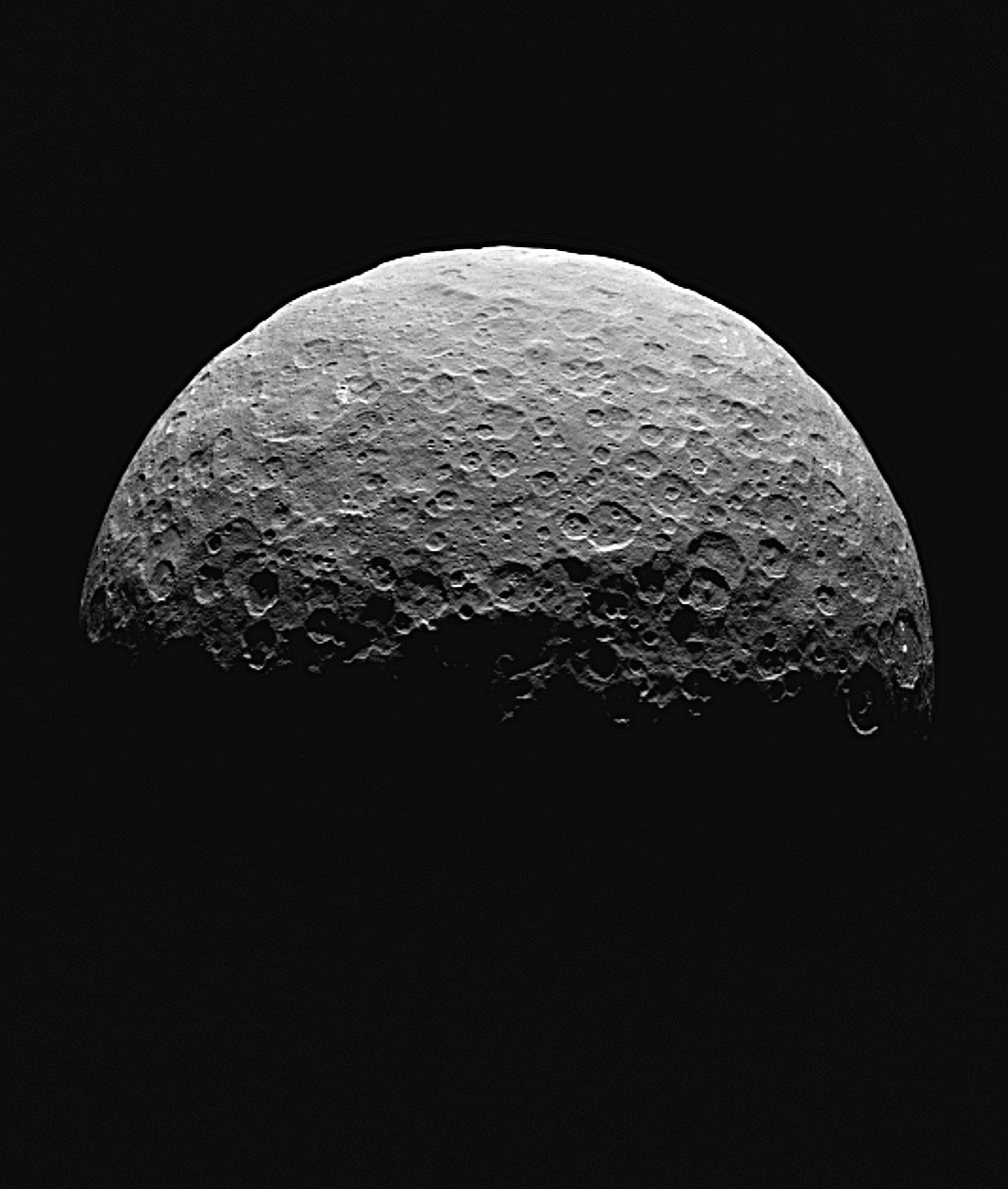
This is a processed still image of Ceres from the above animated sequence of images.
Credit: NASA/JPL-Caltech/UCLA/MPS/DLR/IDA
There’s no help figuring out what they are but the smaller spot is resolved into two spots. The bright one is still unresolved. As of yesterday the Dawn spacecraft should be in its first circular orbit of Ceres at an altitude of 8,400 miles (13,500 km) from Ceres for a few weeks before descending to a lower orbit of Ceres the starting the first week in May.
02/13/2014 – Ephemeris – Dwarf planet Ceres is the next stop for the Dawn spacecraft.
Ephemeris for Thursday, February 13th. The sun will rise at 7:45. It’ll be up for 10 hours and 22 minutes, setting at 6:08. The Moon, 1 day before full, will set at 7:10 tomorrow morning.
The Dawn spacecraft is in the asteroid belt. After spending a year orbiting the asteroid Vesta two years ago, it has set its sights on Ceres, the largest asteroid, which was promoted by the same reasoning that Pluto was demoted, as a dwarf planet. Recently it was announced that Ceres is out-gassing water molecules. Dawn, with its ion engine is slowly approaching Ceres and will enter orbit of the body in April next year, a few months before the new Horizons spacecraft will fly by the dwarf planet Pluto on Bastille Day 2015. Dawn will stay in orbit of Ceres for a year at least. It will take at least several months to download all the images and data from the Pluto encounter from New Horizons, so we will have a very eventful 2015.
Times are for the Traverse City/Interlochen area of Michigan. They may be different for your location.
Addendum
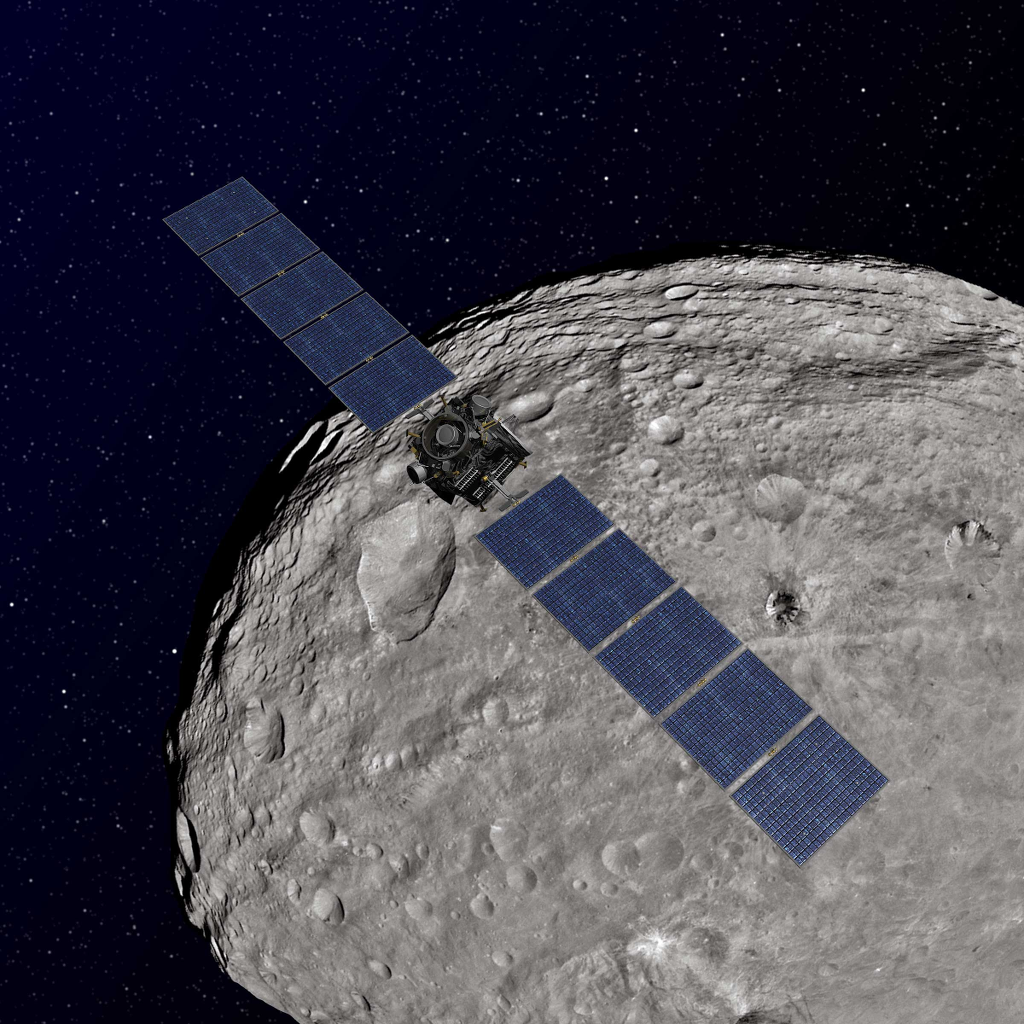
Artist’s rendition of the Dawn spacecraft at Vesta. Credit: NASA/JPL.
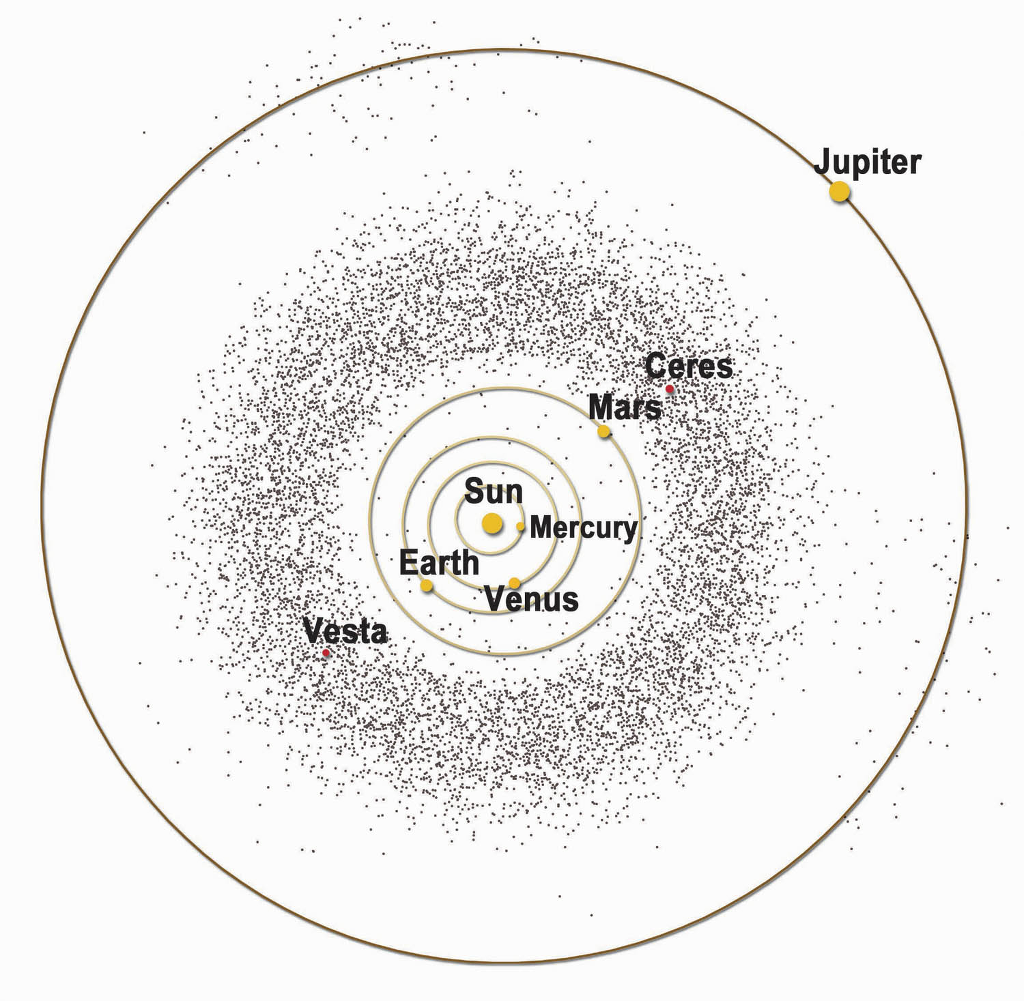
The asteroid belt n the inner solar system. Credit: NASA/JPL.
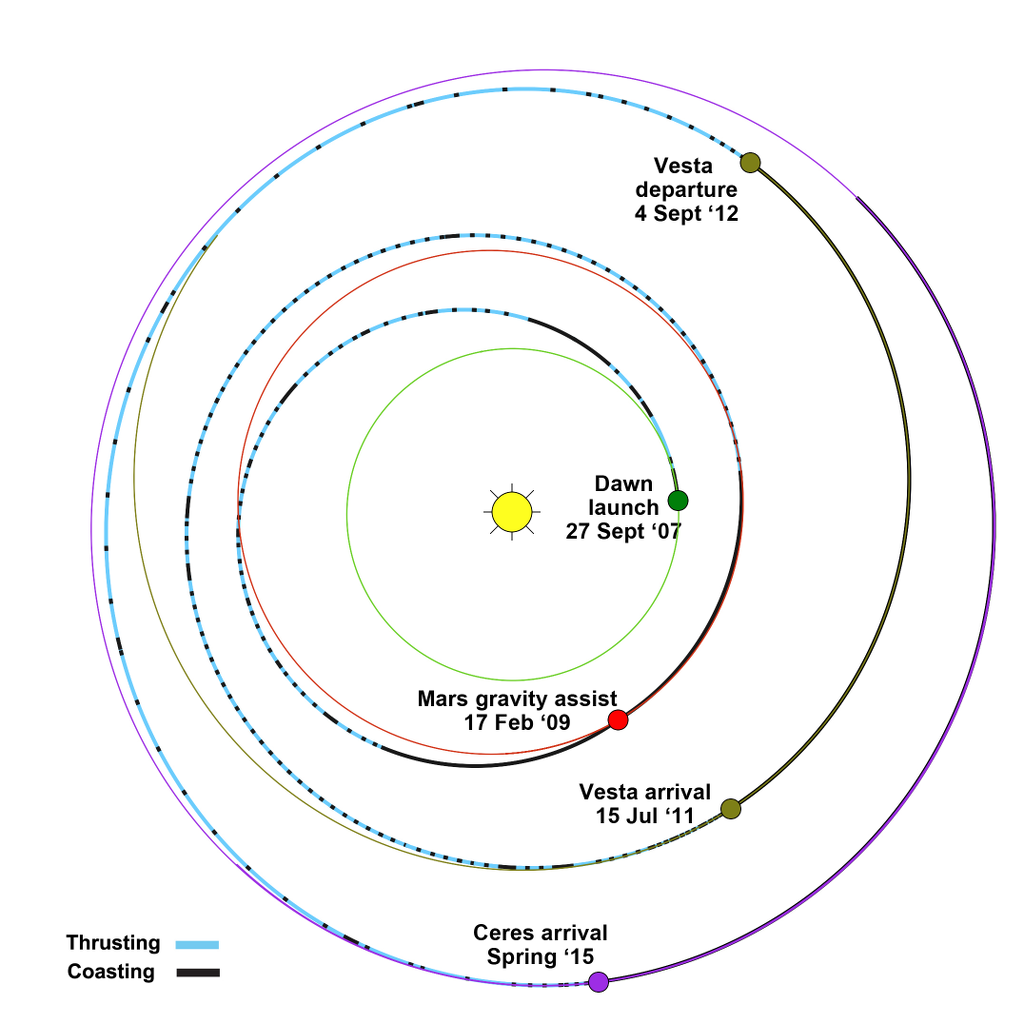
Dawn orbital track past Mars, stopping at Vesta and continuing to Ceres. Credit: NASA/JPL.
The Dawn spacecraft uses ion propulsion, which though 10 times more efficient than chemical fuels, has the thrust comparable to that of the weight of a piece of a piece of paper. Consequently the spacecraft spends most of its time thrusting. Since it’s antenna is bolted on the spacecraft, it cannot thrust and communicate with the earth at the same time, so it has to stop thrusting and turn toward the earth to report back at scheduled intervals before resuming thrusting again.
05/17/11 – Ephemeris – The Dawn spacecraft sights its target the asteroid Vesta
Tuesday, May 17th. Today the sun will be up for 14 hours and 52 minutes, setting at 9:05. The moon, at full today, will rise at 9:51 this evening. Tomorrow the sun will rise at 6:11.
The Dawn spacecraft is about to make news. Never heard of it? Well, it’s been slowly building up speed for the last nearly four years, spiraling its way out into the asteroid belt with its ion engines and one gravity assist from the red planet Mars, on which it tested its cameras. Its first target is coming up, the asteroid Vesta, the brightest of asteroids, though not the largest. There won’t be a time of engine firing to drop the spacecraft into orbit, but Dawn will slowly spiral into lower and lower orbits of this asteroid starting in July. It will spend a year at Vesta before heading to the largest asteroid, now dubbed dwarf planet Ceres. Last week dawn took its first image of Vesta, which covered 5 pixels in its camera, and shows Dawn to be right on target.
* Times are for the Traverse City/Interlochen area of Michigan. They may be different for your location.
 Bob Moler's Ephemeris Blog