Archive
Ephemeris Extra: 03/03/2024 – Tips for viewing the April 8, 2024 total solar eclipse
What is a solar eclipse?
Solar eclipses or eclipses of the Sun occur in about one in six new moons. However, one must be in the right part of the Earth to see them, which is why they may seem rare.
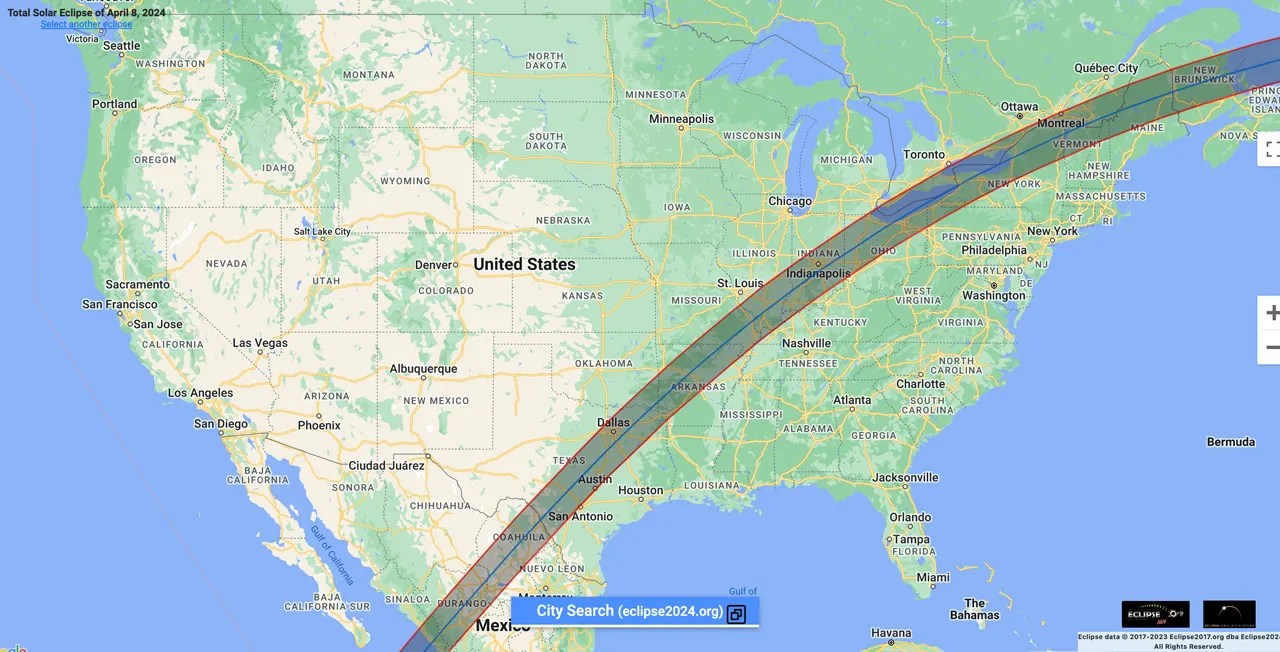
In a solar eclipse the moon’s shadow is cast upon the Earth. Because the Sun is a disk, the Moon’s shadow is fuzzy with sometimes a dark core. The fuzzy outer part of the shadow is called the penumbra. Observers there will see the Sun partially covered by the Moon, a partial eclipse. Observers in the dark core of the shadow are in the umbra, and see the face of the Sun completely covered by the Moon, a total eclipse. The maximum length of totality is never more than about seven minutes. Maximum for this eclipse will be 4 minutes 28 seconds in Mexico. The maximum length of the partial eclipse would be about 2 ½ hours.
What can be seen?
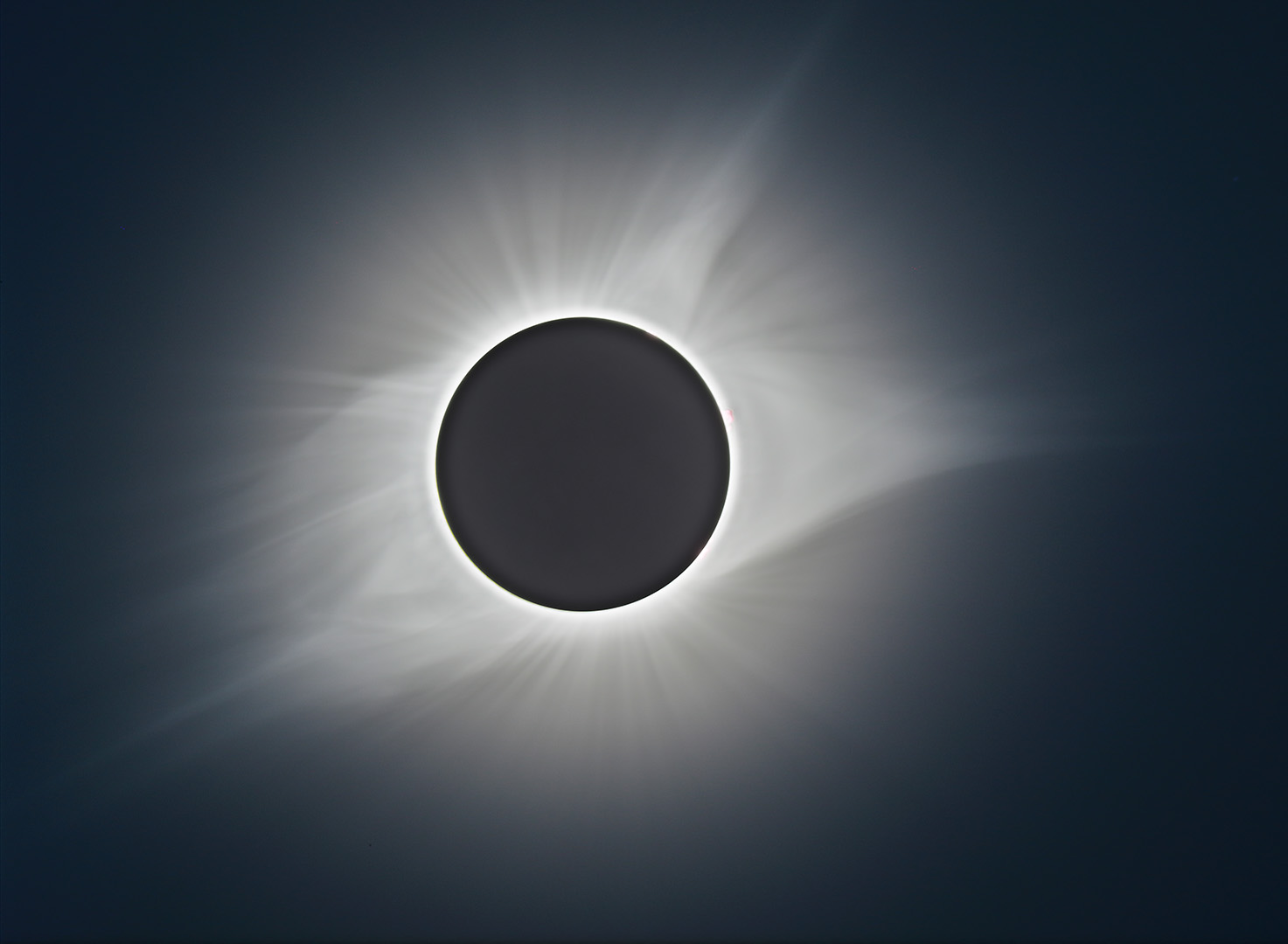
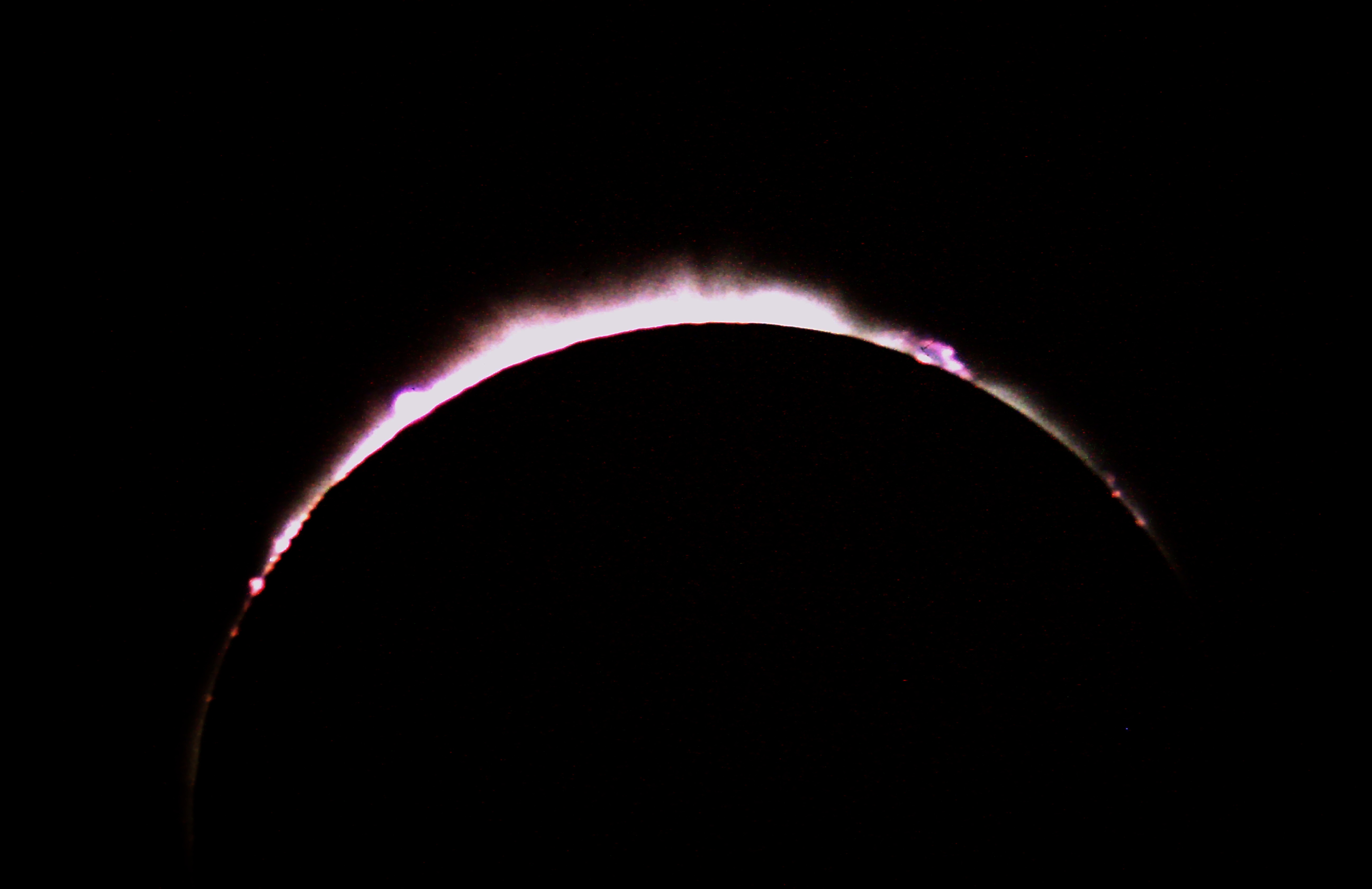
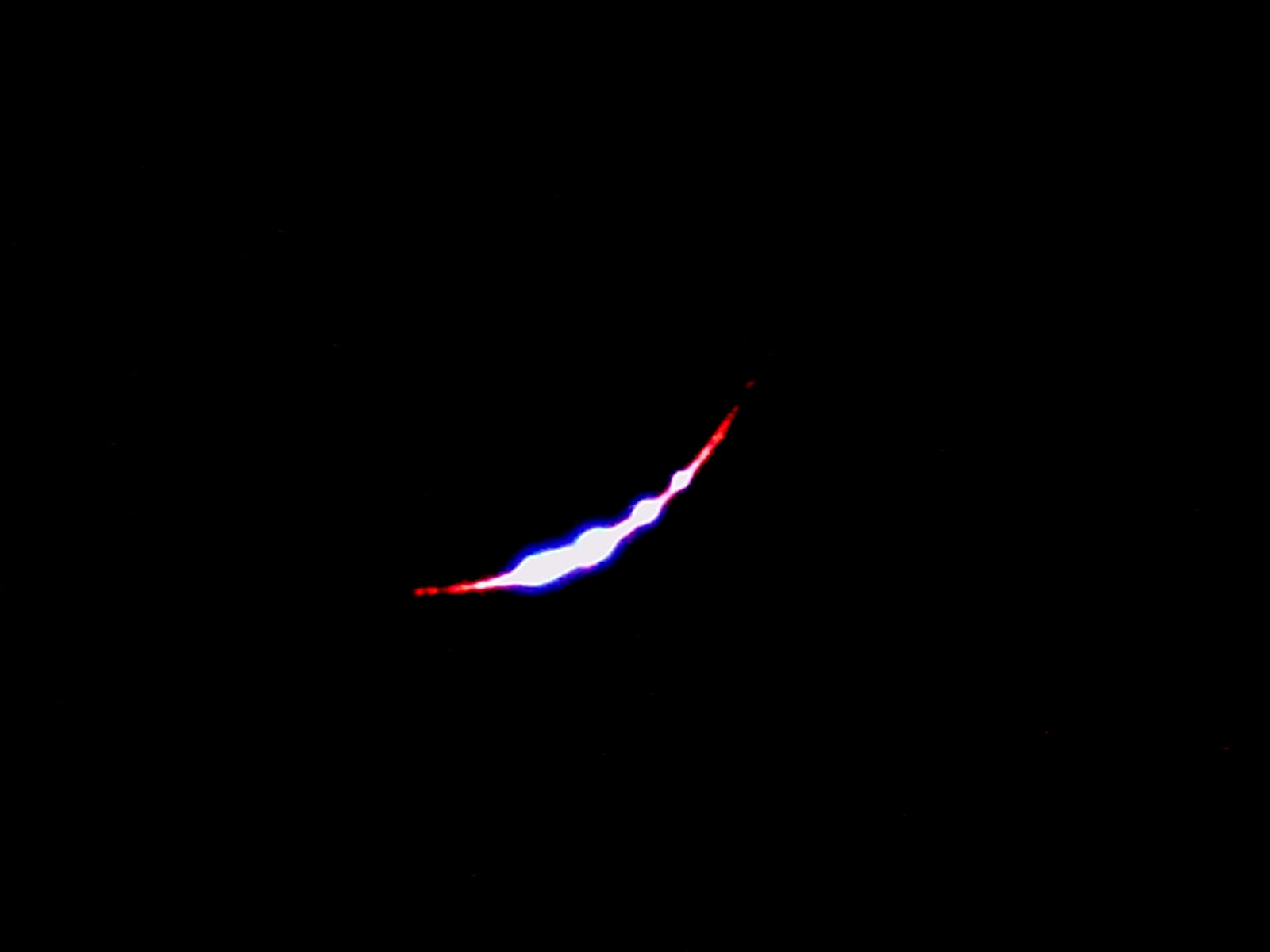
The outer three layers of the Sun are potentially visible to us: photosphere, chromosphere, and corona. The photosphere is the bright ball of the Sun we normally see. Looking at it for any length of time will cause blindness. Never look at the Sun’s photosphere without an approved solar filter. The other two layers can be seen during the totality of a solar eclipse. A thin red layer of gas with flame-like protrusions called prominences just above the photosphere and can normally be seen in a Hydrogen Alpha solar telescope, but easily seen in binoculars just after totality starts and before it ends. The corona is a silvery white extended solar atmosphere that can be seen out to several solar radii out from the edge of the Moon. Its shape changes hour to hour, and sometimes minute by minute.
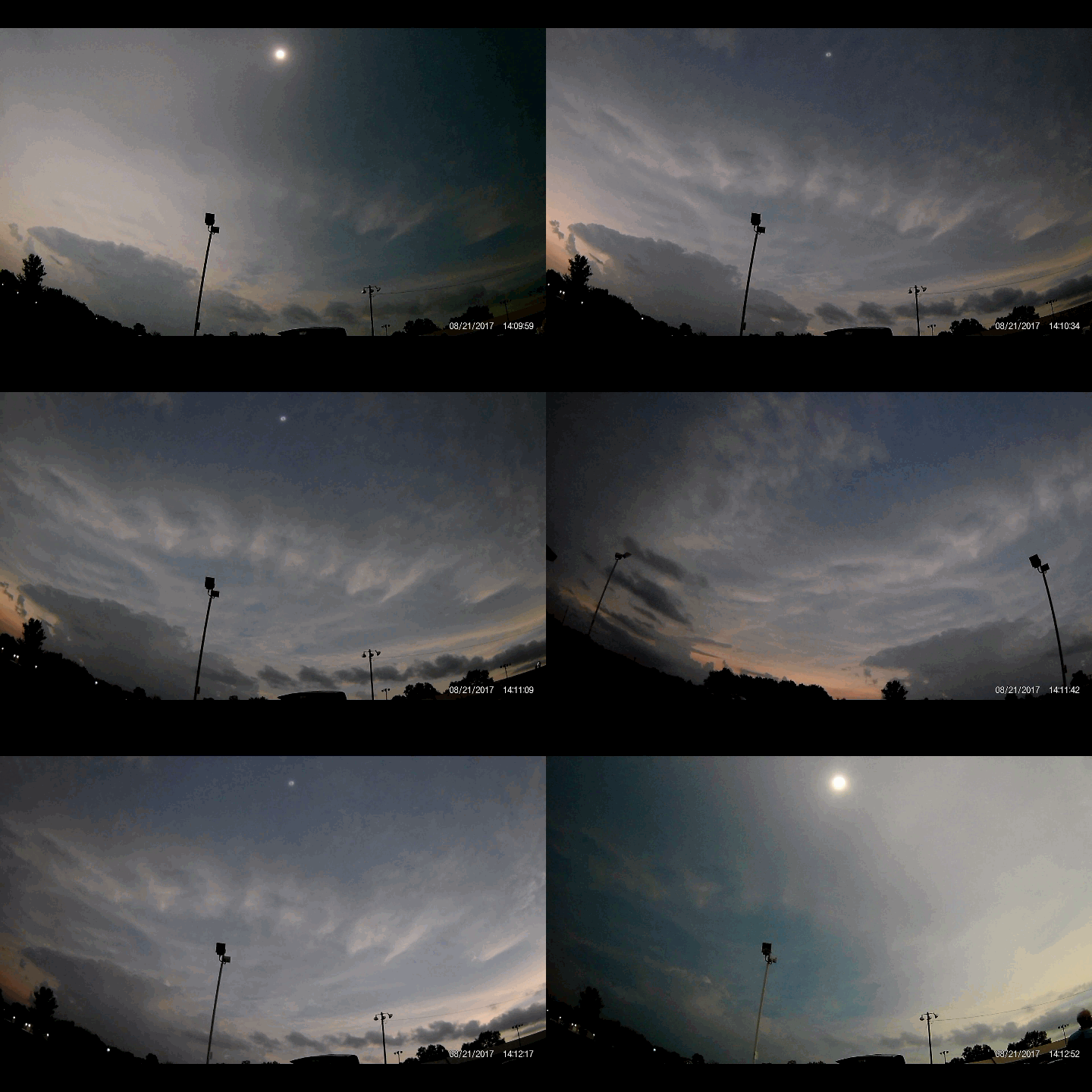
All around you strange things happen as the Sun is covered by the Moon.
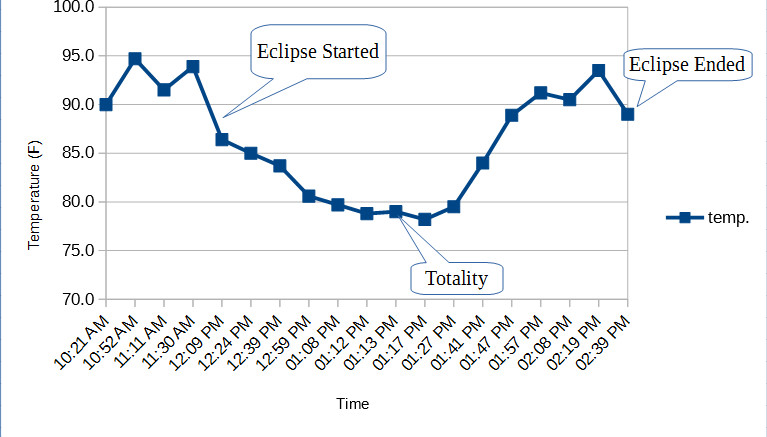
- The temperature will drop as the Sun is covered. It will be interesting to record the drop and recovery before, during and after the eclipse. Even a deep partial eclipse like what we’ll see locally will show a drop.
- Nearing totality the Sun’s light will appear somewhat yellow in hue. The revealed part of the Sun when it is mostly covered by the Moon is cooler and yellower than the central part. This is called limb darkening.
- As totality approaches and the sky darkens, streetlights will turn on.
- Also Chickens and other birds will go to roost. In the country cocks will crow before and after totality. Mosquitoes will think it’s twilight and will come out in mosquito prone areas for a snack.
- Shadow bands will be projected on flat smooth surfaces in near maximum phases of the partially eclipsed Sun. These are very subtle and are caused by atmospheric turbulence and the nearly pinpoint illumination by the Sun. It took me four total eclipses in order to be able to spot the effect on the tarmac of an airport. The nearest analog of this is seeing the shadow pattern on the bottom of a swimming pool on a sunny day, but very much fainter.
- Look for Venus (15° lower right) and Jupiter (30° upper left) of the Sun during totality. Just before, during and after totality look around at the sky and the incoming and outgoing umbral shadow.
- Check out the colorful horizon effects.
Viewing the partial solar eclipse
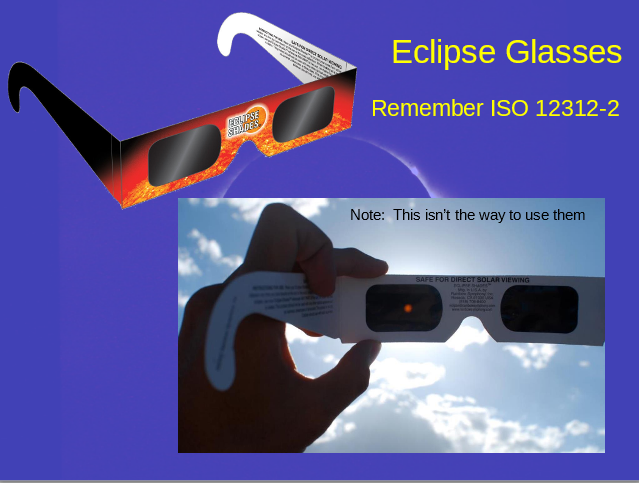
They are especially difficult to use, especially for people who wear glasses and can’t remove them because they are near-sighted.
Personally I do not recommend them, instead relying on one of the projection methods.
Be especially careful about children using them.
Remember the ISO 12312-2 compliance that should be printed on them.
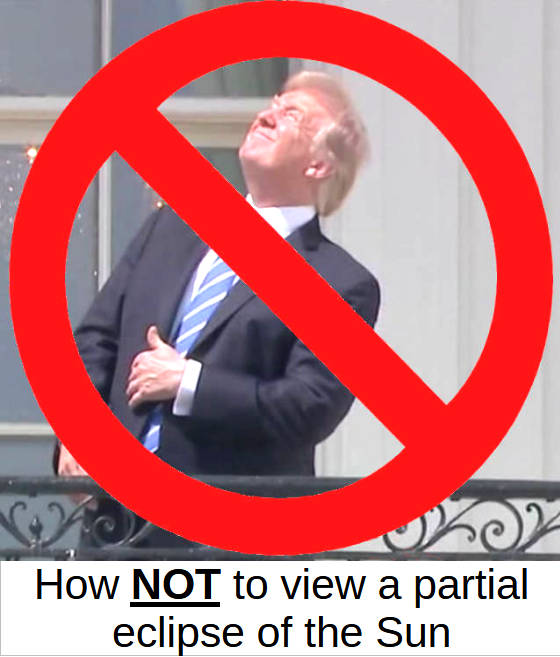
Never look directly at the partially eclipsed Sun without an approved solar filter. Solar filters must comply with ISO 12312-2 and transmit no more than 0.0032% of sunlight, and preferably less. Items sold as Eclipse viewing glasses must state that they comply with ISO 12312-2. People like me who wear glasses will find gaps above and below the frames of these filters where the Sun can get in, so must be used with extreme caution. No eclipse is worth your eyesight. The damage caused by looking directly at the Sun may not be known for several days after exposure, then it’s too late. I never use these filters, and prefer to project the Sun’s image on a white screen.
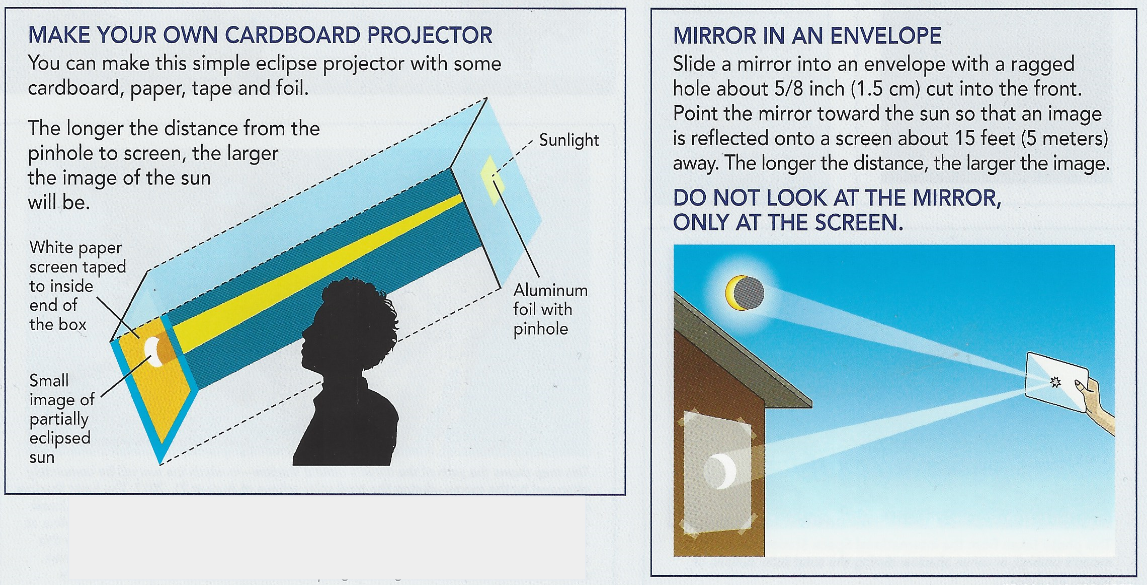
Pinhole projection is an easy way to project the Sun’s image. Depending on how far you want to project the image the larger the pinhole the farther and larger (and dimmer) the image can be. “Pinholes” up to 1/4 inch and maybe even half an inch can be used if you’re projecting it 10 feet or more. One can even use a mirror in an envelope with a small hole punched in it with the paper punch to project the sun’s image on the shady side of a building. That way many people can view the eclipse safely. Also try different size holes to get the best combination of size and brightness of the image. Unlike the illustration above it is best to mount the mirror on a tripod, or other support somehow, rather than holding it to keep the image steady. Using this method, the Sun’s motion due to the Earth’s rotation can be seen. Also, large sunspots may also be visible.
Local Circumstances
Local eclipse times for Traverse City: Starts (first contact) 1:58 p.m. Maximum 3:12 p.m. 89% covered Ends (last contact) 4:25 p.m. Times for other localities in northern Michigan will be within a minute or two of these values. It may be a minute or two after first contact for the first bite of the Moon to become discernible.
Eclipse2024.org provides an interactive map of the April 8, 2024 eclipse on the Internet to allow the display of eclipse times for any location: https://eclipse2024.org/eclipse_cities/statemap.html
Eclipse2024.org provides an interactive map of the April 8, 2024 eclipse on the Internet to allow the display of eclipse times for any location: https://eclipse2024.org/eclipse_cities/statemap.html.
 Bob Moler's Ephemeris Blog