Archive
Ephemeris: 07/21/2025 – When our knowledge of the size of the universe expanded
This is Ephemeris for Monday, July 21st. Today the Sun will be up for 15 hours and 2 minutes, setting at 9:20, and it will rise tomorrow at 6:18. The Moon, 3 days before new, will rise at 3:18 tomorrow morning.
A little over 100 years ago astronomers the Milky Way and the surrounding stars were thought to be the entire universe. A universe which was, apparently, disc shaped. Astronomers photographed examples of objects they called spiral nebulae, which they thought belonged to the Milky Way. Then Edwin Hubble photographed stars in the Andromeda spiral nebula. One star changed brightness in a way like some of the stars we know in our Milky Way. These stars are called Cepheid Variables and the rate of variation in brightness is related to their true brightness. This star that Hubble found was much too dim and much too far away to be in the confines of the Milky Way. Soon we found that we are in a spiral nebula or galaxy, like billions of others.
The astronomical event times given in this blog are for the Traverse City/Interlochen area of Michigan (Lat 44.7° N, Long 85.7° W; EDT, UT – 4 hours) unless stated otherwise. Times will be different for other locations.
Addendum
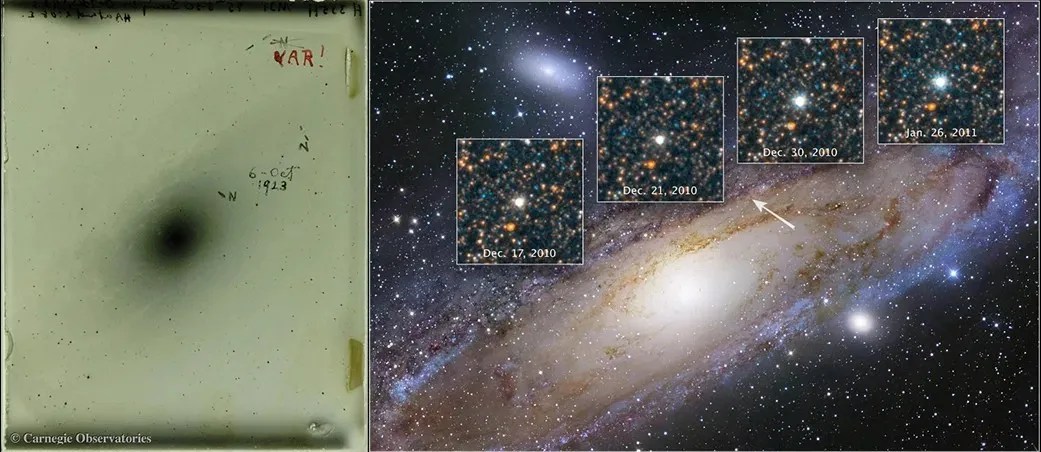
Left: Carnegie Observatories. Right: NASA, ESA, and the Hubble Heritage Team (STScI/AURA); Acknowledgment: R. Gendler
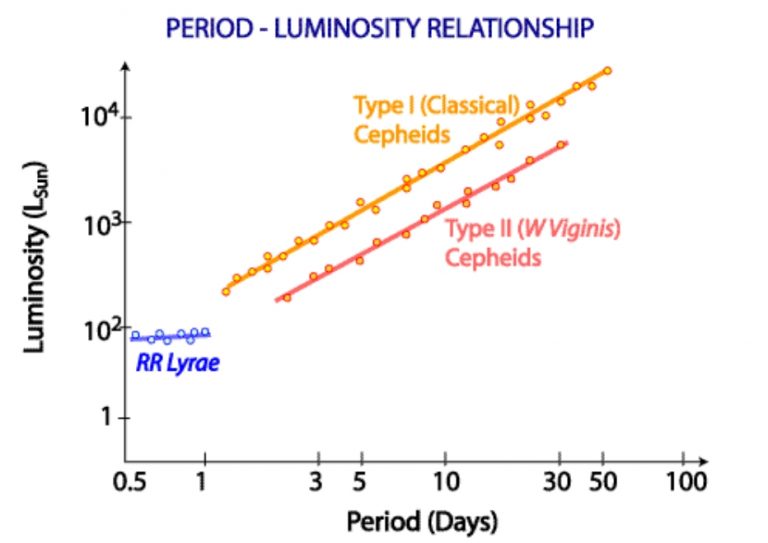
The universe “expanded” again, when astronomers found out there were two types of Cepheids, one 4 times brighter than the other. Using the brighter Type I Cepheids, the measurement doubled the estimated distance*. This was about the time in the early 1950s when I was getting interested in astronomy, so the quoted distance to Andromeda and all the other galaxies doubled from older astronomy books to the newer ones.
* Inverse square law: brightness drops with the square of the distance. Double the distance and the brightness drops by 22 or 4.
 Bob Moler's Ephemeris Blog