Archive
07/12/2022 – Ephemeris – The rest of the first images and data from the James Webb Space Telescope to be released tomorrow
This is Bob Moler with Ephemeris for Tuesday, July 12th. Today the Sun will be up for 15 hours and 18 minutes, setting at 9:27, and it will rise tomorrow at 6:09. The Moon, 1 day before full, will set at 5:26 tomorrow morning.
Later today at 10:30 am, NASA and the Space Telescope Science Institute will present the first results from the James Webb Space Telescope. These will be, I believe, four multi-spectral images rendered in full color, and other data. The wavelength coverage of Webb in the infrared is greater than Hubble Space Telescope, which is mostly visible light, by several factors. The test images we’ve seen released so far are monochromatic and rendered in white, yellow, orange and red to depict a wide brightness range. There will be a Webb image release with explanations at the Milliken Auditorium of the Dennos Museum at 10:30, with doors opening at 10 am; and also at the Main Library in Traverse City. I’ll endeavor to be at the library.
The astronomical event times given are for the Traverse City/Interlochen area of Michigan (EDT, UT – 4 hours). They may be different for your location.
Addendum
Not known by me last Sunday night when I wrote and recorded today’s program was that President Biden was going to preview one of the images Monday evening. If I were the general public, I would have been underwhelmed. It wasn’t enlarged, or particularly colorful. Here it is below. Click on it for an even larger view:
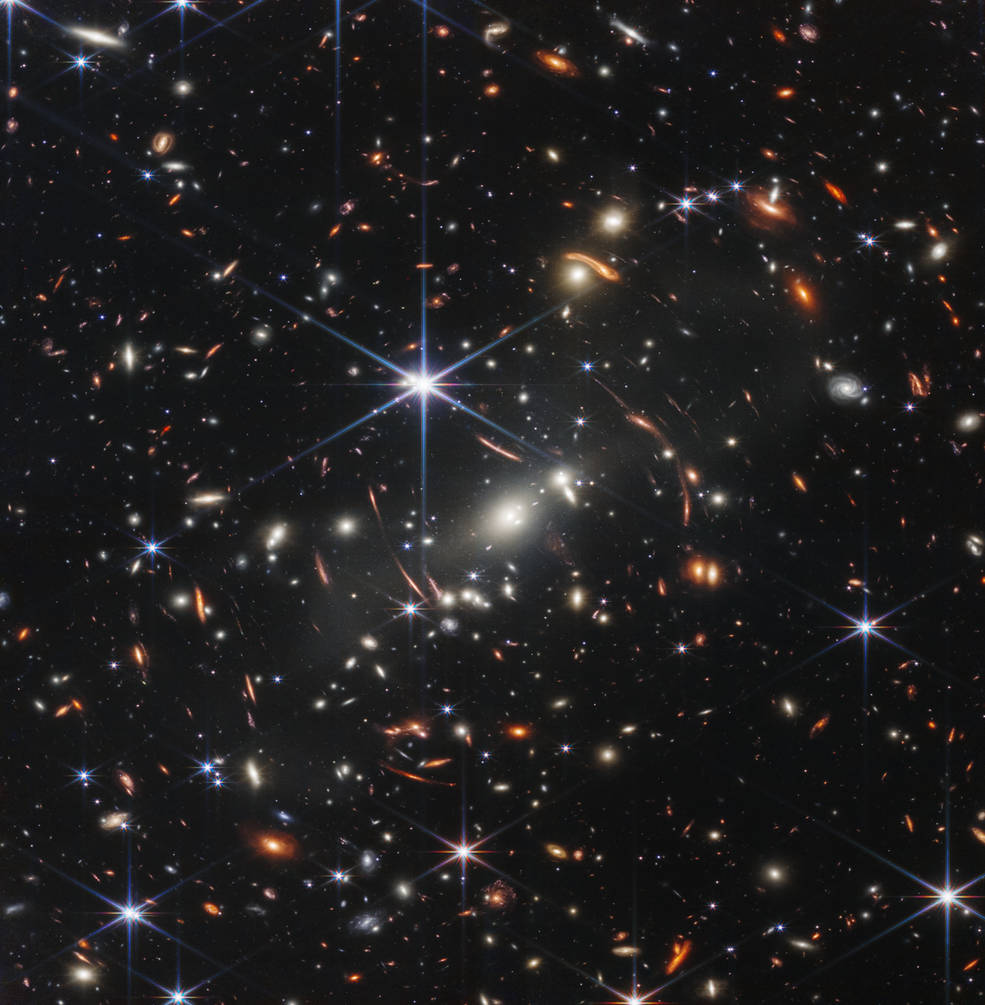
The teaser deep field image from President Biden’s July 11th presentation. Click on the image to fill your screen with it. Credit: NASA, ESA, CSA, JWST, STScI.
In the image above, anything with diffraction spikes is a star in our galaxy. Everything else is a galaxy, like the Milky Way, with billions of stars. This is a tiny piece of sky. As a rule of thumb, the redder the galaxy, the farther away it is. The light emitted by these galaxies are starlight in mostly visible wavelengths, but shifted to the infrared by their great speed of recession caused by the expansion of space between us and them. Also note that many of these galaxies are distorted into short arcs. They seem curved as if being part of a circle around the large, bright galaxy in the center. This is caused by the gravitational lensing caused by the mass of that galaxy, dark matter, and other galaxies in its cluster. This is an effect predicted by Einstein’s theory of General Relativity. I have a feeling that we are going to see a lot more gravitational lensing as the JWST probes into deeper and deeper fields.
One thing to remember about deep fields, is that because of the speed of light being finite, that the farther we look out, the farther back in time we see into an evolving universe. The farthest back we can see with electromagnetic radiation (that is gamma rays, x-rays, ultraviolet, visible, and infrared light, microwaves and radio waves) is the era of the cosmic microwave background, when the universe became transparent, about 380 thousand years after the Big Bang. After that came a period called the dark ages before galaxies formed and the first stars ignited, called the dark ages. At least that’s what I hear-tell. There are lots of questions, like the chicken and egg question: Which came first, supermassive black holes or galaxies?
We will find answers to some of our questions, I’m sure. Even more intriguing, we will be able to ask even more and deeper questions to probe the mystery and beauty of the universe.
 Bob Moler's Ephemeris Blog