Archive
12/29/2016 – Ephemeris – Astronomical milestones of 2016
Ephemeris for Thursday, December 29th. The Sun will rise at 8:19. It’ll be up for 8 hours and 50 minutes, setting at 5:10. The Moon is new today, and won’t be visible.
Looking back at 2016 the biggest astronomical news was the detection of gravitational waves coming from two separate collisions of black holes far beyond our Milky Way galaxy. The two detectors in Washington state and in Louisiana recorded these events in September and December 2015, but the first announcement was made in February this year after the signals were cleaned up and studied. The year saw the end of the European Space Agency’s Rosetta Mission to the comet we’ve come to call 67P after orbiting it for over two years. The Opportunity and Curiosity rovers continued their exploration of Mars along with a fleet of satellites. On a sad note, we lost pioneering Mercury astronaut John Glenn at the age of 95.
Times are for the Traverse City/Interlochen area of Michigan. They may be different for your location.
Addendum
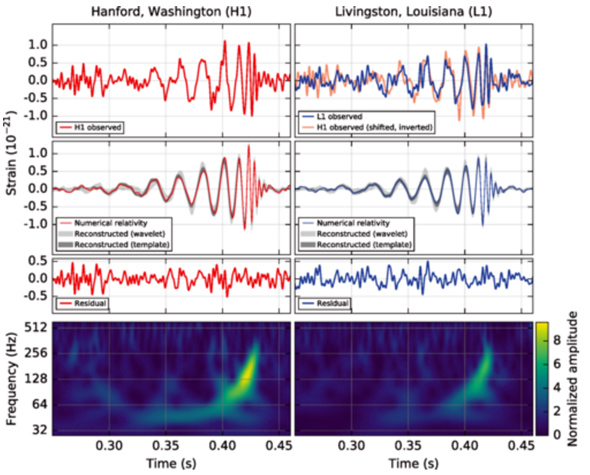
The chirp heard ’round the world and indeed the universe. Credit: LIGO/Abbot et al. 2016. Hat tip: Phil Plait, the Bad Astronomer.
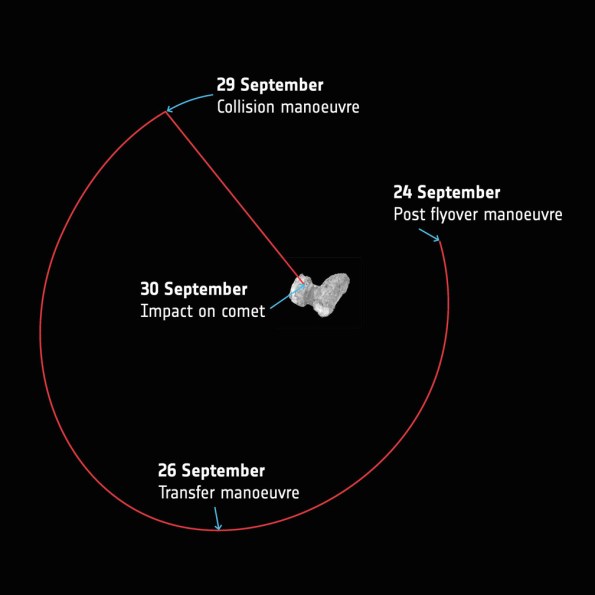
Rosetta, Final orbit. Credit & copyright European Space Agency (ESA)
07/18/2016 – Ephemeris – A second gravitational wave detection and new thoughts about dark matter
Ephemeris for Monday, July 18th. Today the Sun will be up for 15 hours and 8 minutes, setting at 9:22, and it will rise tomorrow at 6:15. The Moon, 1 day before full, will set at 6:04 tomorrow morning.
A couple of weeks ago a second gravitational wave event was reported. This one was detected on December 26th last year. Scientists determined that it came from the collision of a 14 and a 8 solar mass black holes resulting in a 21 solar mass black hole with one solar mass loss as gravitational wave energy. The event happened 1.5 billion light years away. Some scientists at NASA are speculating that, since no particles with the exotic properties of dark matter have been discovered that this matter might be primordial black holes, created at the time of the Big Bang itself. These primordial black holes can also help solve some other problems of the evolving early universe.
Times are for the Traverse City/Interlochen area of Michigan. They may be different for your location.
Addendum
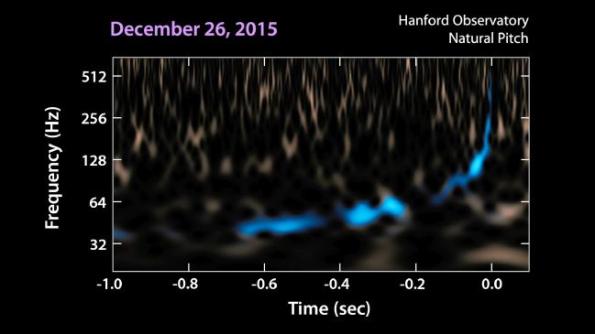
Gravitational wave signal in blue of the December 26, 2015 detection of the second gravitational wave event.
02/22/2016 – Ephemeris – Actual gravitational waves detected!
Ephemeris for Monday, February 22nd. The Sun will rise at 7:32. It’ll be up for 10 hours and 47 minutes, setting at 6:20. The Moon, at full today, will rise at 6:32 this evening.
On February 11th the LIGO team announced the discovery of gravitational waves coming from two black holes merging over a billion light years away. LIGO stands for Laser Interferometry Gravitational-wave Observatory. Two interferometers, one in the state of Washington, and the other in Louisiana detected the same signal milliseconds apart. An interferometer sends a split light beam onto two paths 90 degrees apart to strike mirrors and return to interfere with itself. A minute change in the length either light path will show up as a change in the interference. The maximum change was one-one thousandths of the diameter of the proton subatomic particle. This is a greater discovery than the Higgs Boson of a few years ago.
Times are for the Traverse City/Interlochen area of Michigan. They may be different for your location.
Addendum

A view of the LIGO detector near Livingston, LA. Credit LIGO.org.
The chirp heard ’round the world and indeed the universe. Credit: LIGO/Abbot et al. 2016. Hat tip: Phil Plait, the Bad Astronomer.
 Bob Moler's Ephemeris Blog