Archive
Ephemeris: 12/19/2024 – Jupiter’s dark moon Callisto
This is Bob Moler with Ephemeris for Thursday, December 19th. Today the Sun will be up for 8 hours and 48 minutes, setting at 5:04, and it will rise tomorrow at 8:16. The Moon, 3 days before last quarter, will rise at 9:47 this evening.
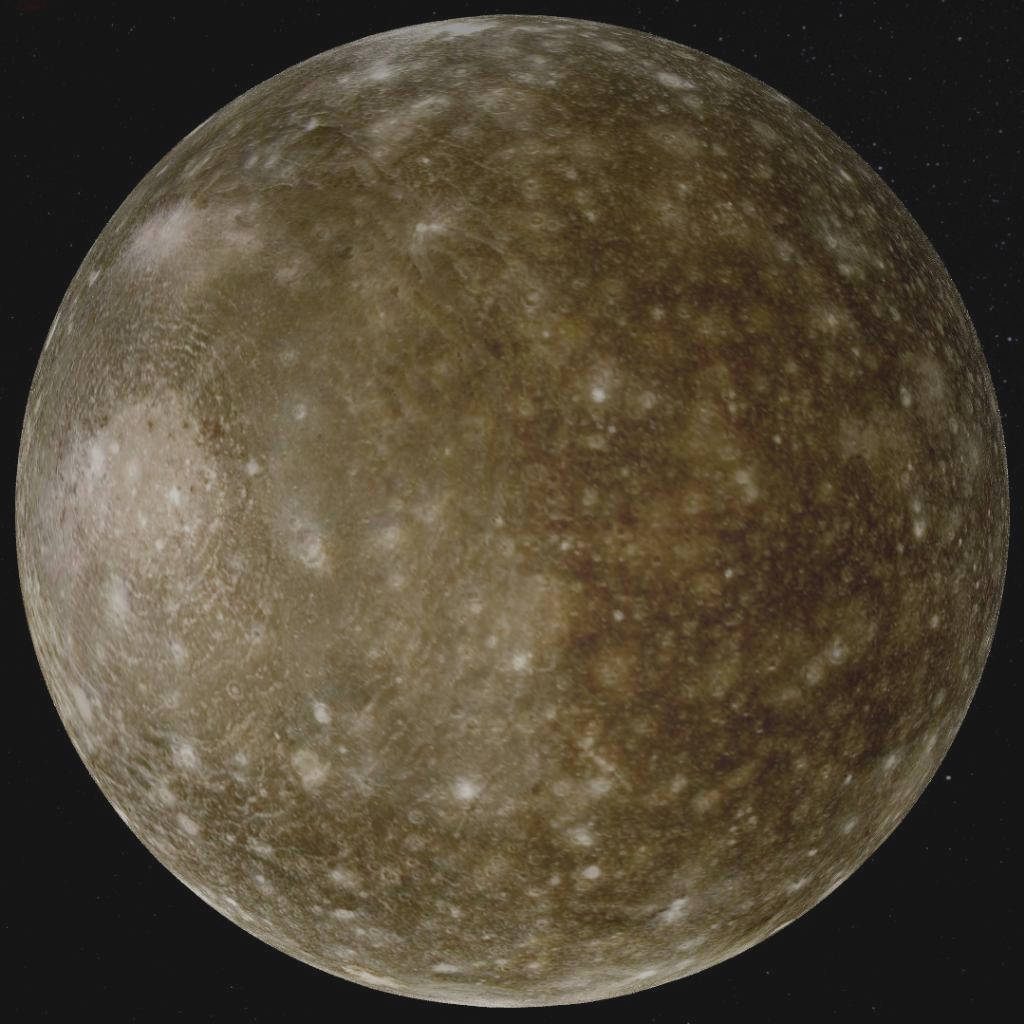
Callisto is the most distant of the Galilean moons from Jupiter, visible in small telescopes or even binoculars. It has the darkest surface of the four moons, and so appears the dimmest, even though it’s the second largest after Ganymede. The largest crater on Callisto is called Valhalla, and it doesn’t look like a crater at all. There’s many concentric, what look like, frozen ripples surrounding it, and it covers a good percentage of the moon’s surface. It is probably the only moon of Jupiter that we could send a crew to, since it’s the farthest from the intense radiation belts of Jupiter. Made of approximately equal parts of water mostly in the form of ice and rock, Callisto probably has a liquid water ocean underneath its icy crust, like Ganymede and Europa.
Addendum
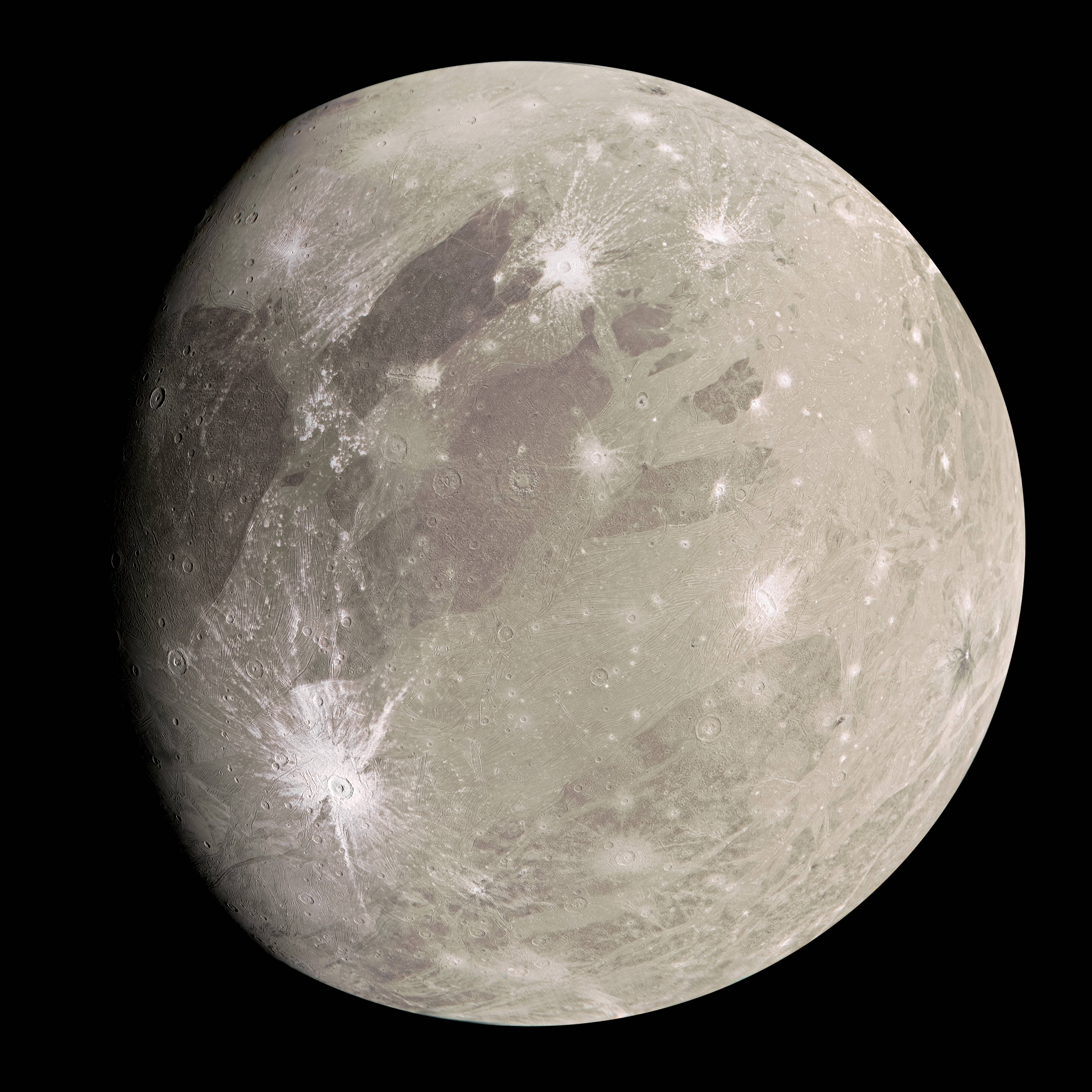
Ephemeris: 12/17/2024 – A closeup look at Ganymede
This is Bob Moler with Ephemeris for Tuesday, December 17th. Today the Sun will be up for 8 hours and 48 minutes, setting at 5:03, and it will rise tomorrow at 8:15. The Moon, 2 days past full, will rise at 7:23 this evening. | Ganymede is the largest satellite in the solar system orbiting the largest planet in the solar system, Jupiter. It is 1 1/2 times the diameter of our Moon, and slightly larger than the planet Mercury. It is an icy moon, being about half made-up of water ice and silica. Ganymede appears to have a below surface ocean of water like Europa. And its surface appears to be quite smooth, not as smooth as Europa’s but parts of it are literally devoid of craters for the most part, and many of the craters it does appear to have inner craters in the center which looks quite weird. The Juno spacecraft, still orbiting Jupiter, took some very close images of Ganymede back in 2021 using its relatively simple camera. These were some of the best images of it.
The astronomical event times given are for the Traverse City/Interlochen area of Michigan (EST, UT – 5 hours). Times will be different for other locations.
Addendum
05/28/2018 – Ephemeris – NASA’s Juno spacecraft takes deep dives at Jupiter
Ephemeris for Memorial Day, Monday, May 28th. Today the Sun will be up for 15 hours and 15 minutes, setting at 9:17, and it will rise tomorrow at 6:02. The Moon, 1 day before full, will set at 6:24 tomorrow morning.
NASA’s Juno spacecraft has made 11 close passes of Jupiter since being inserted into Jovian orbit in July 2016. It has a highly elliptical orbit. It comes in over the north pole, passes only 2,000 miles over the cloud tops at the equator and heads out over the south pole, avoiding the most intense parts of Jupiter’s radiation belts. The high latitude and polar clouds appear more chaotic than expected. We can’t see these very well from the Earth. The magnetic field is much stronger and lumpier than thought before. A very much improved and complex picture of our largest planet is emerging, as we expected. The mission isn’t over and years of analysis are ahead to begin to more fully understand the solar system’s greatest planet.
The times given are for the Traverse City/Interlochen area of Michigan. They may be different for your location.
Addenda
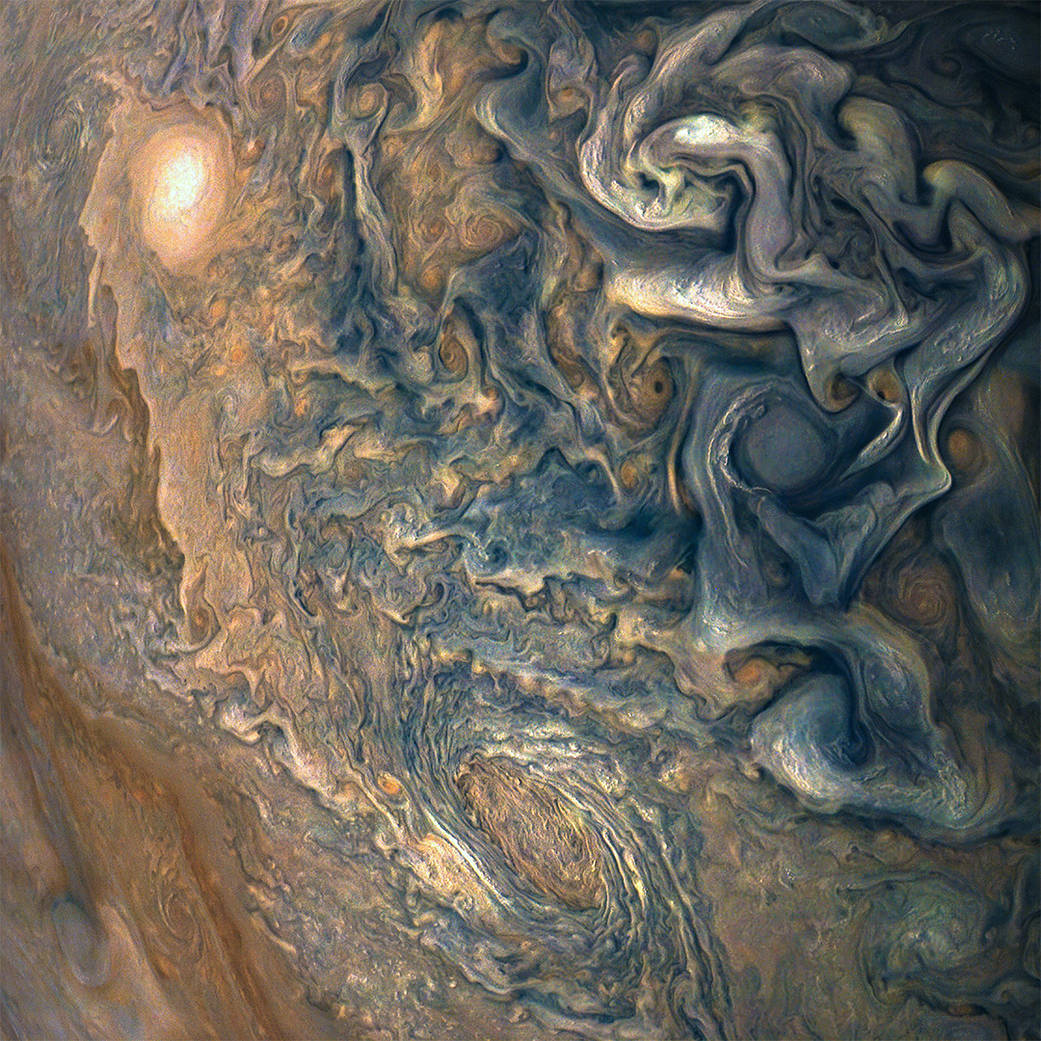
Chaotic storms at Jovian high latitudes. Credit NASA/JUNO
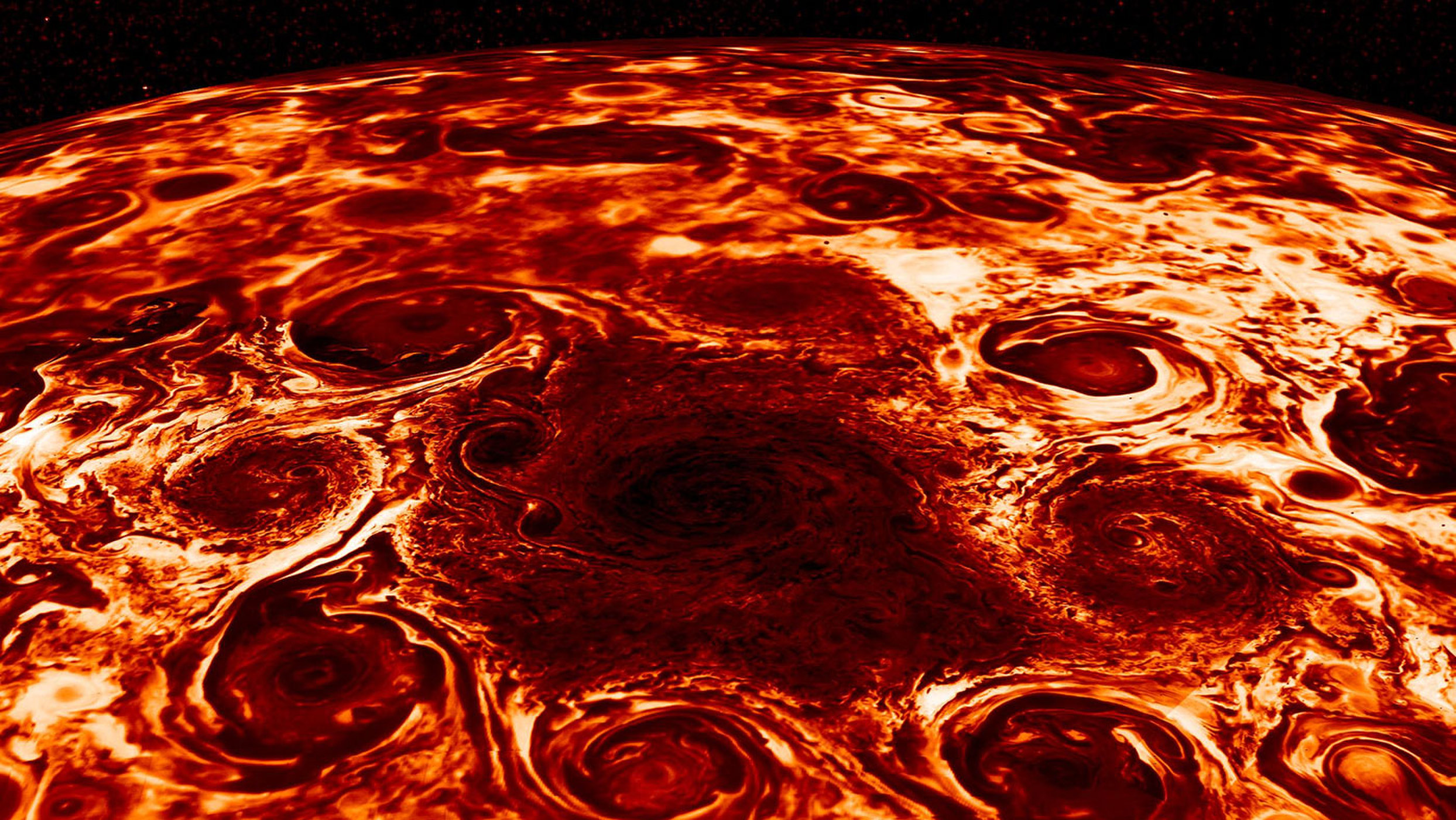
Jupiter’s North Pole in the infrared. 8 cyclones surrounding a 9th at the pole. Credit: NASA/JPL-Caltech/SwRI/ASI/INAF/JIRAM
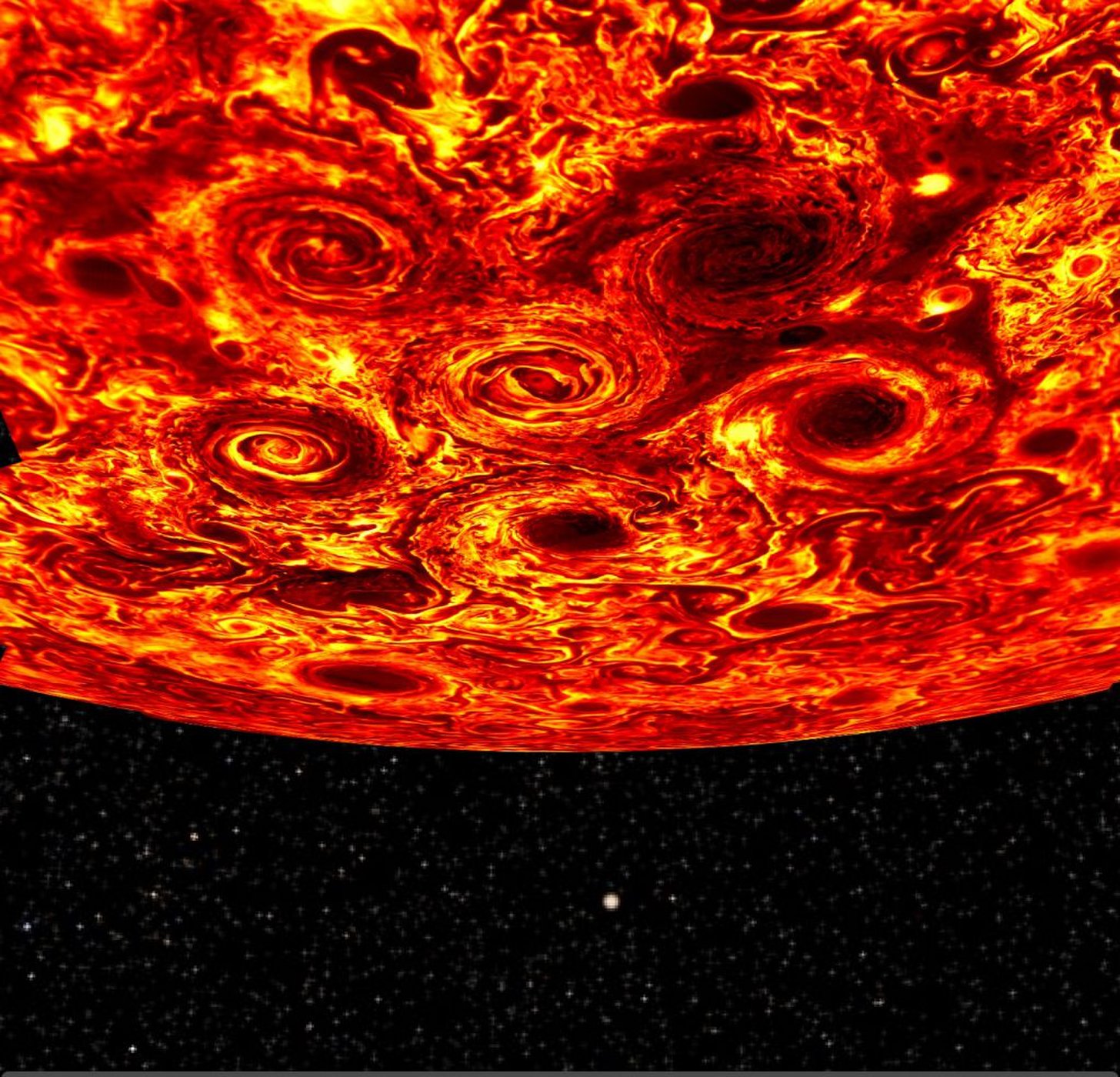
Jupiter’s South Pole in the infrared. 5 cyclones surrounding a 6th at the pole. Credit: NASA/JPL-Caltech/SwRI/ASI/INAF/JIRAM
Alan Bean
Astronaut Alan Bean, 4th person to walk on the Moon with Apollo 12 passed away this weekend. He also commanded the second Skylab mission and retired to become an artist, a painter of his adventures on the Moon and in space. Of the twelve men who walked on the Moon, only four survive.
04/11/2017 – Ephemeris – What’s under Jupiter’s cloud tops?
Ephemeris for Tuesday, April 11th. The Sun will rise at 7:04. It’ll be up for 13 hours and 17 minutes, setting at 8:22. The Moon, at full today, will rise at 8:54 this evening.
I made an error in yesterday’s on-air program which I fixed before posting this blog version. The moon Io will be over the face of Jupiter from when it rises tonight until 8:58 p.m.*, thereafter it will be seen just to the west of the planet. What we see of Jupiter are its cloud tops. Planetary astronomers have some very educated guesses as to what lies beneath them. An atmosphere of mainly hydrogen and helium, ending in a hot liquid ocean of hydrogen. Beneath that a core of metallic hydrogen that generates the planet’s huge magnetic field. Below that maybe a core of solid iron and other metals. NASA’s Juno spacecraft now orbiting Jupiter is tasked with finding out the interior structure by measuring the velocity of the spacecraft as it flies just above the cloud tops of this giant planet.
The times given are for the Traverse City/Interlochen area of Michigan. They may be different for your location.
* Observers in other locations around the world can check out the table from yesterday’s post of other Jovian satellite events after this entry is posted at 4:01 UT, April 11, 2017.
Addendum
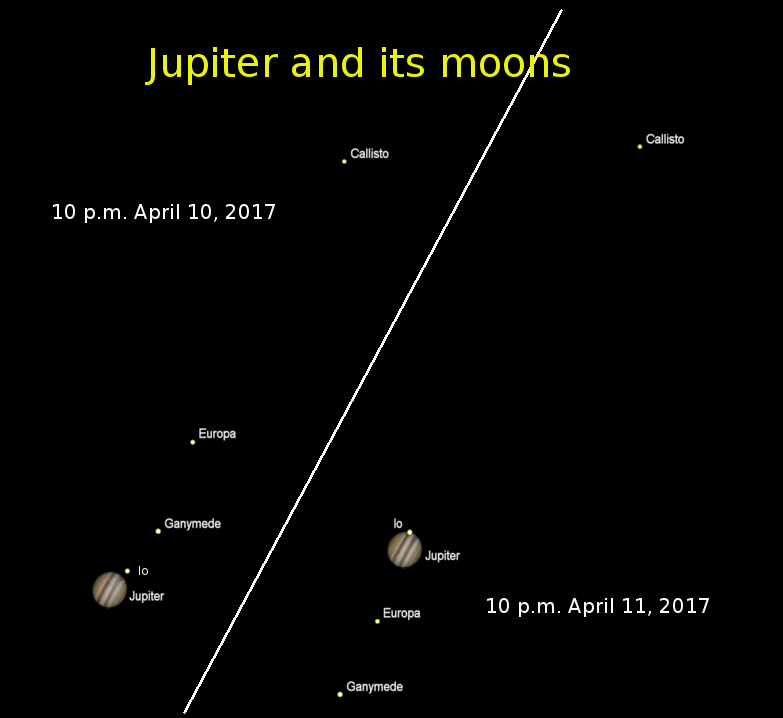
Jupiter and its moons in a telescope at 10 p.m. both April 10th & 11th, 2017. Created using Cartes du Ciel (Sky Charts).
For a year’s worth of Jovian satellite events and when the Great Red Spot crosses Jupiter’s central meridian, go to: http://www.projectpluto.com/jevent.htm.
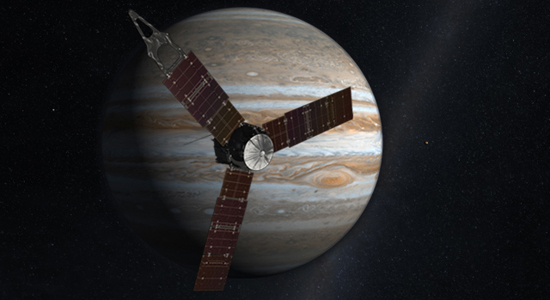
The Juno spacecraft. Credit: NASA.
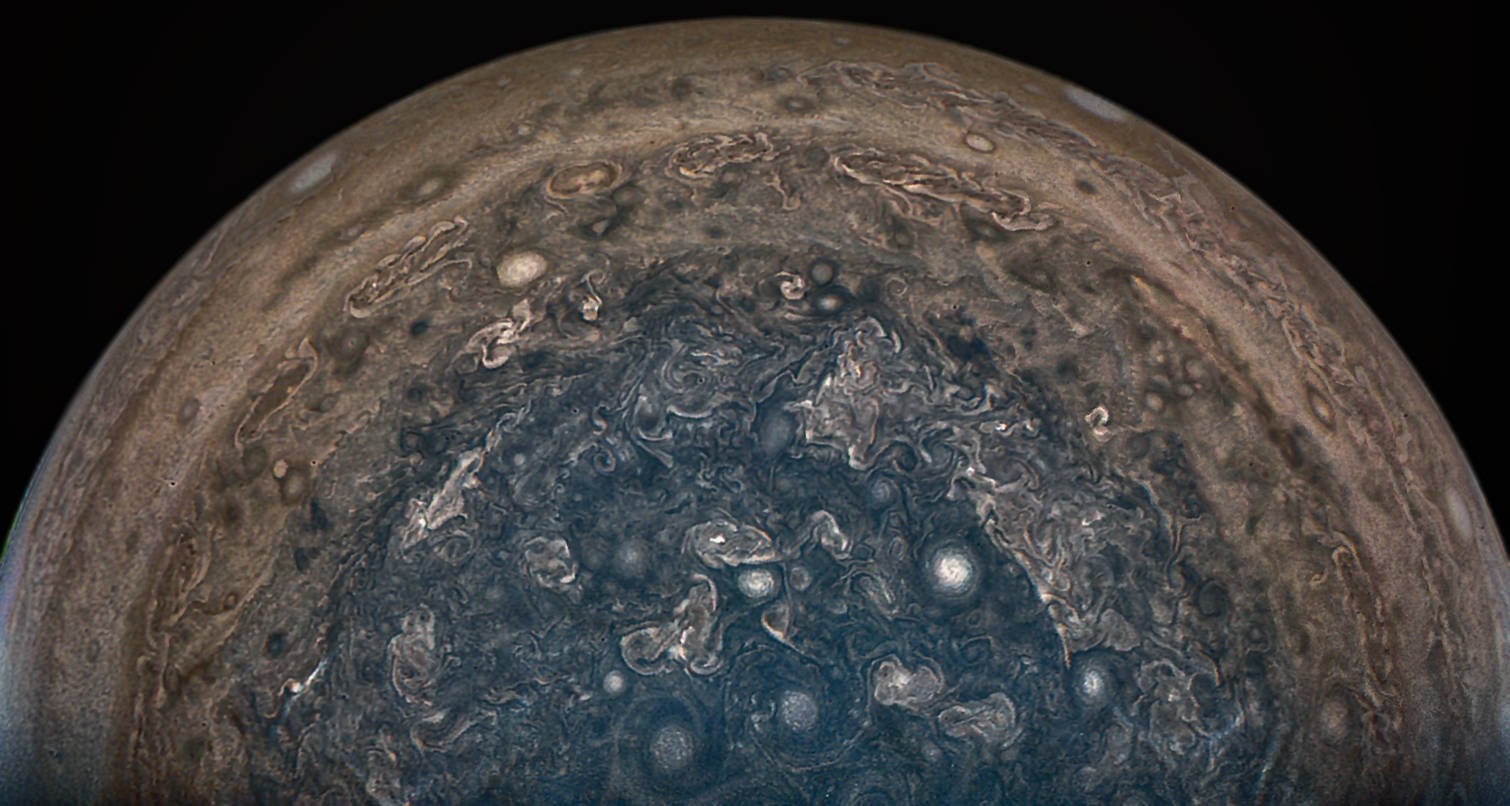
A February 2, 2017 Juno image of Jupiter’s south pole and its chaotic storm clouds. I think I have a paisley tie that looks like that. Credit NASA/JPL-Caltech/SwRI/MSSS/John Landino.
 Bob Moler's Ephemeris Blog