Archive
10/04/2021 – Ephemeris – Why we can’t talk to the Perseverance rover on Mars right now
This is Ephemeris for Monday, October 4th. Today the Sun will be up for 11 hours and 32 minutes, setting at 7:17, and it will rise tomorrow at 7:46. The Moon, 2 days before new, will rise at 6:30 tomorrow morning.
NASA is no longer sending commands to its Perseverance rover or any of its assets roving or orbiting Mars now. The reason isn’t particularly sinister. It’s the approximately 26 month Mars solar conjunction. The Sun is a noisy radio source, and commands sent to or data received from these martian assets could be garbled. This affects everyone’s assets on or orbiting Mars, which includes the Europeans, India, China and the United Arab Emirates. For NASA, communication restrictions started two days ago and will last until the 14th. This will give the folks at JPL who are operating the Curiosity and Perseverance rovers some time off, and time to plan the next few months of activity.
The astronomical event times given are for the Traverse City/Interlochen area of Michigan (EDT, UT-4 hours). They may be different for your location.
Addendum
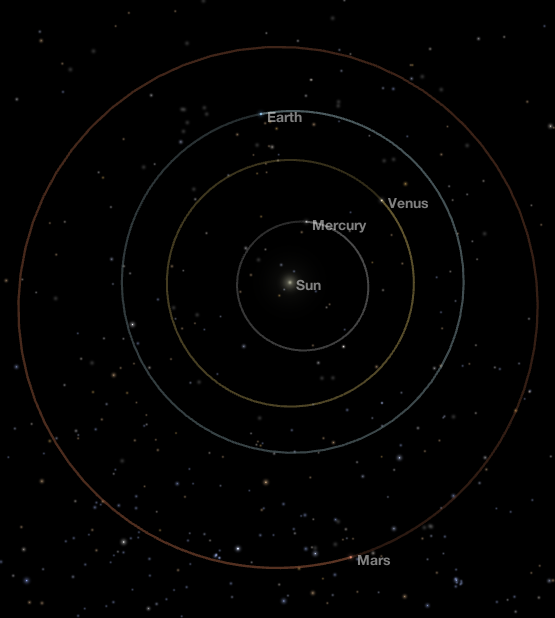
Mars in solar conjunction. Looking at the inner solar system. Mars, near the bottom of the image, is 244.6 million miles (393.9 million kilometers) from Earth. Click on the image to enlarge it. Credit NASA’s Eyes app.
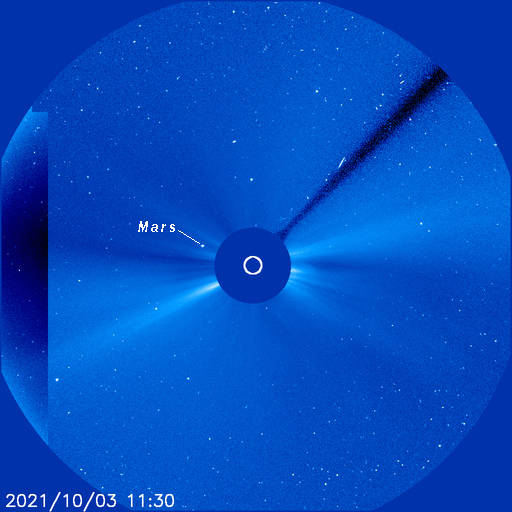
Mars beyond and to the upper left of the Sun yesterday. It’s tough to get intelligible radio signals through the solar corona. Credit: NASA/ESA SOHO* spacecraft. The annotation is mine.
* SOlar and Heliospheric Observatory, spacecraft in halo orbit around the Lagrangian L1 equilibrium point about 930,000 miles (1,500,000 kilometers) sunward of the Earth. This keeps the satellite roughly between the Sun and the Earth, instead of moving ahead of the Earth because it’s closer to the Sun.
06/01/2015 – Ephemeris – Starting orbit 41 looking at June skies
Ephemeris for Monday, June 1st. Today the Sun will be up for 15 hours and 20 minutes, setting at 9:21. The Moon, 1 day before full, will set at 6:17 tomorrow morning and tomorrow the Sun will rise at 6:00.
We’ll start Ephemeris’ 41st orbit of the Sun by looking at the skies of June. There’ will be a lot of sun in June and very little night. The daylight hours will increase a bit from 15 hours and 20 minutes today to 15 hours and 34 minutes on the 21st, retreating back to 15 hours 31 minutes at month’s end. At this time of the year the sunset times for Ludington, Interlochen, Petoskey and Mackinaw City are very nearly the same. However the sunrise times are at their most divergent. With Ludington’s sunrise being 14 minutes later than Mackinaw City’s. The altitude of the sun above the southern horizon at local noon will hover around 68 to 69 degrees. Local noon, when the sun is actually due south will occur at about 1:43 p.m. Here’s what we’ve been waiting for: Summer will start on the 21st at 12:38 p.m.
Times are for the Traverse City/Interlochen area of Michigan. They may be different for your location.
Addendum
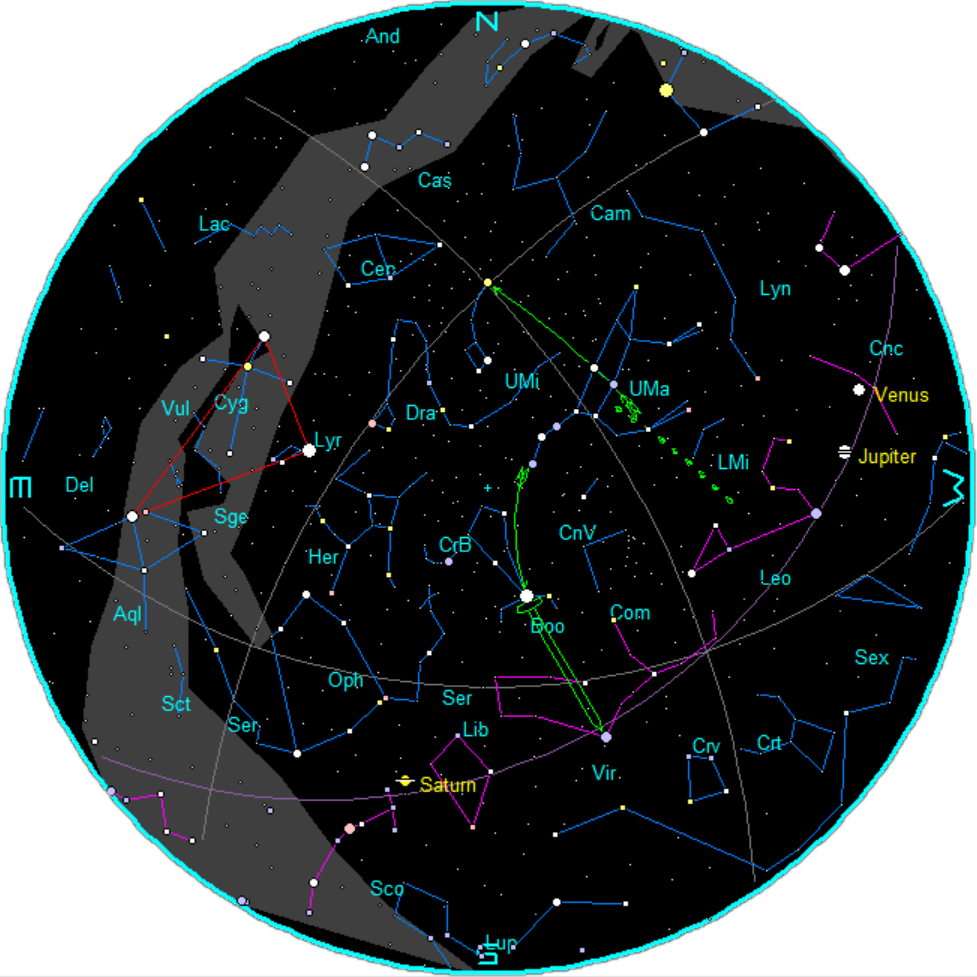
Star Chart for June 2015. Created using my LookingUp program.
The Moon is not plotted.
The planets and stars are plotted for the 15th at 11 p.m. EDT. That is chart time. Note, Traverse City is located 1 hour 45 minutes behind our time meridian. To duplicate the star positions on a planisphere set it to 1 hour 45 minutes earlier than the current time.
Evening Astronomical twilight ends at 11:43 p.m. EDT on June 1st, increasing to midnight EDT on the 30th.
Morning astronomical twilight starts at 4:38 a.m. EDT on June 1st, and decreasing to 3:31 a.m. EDT on the 30th.
Add a half hour to the chart time every week before the 15th and subtract and hour for every week after the 15th.
For a list of constellation names to go with the abbreviations click here.
The green pointer from the Big Dipper is:
- Pointer stars at the front of the bowl of the Big Dipper point to Polaris the North Star.
- Drill a hole in the bowl of the Big Dipper and the water will drip on the back of Leo the Lion.
- Follow the arc of the Big Dipper’s handle to Arcturus
- Continue with a spike to Spica
- The Summer Triangle is shown in red
Calendar of Planetary Events
Credit: Sky Events Calendar by Fred Espenak and Sumit Dutta (NASA’s GSFC)
To generate your own calendar go to http://eclipse.gsfc.nasa.gov/SKYCAL/SKYCAL.html
Times are Eastern Daylight Time on a 24 hour clock. Some additions made to aid clarity.
Conjunctions like the Moon-Saturn: 2.1° S means Saturn will appear 2.3° south of the Moon.
| Jun | 01 | Mo | Venus: 45.3° E | |
| 01 | Mo | 16:02 | Moon-Saturn: 2° S | |
| 02 | Tu | 12:19 | Full Moon | |
| 03 | We | 17:10 | Moon South Dec.: 18.4° S | |
| 06 | Sa | 14:59 | Venus Elongation: 45.4° E | |
| 09 | Tu | 11:42 | Last Quarter | |
| 10 | We | 00:39 | Moon Perigee: 369700 km | |
| 10 | We | 19:29 | Moon Descending Node | |
| 13 | Sa | 04:59 | Venus-Beehive: 0.6° N | |
| 14 | Su | 10:39 | Mars Solar Conjunction | |
| 16 | Tu | 10:05 | New Moon | |
| 16 | Tu | 15:47 | Moon North Dec.: 18.5° N | |
| 20 | Sa | 07:28 | Moon-Venus: 6.3° N | |
| 21 | Su | 12:38 | Summer Solstice | |
| 23 | Tu | 05:39 | Mercury-Aldebaran: 1.9° N | |
| 23 | Tu | 13:01 | Moon Apogee: 404100 km | |
| 24 | We | 07:03 | First Quarter | |
| 24 | We | 12:59 | Mercury Elongation: 22.5° W | |
| 24 | We | 13:23 | Moon Ascending Node | |
| 28 | Su | 21:27 | Moon-Saturn: 2.1° S | |
| 30 | Tu | 22:14 | Venus-Jupiter: 0.3° N | |
| Jul | 01 | We | 02:48 | Moon South Dec.: 18.4° S |
| 01 | We | Venus: 42.4° E | ||
 Bob Moler's Ephemeris Blog