Archive
Ephemeris: 02/14/2025 – A Valentine’s Day Rendezvous

This is Ephemeris for St Valentine’s Day, Friday, February 14th. Today the Sun will be up for 10 hours and 26 minutes, setting at 6:10, and it will rise tomorrow at 7:42. The Moon, 2 days past full, will rise at 8:34 this evening.
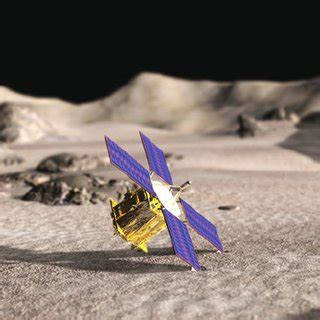
Twenty-five years ago to the day, the NEAR-Shoemaker* spacecraft entered into orbit of the near Earth asteroid 433 Eros. It wasn’t originally planned to enter orbit of the asteroid named after the Greek god of love on Valentine’s Day, 2000. It arose after an aborted course correction a year earlier. After solving the problem, a new course was plotted and NEAR-Shoemaker was gently inserted into orbit of this 21 mile long asteroid, shaped like a bent bread stick with a bite taken out of the center of it. The spacecraft spent almost a year orbiting Eros at various altitudes. The spacecraft ended its mission by gently dropping onto the middle of the asteroid, where it stayed alive for ten days before succumbing to the cold.
The astronomical event times given are for the Traverse City/Interlochen area of Michigan (EST, UT – 5 hours). Times will be different for other locations.
* The spacecraft was launched as NEAR for Near Earth Asteroid Rendezvous. It was renamed en route NEAR-Shoemaker after Eugene Shoemaker’s death in 1997. Shoemaker was a geologist who trained Apollo astronauts and proved that the Barringer Meteor Crater was indeed an impact site and not a volcanic caldera, and that most of the Moon’s craters were also caused by impacts. He with his wife Carolyn and David Levy discovered Comet Shoemaker-Levy 9, which crashed into Jupiter in 22 pieces in July 1994, gaining worldwide attention.
Addendum

NASA/JPL/JHUAPL. Caption from: https://eros2019.imcce.fr/eros.html via Google Translate.
02/14/2022 – Ephemeris – A celestial Valentine’s Day encounter
This is Bob Moler with Ephemeris for St Valentine’s Day, Monday, February 14th. Today the Sun will be up for 10 hours and 25 minutes, setting at 6:10, and it will rise tomorrow at 7:43. The Moon, 2 days before full, will set at 7:40 tomorrow morning.
Twenty-two years ago to the day, the NEAR-Shoemaker* spacecraft entered into orbit of the near Earth asteroid 433 Eros. It wasn’t originally planned to enter orbit of the asteroid named after the Greek god of love on Valentine’s Day, 2000. It arose after an aborted course correction a year earlier. After solving the problem, a new course was plotted and NEAR-Shoemaker was gently inserted into orbit of this 21 mile long asteroid shaped like a bent bread stick with a bite taken out of the center of it. The spacecraft spent almost a year orbiting Eros at various altitudes. The spacecraft ended its mission gently crashing into the middle of the asteroid, where it stayed alive for two weeks before succumbing to the cold.
The astronomical event times given are for the Traverse City/Interlochen area of Michigan (EST, UT – 5 hours). They may be different for your location.
*The name Shoemaker was added to the NEAR spacecraft name after it was launched. NEAR stands for Near Earth Asteroid Rendezvous. It was named for Eugene Shoemaker, a geologist who proved that the Barringer Crater in Arizona was an impact crater rather than a volcanic crater, thus proving, before the Apollo 11 landing on the Moon, that the Moon’s craters were mostly impact craters produced by small asteroids like Eros. Shoemaker and his wife Carolyn, the astronomer in the family, along with David Levy discovered the Comet Shoemaker-Levy 9. The comet had broken into more than 22 pieces and crashed into Jupiter over a week in July 1994, making blemishes in the Jovian clouds that lasted many months.
Addendum
“These color images of Eros were taken by the NEAR probe on February 12, 2000, at a distance of 1,800 kilometers, during the final approach imaging sequence before insertion into orbit. The images show the approximate color of Eros as it would be seen with the naked eye.” Click on the image to enlarge it. Credit
NASA/JPL/JHUAPL. Caption from: https://eros2019.imcce.fr/eros.html via Google Translate.
By the way, the Roman equivalent to Eros was the god Cupid, whose love dart is the constellation Sagitta, which resides within the Summer Triangle of bright stars, to be seen in the evening sky four months from now.
I’ll end with a Valentine heart. The red color is real, it’s due to hydrogen.
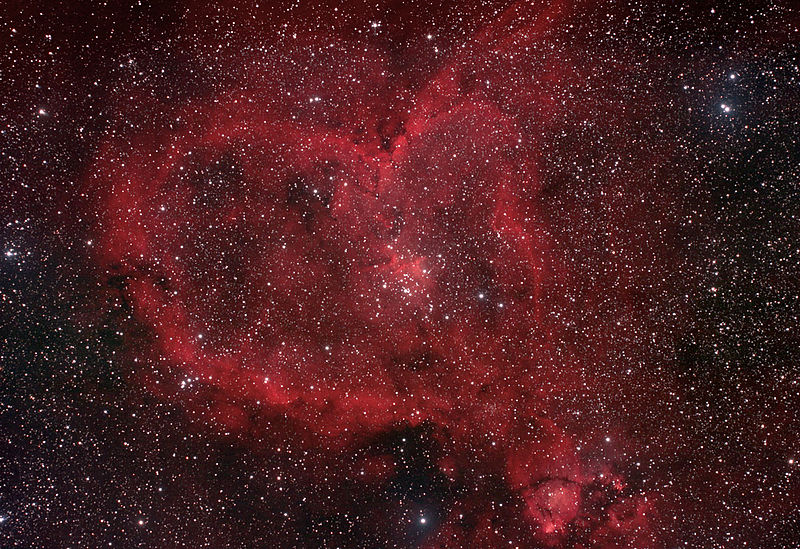
IC 1805 (Heart Nebula) Credit: s58y [CC BY 2.0 (https://creativecommons.org/licenses/by/2.0)%5D, via Wikimedia Commons.
 Bob Moler's Ephemeris Blog