Archive
Ephemeris: 07/15/2024 – When planets go rogue
This is Ephemeris for Monday, July 15th. Today the Sun will be up for 15 hours and 13 minutes, setting at 9:25, and it will rise tomorrow at 6:12. The Moon, 2 days past first quarter, will set at 1:40 tomorrow morning.
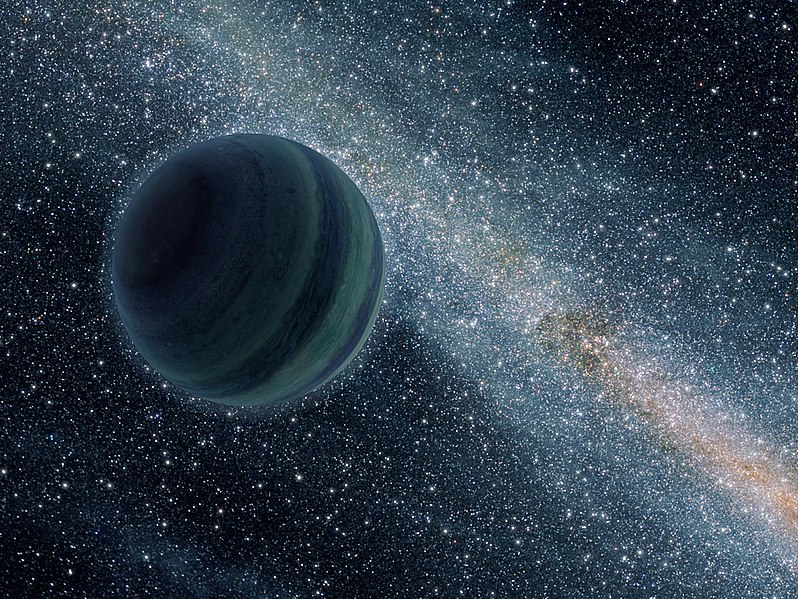
We all know that there are stars and there are planets and planets orbit stars, right? Well maybe not. Astronomers have recently discovered planets that don’t orbit stars. They float free in interstellar space. They are called rogue planets. There seems to be two ways to produce a rogue planet. The first way is to have the planet ejected from a star system through gravitational interaction with other planets especially big ones like Jupiter. Also, it appears that rogue planets can form like stars, and have protoplanetary discs. Or proto-moon disks? They can be discovered by the infrared light they give off, or by gravitational microlensing of a star that passes directly behind them.
The astronomical event times given are for the Traverse City/Interlochen area of Michigan (EDT, UT–4 hours). They may be different for your location.
Addendum

Ephemeris: 08/03/2023 – What is a rogue planet?
This is Bob Moler with Ephemeris for Thursday, August 3rd. Today the Sun will be up for 14 hours and 35 minutes, setting at 9:06, and it will rise tomorrow at 6:32. The Moon, 2 days past full, will rise at 10:40 this evening.
Did you ever hear of something called a rogue planet? A rogue planet is an exoplanet without a star, wandering through interstellar space. A planet could be ejected from its planetary system through interaction with another planet, or maybe it’s in a multiple star system and usually the body with the lease mass loses and can be ejected from the system. Another way to create a rogue planet is to have a planet being created like a star but without enough mass to build it up and be left with too little mass to ignite the hydrogen within its core to create helium and thus begin to shine. Rogue planets are detectable by gravitational microlensing, causing a background star inline with the rogue planet and the Earth to briefly brighten. Rogue planets can be detected and studied because they are relatively warmer than the 3
Kelvin Cosmic Microwave Background. The James Webb Space Telescope is an ideal tool to study them. There may be more rogue planets than stars in the Milky Way.
The astronomical event times given are for the Traverse City/Interlochen area of Michigan (EDT, UT –4 hours). They may be different for your location.
This has been extensively modified from the presentation in the radio program.
Addendum
 Bob Moler's Ephemeris Blog