Archive
11/03/2020 – Ephemeris – Two meteor showers emanating from Taurus
This is Ephemeris for Election Day, Tuesday, November 3rd. Today the Sun will be up for 10 hours and 3 minutes, setting at 5:27, and it will rise tomorrow at 7:25. The Moon, 3 days past full, will rise at 7:22 this evening.
November is a month of low grade meteor showers. The first two are related showers from the same comet. They are the South Taurid and North Taurid meteor showers. The South Taurid meteor shower peaks on October 10th, while the North Taurid meteor shower peaks on November 12th. The both have Encke’s Comet as their source. Encke’s official name is 2P/Encke named after Johann Franz Encke who calculated it’s orbit after it had been observed on three earlier appearances including by Charles Messier and Caroline Herschel, sister of William Herschel, astronomer and composer. Encke has the shortest period of any reasonably bright comet of 3.3 years. The other notable meteor shower this month is the Leonids which we’ll visit later.
The event times given are for the Traverse City/Interlochen area of Michigan. They may be different for your location.
Addendum
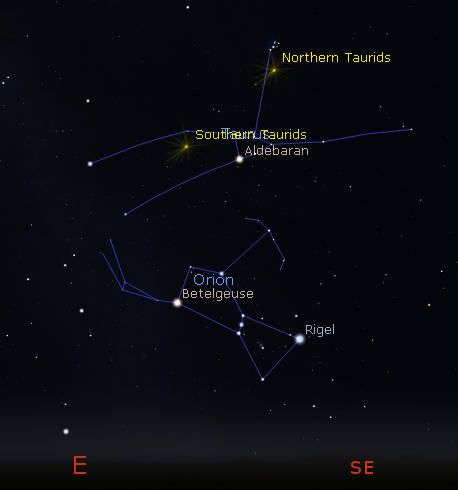
The radiants of the Northern and Southern Taurid meteor showers at 11 pm November 12, 2020. Both these radiants move eastward with time due to the Earth’s orbital motion. The activity dates of the two meteor showers overlap. The Southern Taurids are active between September 10 to November 20, while the Northern Taurids are active between October 20 to December 10. Both have peak rates of 5-10 meteors per hour. Created using Stellarium.
11/06/2018 – Ephemeris – The Taurid meteor showers
Ephemeris for Election Day, Tuesday, November 6th. The Sun will rise at 7:27. It’ll be up for 9 hours and 57 minutes, setting at 5:24. The Moon, 1 day before new, will rise at 7:09 tomorrow morning.
We are in the midst of two showers of meteors that seen to come from the constellation of Taurus the bull. These are the Southern and Northern Taurids respectively. They only produce a handful of meteors per hour, but there seems to be some discrepancy in their peak dates. The International Meteor Organization has the Southern group peak October 10th. Other sources have it peak November 5th. The Northern group peaks on the 10th or 12th of November depending on the source. Anyway these are bits shed by Comet 2P/Encke, which has only a 3 year orbit of the Sun. Encke’s orbit also comes close to the Earth’s orbit where the Earth is at the end of June. I’ve always wondered if it was a piece of Encke’s nucleus that hit Siberia on June 30, 1908?
The times given are for the Traverse City/Interlochen area of Michigan. They may be different for your location.
Addendum
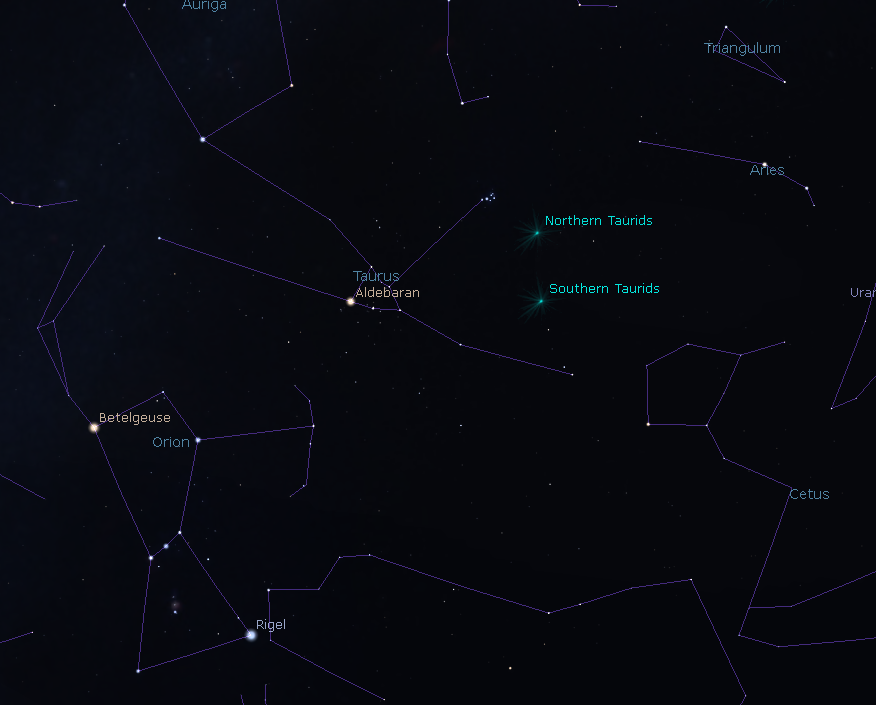
The radiants are not as nearly defined as shown here
 Bob Moler's Ephemeris Blog