Archive
02/28/2017 – Ephemeris – Previewing the skies of March 2017
Ephemeris for Fat Tuesday, February 28th. The Sun will rise at 7:21. It’ll be up for 11 hours and 8 minutes, setting at 6:29. The Moon, 2 days past new, will set at 9:03 this evening.
Let’s preview the month of March which begins tomorrow. In March the increase in daylight hours is at its greatest, with Spring 3 weeks away. Daylight hours will increase from 11 hours and 11 minutes tomorrow to 12 hours and 44 minutes on the 31st. Along with that the altitude of the sun at local noon will increase from 38 degrees today to 49 ½ degrees at month’s end. The big astronomical event of this month will be a near grazing occultation of the bright star Aldebaran by the Moon. Aldebaran is the bright star in the face of Taurus the bull. This will occur just after 11 p.m. Saturday night the 4th. The southern half of the IPR listening area will be able to see it. See bobmoler.wordpress.com for more information.
Times are for the Traverse City/Interlochen area of Michigan. They may be different for your location.
Addenda
March Star Charts
Evening
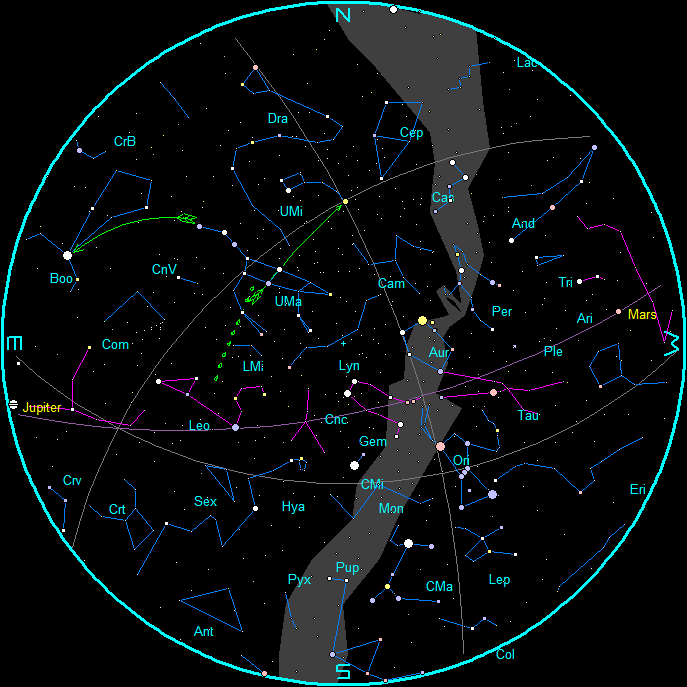
Star Chart for March 2017. Created using my LookingUp program. Click on image to enlarge.
Morning
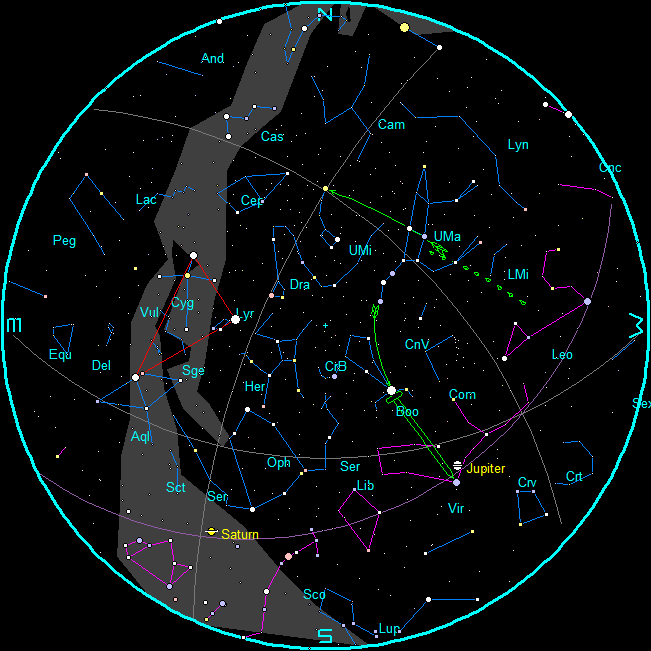
Star Chart for March 2017 mornings. Created using my LookingUp program. Click on image to enlarge.
The planets and stars are plotted for the 15th at 10 p.m. EDT, and again at 6 a.m. Those are chart times. Note, Traverse City is located approximately 45 minutes behind our time meridian. (An hour 45 minutes behind our daylight saving time meridian. during EDT and 45 minutes behind our daylight standard time meridian. during EST). To duplicate the star positions on a planisphere you may have to set it to 1:45 or 0:45 earlier than the current time if you were near your time meridian.
For a list of constellation names to go with the abbreviations click here.
- Pointer stars at the front of the bowl of the Big Dipper point to Polaris the North Star
- Follow the arc of the handle of the Big Dipper to the star Arcturus, and
- Straighten to a spike to Spica
- The Summer Triangle is shown in red
Evening nautical twilight ends at 7:32 p.m. EST on the 1st, increasing to 9:16 p.m. EDT on the 31st.
Evening astronomical twilight ends at 8:06 p.m. EST on the 1st, increasing to 9:53 p.m. EDT on the 31st.
Morning astronomical twilight starts at 5:43 a.m. EST on the 1st, and increasing to 5:48 a.m. EDT on the 31st.
Morning nautical twilight starts at 6:17 a.m. EST on the 1st, and Increasing to 6:25 a.m. EDT on the 31st.
NASA Calendar of Planetary Events
Credit: Sky Events Calendar by Fred Espenak and Sumit Dutta (NASA’s GSFC)
To generate your own calendar go to http://eclipse.gsfc.nasa.gov/SKYCAL/SKYCAL.html
Times are Eastern Time and follow the time change dates.
Date        Time    Event
Mar 01  We          Venus: 32.5° E
    01  We  1:58 am Moon-Mars: 4.4° N
    01  We  9:22 pm Neptune Conjunction
    03  Fr  2:24 am Moon Perigee: 369100 km
    04  Sa  9:38 pm Moon-Aldebaran: 0.2° S  Occultation!
    05  Su  6:32 am First Quarter
    06  Mo  7:08 pm Mercury Superior Conjunction with the Sun
    06  Mo  7:43 pm Moon North Dec.: 18.9° N
    10  Fr  5:20 pm Moon-Regulus: 0.9° N
    10  Fr 11:17 pm Moon Ascending Node
    12  Su  2:00 am Daylight Saving Time starts (Spring Forward)
    12  Su 10:54 am Full Moon
    14  Tu  4:04 pm Moon-Jupiter: 2.7° S
    18  Sa  1:25 pm Moon Apogee: 404700 km
    20  Mo  6:29 am Vernal Equinox. Spring starts
    20  Mo  6:49 am Moon-Saturn: 3.8° S
    20  Mo 11:58 am Last Quarter
    21  Tu  1:22 am Moon South Dec.: 18.9° S
    25  Sa  6:31 am Venus Inferior Conjunction with the Sun
    25  Sa 11:41 am Moon Descending Node
    27  Mo 10:57 pm New Moon
    30  Th  8:39 am Moon Perigee: 363900 km
Apr 01  Sa          Venus: 13.4° W
March 2017 Calendar
LU                  Ephemeris of Sky Events for Interlochen/TC
March, 2017    Local time zone: EST
+-----------------------------------------------------------------------+
| DATE |  SUN     SUN  DAYLIGHT|   TWILIGHT*    |MOON  RISE OR    ILLUM |
|      |  RISE    SET    HOURS |  END    START  |PHASE SET** TIME FRACTN|
+=======================================================================+
|Wed  1| 07:19a  06:30p  11:11 | 07:34p  06:16a |      Set  10:15p   14%|
|Thu  2| 07:18a  06:32p  11:14 | 07:35p  06:15a |      Set  11:26p   23%|
|Fri  3| 07:16a  06:33p  11:17 | 07:36p  06:13a |      Set  12:37a   33%|
|Sat  4| 07:14a  06:34p  11:20 | 07:37p  06:11a |      Set  01:45a   44%|
+------+-----------------------+----------------+-----------------------+
|Sun  5| 07:12a  06:36p  11:23 | 07:39p  06:09a |F Qtr Set  02:50a   56%|
|Mon  6| 07:11a  06:37p  11:26 | 07:40p  06:08a |      Set  03:48a   67%|
|Tue  7| 07:09a  06:38p  11:29 | 07:41p  06:06a |      Set  04:40a   77%|
|Wed  8| 07:07a  06:40p  11:32 | 07:43p  06:04a |      Set  05:25a   86%|
|Thu  9| 07:05a  06:41p  11:35 | 07:44p  06:02a |      Set  06:04a   92%|
|Fri 10| 07:03a  06:42p  11:38 | 07:45p  06:00a |      Set  06:38a   97%|
|Sat 11| 07:02a  06:44p  11:42 | 07:47p  05:59a |      Set  07:09a  100%|
+------+-----------------------+----------------+-----------------------+
| EDT  |      Time Change      |                |                       |
|Sun 12| 08:00a  07:45p  11:45 | 08:48p  06:57a |Full  Rise 08:00p  100%|
|Mon 13| 07:58a  07:46p  11:48 | 08:49p  06:55a |      Rise 09:03p   98%|
|Tue 14| 07:56a  07:47p  11:51 | 08:51p  06:53a |      Rise 10:05p   94%|
|Wed 15| 07:54a  07:49p  11:54 | 08:52p  06:51a |      Rise 11:05p   89%|
|Thu 16| 07:52a  07:50p  11:57 | 08:53p  06:49a |      Rise 12:04a   82%|
|Fri 17| 07:51a  07:51p  12:00 | 08:55p  06:47a |      Rise 01:01a   74%|
|Sat 18| 07:49a  07:53p  12:03 | 08:56p  06:46a |      Rise 01:57a   66%|
+------+-----------------------+----------------+-----------------------+
|Sun 19| 07:47a  07:54p  12:07 | 08:57p  06:44a |      Rise 02:50a   56%|
|Mon 20| 07:45a  07:55p  12:10 | 08:59p  06:42a |L Qtr Rise 03:40a   47%|
|Tue 21| 07:43a  07:56p  12:13 | 09:00p  06:40a |      Rise 04:27a   37%|
|Wed 22| 07:41a  07:58p  12:16 | 09:01p  06:38a |      Rise 05:09a   28%|
|Thu 23| 07:39a  07:59p  12:19 | 09:03p  06:36a |      Rise 05:48a   19%|
|Fri 24| 07:38a  08:00p  12:22 | 09:04p  06:34a |      Rise 06:24a   12%|
|Sat 25| 07:36a  08:01p  12:25 | 09:05p  06:32a |      Rise 06:58a    6%|
+------+-----------------------+----------------+-----------------------+
|Sun 26| 07:34a  08:03p  12:28 | 09:07p  06:30a |      Rise 07:31a    2%|
|Mon 27| 07:32a  08:04p  12:32 | 09:08p  06:28a |New   Set  07:43p    0%|
|Tue 28| 07:30a  08:05p  12:35 | 09:10p  06:26a |      Set  08:56p    1%|
|Wed 29| 07:28a  08:06p  12:38 | 09:11p  06:24a |      Set  10:10p    5%|
|Thu 30| 07:26a  08:08p  12:41 | 09:12p  06:22a |      Set  11:24p   11%|
|Fri 31| 07:25a  08:09p  12:44 | 09:14p  06:20a |      Set  12:36a   20%|
+-----------------------------------------------------------------------+
* Nautical Twilight
** Moonrise or moonset, whichever occurs between sunrise and sunset
Grazing Occultation of Aldebaran March 4 or 5, 2017 (Depending on your location)
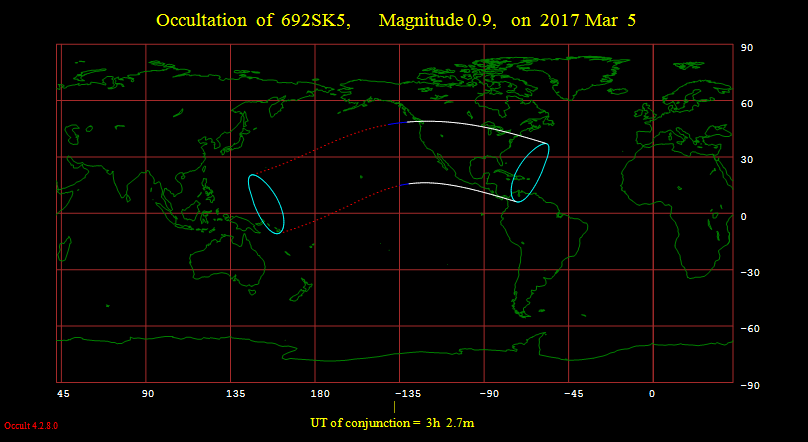
Path of the occultation of Aldebaran for March 4-5, 2017. Note where the top edge of the path goes. Right through northern Michigan.
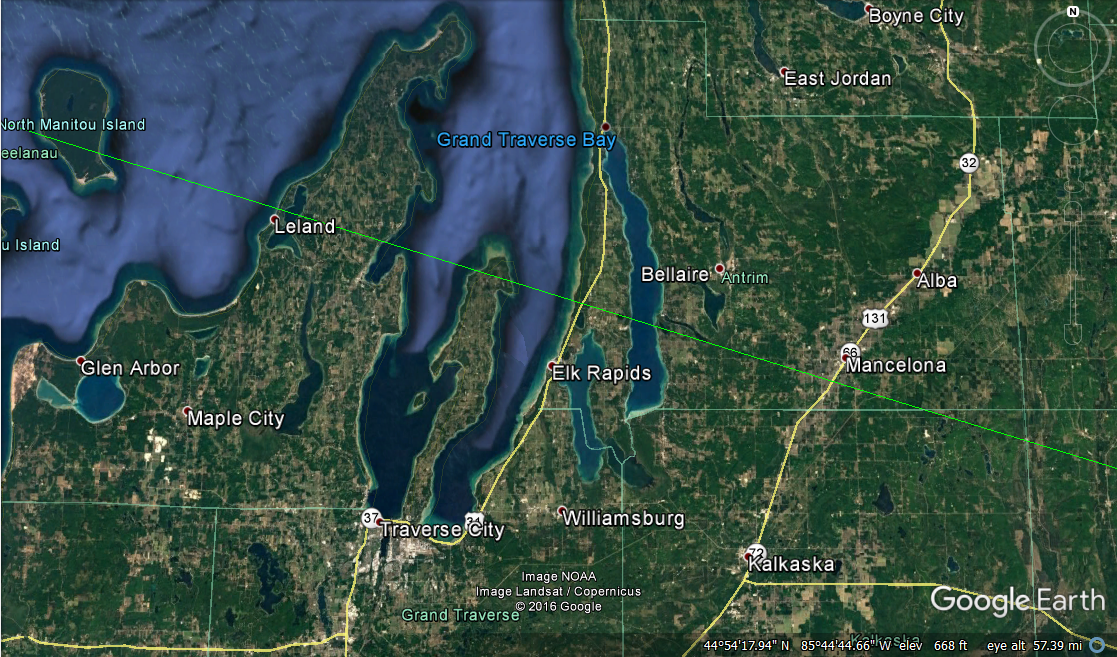
Here’s the line where the limit of the occultation passes in northwestern lower Michigan. Occult4 kml file plotted on Google Earth.
The central time of the occultation is 11:13 p.m. Start viewing the Moon before 11 p.m. The farther south one is of the line the earlier the occultation starts and the longer it lasts. I’ll have lots more information in Thursday’s post.
04/29/2016 – Ephemeris – Let’s preview the merry skies of May
Ephemeris for Arbor Day, Friday, April 29th. The Sun rises at 6:34. It’ll be up for 14 hours and 10 minutes, setting at 8:45. The Moon, at last quarter today, will rise at 3:01 tomorrow morning.
Sunday starts the month when the promise of spring is finally fulfilled. Daylight hours in the Interlochen/Traverse City area will increase from 14 hours and 16 minutes Sunday to 15 hours 20 minutes on the 31st. The altitude, or angle, of the Sun above the southern horizon at local noon will ascend from 60 degrees Sunday to 67 degrees at month’s end. The altitude of the sun in the Straits area will be a degree lower than that but your daylight will be a few minutes longer. The big event of May will be the transit of the tiny planet Mercury across the face of the Sun on May 9th. I’ll have more on that next week. Also Mars will be in opposition from the Sun on the 22nd which due to its elliptical orbit will actually be closest to us 8 days later on the 30th at 46.779 million miles (75.284 million km).
Times are for the Traverse City/Interlochen area of Michigan. They may be different for your location.
Addendum
May Star Chart
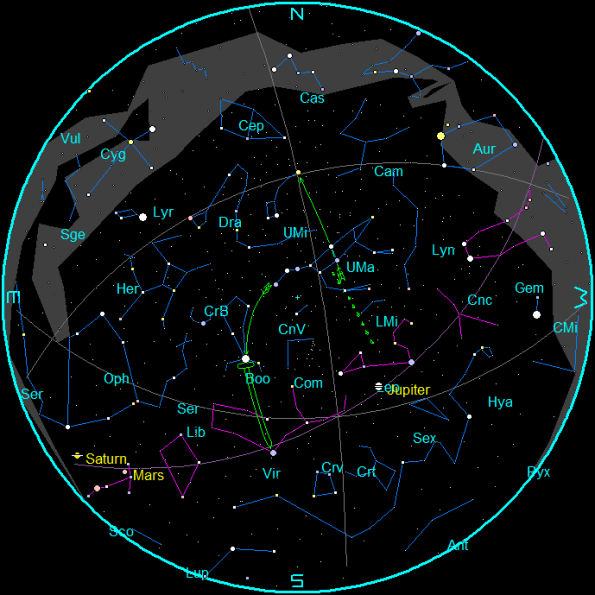
Star Chart for May 2016. Created using my LookingUp program. To enlarge in Firefox Right-click on image then click View Image.
The planets and stars are plotted for the 15th at 11 p.m. EDT. That is chart time. Note, Traverse City is located approximately 45 minutes behind our time meridian. (An hour 45 minutes behind our daylight saving time meridian.) To duplicate the star positions on a planisphere you may have to set it to 1:45 earlier than the current time.
Evening nautical twilight ends at 10:00 p.m. EDT on the 1st, increasing to 10:43 p.m. EDT on the 31st.
Morning nautical twilight starts at 5:20 a.m. EDT on the 1st, and decreasing to 4:38 a.m. EDT on the 31st.
Add a half hour to the chart time every week before the 15th and subtract a half hour for every week after the 15th. Before the 13th also subtract an hour for Standard Time.
For a list of constellation names to go with the abbreviations click here.
- Pointer stars at the front of the bowl of the Big Dipper point to Polaris the North Star
- A leaky Big Dipper drips on Leo
- Follow the arc of the handle of the Big Dipper to the star Arcturus
- Extend the ac to a spike to point to Spica
Calendar of Planetary Events
Credit: Sky Events Calendar by Fred Espenak and Sumit Dutta (NASA’s GSFC)
To generate your own calendar go to http://eclipse.gsfc.nasa.gov/SKYCAL/SKYCAL.html
Times are Eastern Time. Some additions made to aid clarity.
    Date   Time      Event
May 01 Su            Venus: 9.8° W
    02 Mo  9:27 p.m. Moon Descending Node
    04 We  2:45 p.m. Eta Aquarid Shower: ZHR = 60
    06 Fr 12:14 a.m. Moon Perigee: 357800 km
    06 Fr  3:30 p.m. New Moon
    08 Su  4:21 a.m. Moon-Aldebaran: 0.5° S
    09 Mo  7:12 a.m. Mercury transit begins
    09 Mo 10:57 a.m. Mercury mid-transit
    09 Mo  2:42 p.m. Mercury transit ends
    09 Mo  5:54 p.m. Moon North Dec.: 18.4° N
    13 Fr  1:02 p.m. First Quarter
    14 Sa  3:06 a.m. Moon-Regulus: 2.5° N
    15 Su  5:30 a.m. Moon-Jupiter: 2.2° N
    15 Su  4:39 p.m. Moon Ascending Node
    18 We  6:06 p.m. Moon Apogee: 405900 km
    21 Sa  5:15 p.m. Full Moon
    22 Su  7:15 a.m. Mars Opposition
    22 Su  5:59 a.m. Moon-Saturn: 3.5° S
    24 Tu  7:16 a.m. Moon South Dec.: 18.5° S
    29 Su  8:12 a.m. Last Quarter
    30 Mo 12:45 a.m. Moon Descending Node
    30 Mo  5:36 p.m. Mars closest to the Earth 0.50321 AU
Jun 01 We            Venus: 1.5° W
Transit of Mercury
May 9, 2016 7:12 a.m. (11:21 UT) to 2:42 p.m. (18:42 UT)
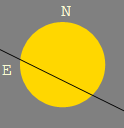
The track of Mercury across the face of the Sun. Mercury will travel from upper left to lower right. Mercury will not be visible until it impinges upon the disk of the Sun. Credit IOTA’s program Occult4.

The map showing where the transit is visible in whole or in part. If using Firefox enlarge the map by right clicking on it and select View Image.
03/01/2016 – Ephemeris – Previewing March skies
Ephemeris for Tuesday, March 1st. The Sun will rise at 7:19. It’ll be up for 11 hours and 11 minutes, setting at 6:31. The Moon, at last quarter today, will rise at 2:15 tomorrow morning.
Let’s look at the skies for the month of March. The sun will pass the celestial equator as the promising season of spring will begin. Daylight hours in the Interlochen/Traverse City area and will increase from 11 hours and 11 minutes today to 12 hours 45 minutes on the 31st. The altitude, or angle, of the sun above the southern horizon at local noon will be 38 degrees today and will ascend to nearly 50 degrees on the 31st. Jupiter will reach opposition from the Sun on the 8th and enter the evening sky. That evening our time a total solar eclipse will be visible from Indonesia to the Pacific Ocean. Spring will begin on the 20th at 12:31 a.m. Easter, announced by the full moon on the 23rd will be celebrated on the 27th for western churches.
Times are for the Traverse City/Interlochen area of Michigan. They may be different for your location.
Addendum
March Star Chart
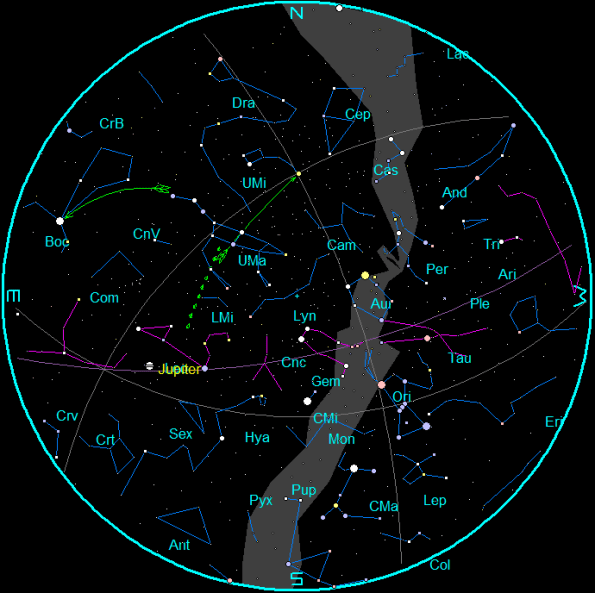
Star Chart for March 2016. Created using my LookingUp program. To enlarge in Firefox Right-click on image then click View image.
The planets and stars are plotted for the 15th at 10 p.m. EST. That is chart time. Note, Traverse City is located 45 minutes behind our time meridian. To duplicate the star positions on a planisphere you may have to set it to 45 minutes earlier than the current time.
Evening astronomical twilight ends at 7:34 p.m. EST on the 1st, increasing to 9:14 p.m. EDT on the 31st.
Morning astronomical twilight starts at 6:16 a.m. EDT on the 1st, and decreasing to 6:20 a.m. EST on the 31st.
Add a half hour to the chart time every week before the 15th and subtract a half hour for every week after the 15th. Before the 13th also subtract an hour for Standard Time.
For a list of constellation names to go with the abbreviations click here.
- Pointer stars at the front of the bowl of the Big Dipper point to Polaris the North Star
- A leaky Big Dipper drips on Leo
- Follow the arc of the handle of the Big Dipper to the star Arcturus
Calendar of Planetary Events
Credit: Sky Events Calendar by Fred Espenak and Sumit Dutta (NASA’s GSFC)
To generate your own calendar go to http://eclipse.gsfc.nasa.gov/SKYCAL/SKYCAL.html
Times are Eastern Time. Some additions made to aid clarity.
    Date  Time(EST) Event
Mar 01  Tu          Venus: 24.9° W
    01  Tu  6:11 pm Last Quarter
    02  We  1:53 am Moon-Saturn: 3.9° S
    03  Th  9:19 am Moon South Dec.: 18.2° S
    07  Mo  5:54 am Moon-Venus: 3.5° S
    08  Tu  4:58 am Jupiter Opposition from the Sun
    08  Tu  8:54 pm New Moon
    08  Tu  8:58 pm Total Solar Eclipse* (Indonesia & Pacific)
    09  We  1:31 am Moon Descending Node
    10  Th  2:02 am Moon Perigee: 359500 km
    13  Su  2:00 am Daylight Saving Time starts (EDT) Boo Hiss!
    14  Mo  9:44 am Moon-Aldebaran: 0.3° S
    15  Tu  1:03 pm First Quarter
    16  We  1:01 am Moon North Dec.: 18.2° N
    20  Su 12:31 am Vernal Equinox – Yea Spring!
    20  Su  3:05 pm Moon-Regulus: 2.8° N
    21  Mo 11:57 pm Moon-Jupiter: 2.3° N
    22  Tu  8:58 pm Moon Ascending Node
    23  We  7:48 am Penumbral Lunar Eclipse (not visible from here)
    23  We  8:01 am Full Moon
    23  We  4:05 pm Mercury Superior Conjunction with the Sun
    25  Fr 10:16 am Moon Apogee: 406100 km
    28  Mo  2:45 pm Moon-Mars: 4.6° S
    29  Tu 10:58 am Moon-Saturn: 3.8° S
    30  We  6:12 pm Moon South Dec.: 18.2° S
    31  Th 11:17 am Last Quarter
Apr 01              Venus: 17.4° W

* Coverage on NASA-TV-2 & www.exploratorium.edu/eclipse from 8 p.m. to 9 p.m.
Comet Catalina
Comet Catalina has become too faint to be seen in binoculars as it heads out of the solar system. To follow the comet further go to Seiichi Yashida’s Weekly Bright Comets page. Comet Catalina is no longer the brightest comet on the list, and is currently listed second. Click on it [C/2013 US10 ( Catalina )] for finder charts and other information.
When last we saw the comet was headed toward the constellation. But it’s headed almost straight away from the Earth now, and the Earth’s motion around the Sun is making the comet appear to start a loop north of Perseus. Another proof that Copernicus was right.
01/01/2016 – Ephemeris – Happy New Year – It’s a busy few days to start off the year
Happy New Year. This is Bob Moler with Ephemeris for New Years Day, Friday, January 1st, 2016. The Sun will rise at 8:20. It’ll be up for 8 hours and 52 minutes, setting at 5:12. The Moon, 1 day before last quarter, will rise at 12:54 tomorrow morning.
It’s always a busy time, astronomically speaking, around the start of the year. This year even more so. Comet Catalina is found near the bright star Arcturus now, which is a good way to find it in binoculars. Tomorrow at 7:59 p.m. (1:59 UT 3rd) the Earth will reach perihelion, the closest point in its orbit to the Sun at about 91.4 million miles (0.9833 AU). It doesn’t add much to the heat we get from the Sun, but it does make winter a couple of days shorter than summer. Monday at 3 a.m. will see the peak of the Quadrantid meteor shower. Unfortunately that’s about the time the Moon will rise. The radiant is north of the handle of the Big Dipper. Good news: tomorrow is the latest sunrise, it should be rising earlier until June.
Times are for the Traverse City/Interlochen area of Michigan. They may be different for your location.
Addenda
January Star Chart
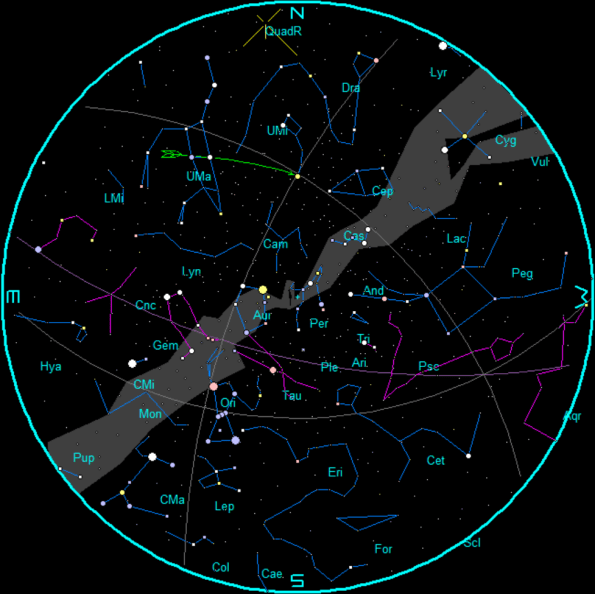
Star Chart for January 2016. Created using my LookingUp program. To enlarge in Firefox Right-click on image then click View Image.
The planets and stars are plotted for the 15th at 9 p.m. EST. That is chart time. Note, Traverse City is located 45 minutes behind our time meridian. To duplicate the star positions on a planisphere you may have to set it to 45 minutes earlier than the current time.
Evening astronomical twilight ends at 6:22 p.m. EST on January 1st, increasing to 6:55 p.m. EST on the 31st.
Morning astronomical twilight starts at 7:09 a.m. EST on January 1st, and decreasing to 6:57 a.m. EST on the 31st.
Add a half hour to the chart time every week before the 15th and subtract and hour for every week after the 15th.
For a list of constellation names to go with the abbreviations click here.
- Pointer stars at the front of the bowl of the Big Dipper point to Polaris the North Star.
- QuadR is the Quadrantid meteor shower radiant
Calendar of Planetary Events
Credit: Sky Events Calendar by Fred Espenak and Sumit Dutta (NASA’s GSFC)
To generate your own calendar go to http://eclipse.gsfc.nasa.gov/SKYCAL/SKYCAL.html
Times are Eastern Time. Some additions made to aid clarity.
     Date   Local      Event
            Time EST
Jan  01  Fr            Venus: 37.9° W
     02  Sa 12:30 a.m. Last Quarter
     02  Sa  6:53 a.m. Moon Apogee: 404300 km
     02  Sa  7:59 p.m. Perihelion: 0.9833 AU
     03  Su  1:45 p.m. Moon-Mars: 1.6° S
     04  Mo  3:01 a.m. Quadrantid Shower: ZHR = 120
     06  We  6:57 p.m. Moon-Venus: 3.3° S
     06  We 11:57 p.m. Moon-Saturn: 3.6° S
     07  Th  6:32 a.m. Venus-Antares: 6.4° N
     08  Fr 12:56 p.m. Moon South Dec.: 18.4° S
     09  Sa  2:42 a.m. Venus-Saturn: 0.1° N
     09  Sa  8:30 p.m. New Moon
     14  Th  9:02 a.m. Mercury Inferior Conj.
     14  Th 10:48 a.m. Moon Descending Node
     14  Th  9:10 p.m. Moon Perigee: 369600 km
     16  Sa  6:26 p.m. First Quarter
     19  Tu  9:16 p.m. Moon-Aldebaran: 0.5° S (Occultation*)
     21  Th 11:41 a.m. Moon North Dec.: 18.4° N
     23  Sa  8:46 p.m. Full Moon
     26  Tu 12:10 a.m. Moon-Regulus: 2.8° N
     27  We  6:58 p.m. Moon Ascending Node
     27  We  8:14 p.m. Moon-Jupiter: 1.6° N
     30  Sa  4:10 a.m. Moon Apogee: 404600 km
     31  Su 10:28 p.m. Last Quarter
Feb  01  Mo            Venus: 31.4° W
* Occultation of Aldebaran For the Grand Traverse Area ± 1-2 minutes:
Disappearance 9:06 p.m. Reappearance 10:25 p.m. I’ll have more information on the 19th.
Occultation Map
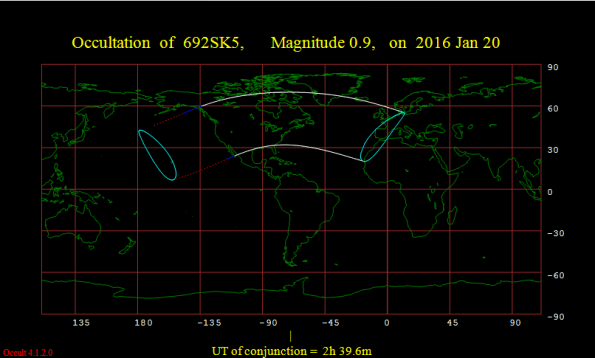
Occultation visibility map for January 20, 2016 (UT). Credit IOTA/Occult4 program.
Estimating occultation timings for your location
I used Cartes du Ciel the free software that I have a link to on the right. Make sure that the program is set for topocentric positions under Setup/Solar System. And you have entered your position under Setup/Observatory. You can find your location in Google Earth, or your GPS device or smart phone.
You can also use Stellarium. Just make sure the Moon is normal sized.
In both programs you can lock the Moon or Aldebaran in the center of the screen Pick a time in advance of the occultation and using the set time window walk the star towards the Moon, mark the time. Then walk the star out from the Moon and record the reappearance time. That’s it.
This should work with other planetarium programs too.
For better accuracy go to the International Occultation Timing Association (IOTA) website. Download and install their Occult4 program for Windows computers. Follow the instructions. When I ran the program for my location, the location I use for Interlochen/Traverse City (Since I live approximately half-way between the two). I got results within a half-minute of the IOTA Occult4 program results. So the approximation method using these planetarium programs is valid.
Comet C/2013 US10 (Catalina)
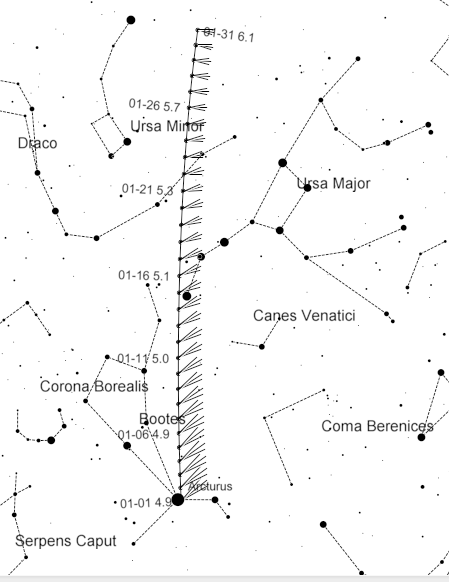
The track of Comet C/2013 US10 (Catalina) for January 2016. Created using Cartes du Ciel (Sky Charts).
The comet is roughly one magnitude fainter than given. Comet is plotted every day at 4 a.m. EST (9 hr UT) with the date and magnitude labeled every 5th day. According to the brightness graph the comet began to under perform in brightness back in September, however, according to a new brightness formula the comet may increase in brightness by a magnitude by late February when it will be well placed for viewing all night. To monitor the brightness reports from observers go to http://www.aerith.net/comet/catalog/2013US10/2013US10.html.
xxxvvvvv
05/30/2014 – Ephemeris – Previewing June skies or Where’d the night go?
Ephemeris for Friday, May 30th. Today the sun will be up for 15 hours and 17 minutes, setting at 9:18. The moon, 2 days past new, will set at 10:51 this evening. Tomorrow the sun will rise at 6:01. | Let’s preview June skies. There will be a lot of sun in June and very little night. The daylight hours will increase a bit from 15 hours and 20 minutes Sunday to 15 hours and 33 minutes on the 21st, retreating back to 15 hours 30 minutes at month’s end. The altitude of the sun above the southern horizon at local noon will hover around 68 to 69 degrees. Local noon, when the sun is actually due south will occur at about 1:43 p.m. Summer begins on the 21st at 6:52 a.m. when the sun reaches its farthest north. The actual amount of night-time will be quite short mostly due to the length of daylight, but also because twilight last much longer than average because the sun sets at a shallow angle. On the 21st there’s only 3 ½ hours of total darkness, starting after midnight.
Times are for the Traverse City/Interlochen area of Michigan. They may be different for your location.
Addendum
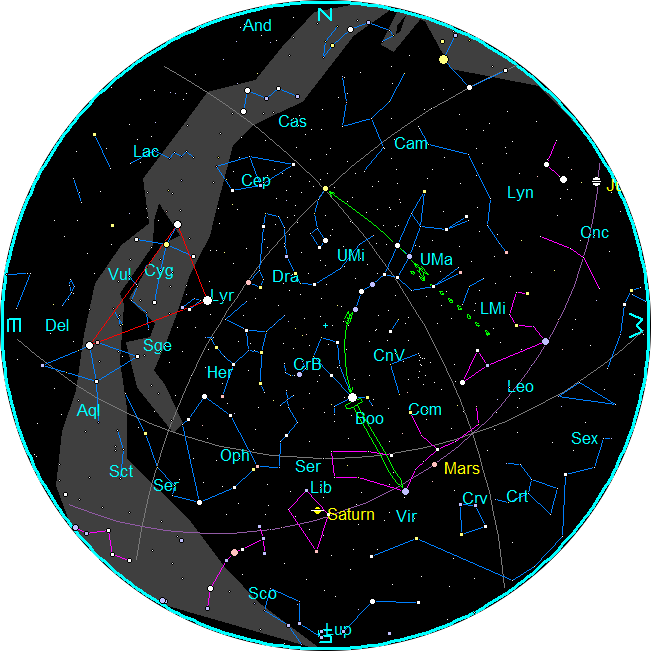
June star chart for 11 p.m. on June 15, 2014. Created by my LookingUp program.
Astronomical twilight ends about midnight in June.
Add a half hour to every week before the 15th and subtract and hour for every week after the 15th.
For a list of constellation names to go with the abbreviations click here.
Also shown is the Summer Triangle in red. Clockwise from the top star is Deneb in Cygnus, Vega in Lyra and Altair in Aquila.
The green pointers from the Big Dipper are:
- Pointer stars at the front of the bowl of the Big Dipper point to Polaris the North Star.
- The leaky bowl drips on the back of Leo the lion.
- The arc of the dipper’s handle points to Arcturus.
- The straighten the ark to a spike to point to Spica.
03/31/2014 – Ephemeris – Previewing April skies
Ephemeris for Monday, March 31st. The sun will rise at 7:25. It’ll be up for 12 hours and 43 minutes, setting at 8:08. The moon, 1 day past new, will set at 9:30 this evening.
The 4th month of the year begins tomorrow. Daylight hours in the Interlochen/Traverse City area and will increase from 12 hours and 46 minutes tomorrow to 14 hours 11 minutes on April 30th. The altitude, or angle, of the sun above the southern horizon at local noon will be 50 degrees tomorrow and will ascend to 60 degrees on April 30th. The altitude of the sun in the Straits area will be a degree lower. The actual time of local apparent noon this month for the Interlochen/Traverse City area, when the sun passes due south, will be about 1:43 p.m. The big event for this month will be a total lunar eclipse visible from our area in the wee hours of the morning on April 15th. It’s the first or two lunar eclipses visible from here this year. The other is in October.
Times are for the Traverse City/Interlochen area of Michigan. They may be different for your location.
Addendum
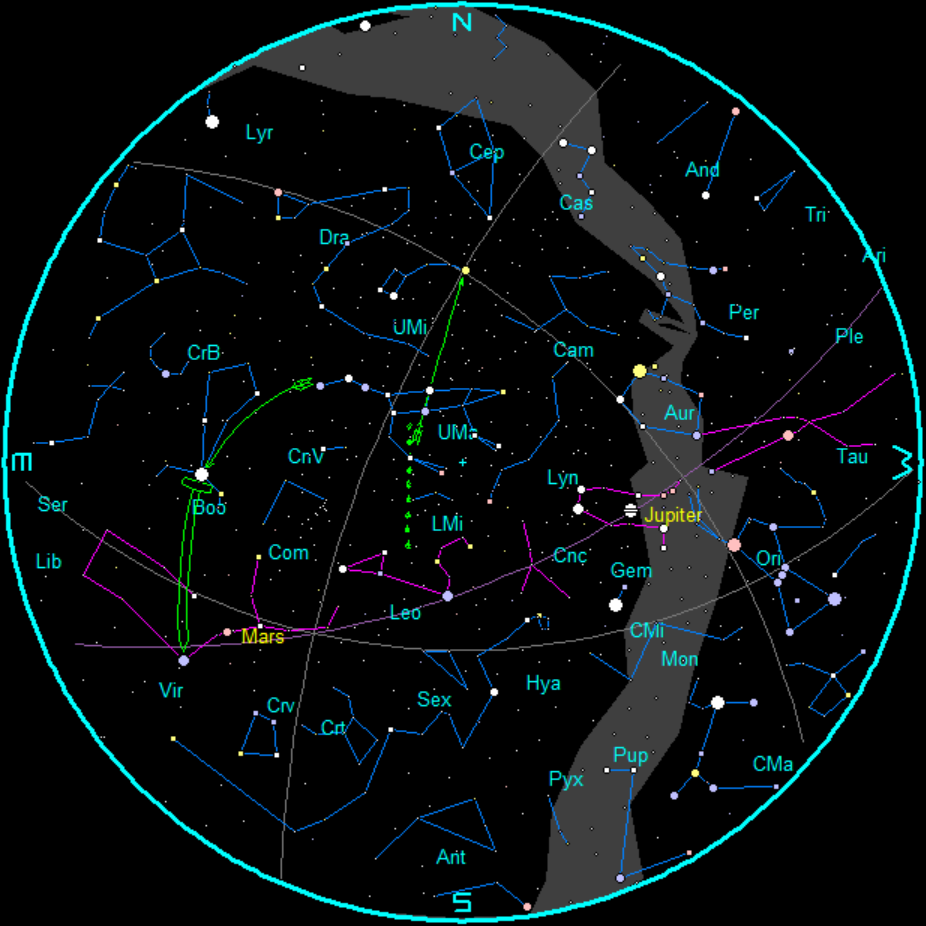
Star Chart for mid-month for April 2014 at 10 p.m. Credit: Bob Moler.
Add a half hour to every week before the 15th and subtract and hour for every week after the 15th.
For a list of constellation names to go with the abbreviations click here.
 Bob Moler's Ephemeris Blog