Archive
07/10/2023 – Ephemeris – Presentation about the James Webb Space Telescope in Traverse City!
This is Bob Moler with Ephemeris for Monday, July 10th. Today the Sun will be up for 15 hours and 21 minutes, setting at 9:28, and it will rise tomorrow at 6:07. The Moon, 1 day past last quarter, will rise at 1:39 tomorrow morning.
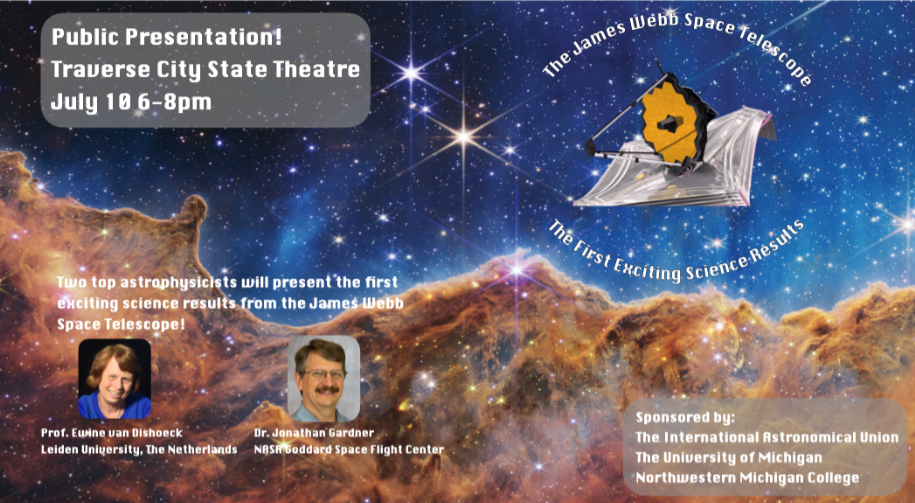
The International Astronomical Union, or IAU, is holding a symposium in Traverse City this week, a meeting of some of the world’s astronomers on the general topic of astrochemistry: From the First Galaxies to the Formation of Habitable Worlds, at the Park Place Hotel & Conference Center. As part of the meeting, there will be a presentation at the State Theater on East Front Street at 6 pm Monday, July 10, 2023 by Professor Ewine van Dishoeck and Dr. Jonathan Gardner on The James Webb Space Telescope – The First Exciting Results. There may still be some free tickets that can be obtained from the State Theater website: https://stateandbijou.org. The program is sponsored by the IAU, University of Michigan, Northwestern Michigan College and the Grand Traverse Astronomical Society.
The astronomical event times given are for the Traverse City/Interlochen area of Michigan (EDT, UT –4 hours). They may be different for your location.
Addendum
This was provided to us about the presentation and the presenters:
Title: The James Webb Space Telescope: a new exploration of the cosmos
Speakers: Jonathan Gardner and Ewine van Dishoeck
Abstract:
The James Webb Space Telescope was launched on Christmas Day 2021 after 25 years of planning, design, development, integration, and testing. Following a six-month deployment and commissioning period, the first science results from Webb have engaged the public and surprised the scientists. Webb’s science goals address our origins and the history of the universe: the first stars and galaxies that formed after the Big Bang; the morphological and dynamical buildup of galaxies; the formation of stars and planetary systems; and exoplanets, our Solar System, and the conditions for life. Webb has already found the most distant galaxies ever seen, made the first detection of carbon dioxide in the atmosphere of an exoplanet, and has examined the interactions between giant stars and the planets that are forming near them.
Jonathan Gardner will review Webb’s construction, launch, and deployments, and discuss the commissioning of the telescope and its instruments. He will describe what scientists have learned in the first year of science results from the telescope on the deep universe. Ewine van Dishoeck will focus on the new insights that Webb has provided us on the formation of new stars and planets and the habitability of other worlds. She will highlight chemical richness of the Webb data, with water and other molecules seen throughout the universe.
Bio:
Jonathan Gardner is the Deputy Senior Project Scientist for the James Webb Space Telescope, a position he has held since 2002 at NASA’s Goddard Space Flight Center. Gardner received an AB degree from Harvard and MS and PhD from the University of Hawaii. As a NATO Fellow, he did postdoctoral research at the University of Durham in the UK. He came to NASA-Goddard in 1996 to work with the Hubble Space Telescope, but soon got involved in early studies of Webb. His scientific research involves using deep infrared observations to study the statistical evolution of galaxies. On the Webb project, he works with the other scientists to ensure the scientific success of the mission, now coming to fruition with Webb’s scientific results.
Ewine van Dishoeck is professor of molecular astrophysics at Leiden University, the
Netherlands. Graduated from Leiden in 1984, she held positions at Harvard, Princeton and
Caltech before returning to Leiden in 1990. The work of her group unites the world of
chemistry with that of physics and astronomy. She has been heavily involved in planning
major new telescopes, including being co-PI on the JWST-MIRI instrument for more than 20
years. She has been fortunate to receive many awards, including the 2018 Kavli Prize for
Astrophysics, as well as membership of the Netherlands, US, German and Norwegian
academies. From 2018-2021, Ewine served as the President of the International
Astronomical Union (IAU).
 Bob Moler's Ephemeris Blog