Archive
04/03/2012 – Ephemeris – Venus passes the Pleiades part 2.
Ephemeris for Tuesday, April 3rd. The sun will rise at 7:18. It’ll be up for 12 hours and 54 minutes, setting at 8:13. The moon, 3 days before full, will set at 5:43 tomorrow morning.
The brilliant planet Venus is passing by the Pleiades star cluster. It will be a great sight in the west in the evening. Binoculars will help in picking out the Pleiads, as the individual stars of the Pleiades are called. The celestial sphere is the ultimate reference frame for objects in the heavens. It used to be the stars, but the stars move, the sun moves and the earth moves. Now the standard for an unmoving frame of reference is distance quasars, the nearly stellar in size active cores of distant galaxies. While they’re moving too, they are so far away we cannot detect any motion on the celestial sphere. Our earth centered frame of reference rotates within that at once in 26 thousand years as the earth’s axis precesses due to the gravitational pull of the moon.
* Times are for the Traverse City/Interlochen area of Michigan. They may be different for your location.
Addendum
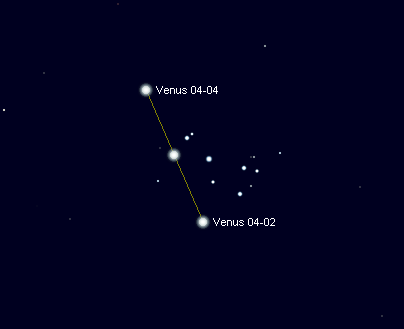
Venus passing the Pleiades April 2 - 4, 2012. Created using Cartes du Ciel.
Click here for a Space.com write up on how quasars are being used as a reference for the GPS system.
04/02/2012 – Ephemeris – Venus will pass the Pleiades tonight
Ephemeris for Monday, April 2nd. The sun will rise at 7:20. It’ll be up for 12 hours and 51 minutes, setting at 8:11. The moon, 3 days past first quarter, will set at 5:14 tomorrow morning.
This evening Venus starts a pass by the Pleiades star cluster. The Pleiades is also known as the Seven Sisters and soon it will disappear in the twilight glow. The next time it will be seen in the evening is in next October. Venus will head back toward the sun, which it will pass directly in front of on June 5th. The sun will pass the Pleiades in mid May, so Venus will never quite make it back to the Pleiades this go around anyway. Though Venus is beginning to head back to the sun, it is still moving eastward against the stars, though a little slower than the sun. Right now Venus is mostly heading toward us. Around the 16th of May Venus will finally stop its eastward motion with respect with the stars and will head westward.
* Times are for the Traverse City/Interlochen area of Michigan. They may be different for your location.
Addendum
Venus passing the Pleiades April 2 - 4, 2012. Created using Cartes du Ciel.
In the real sky Venus is a heck of a lot brighter than you see here. And with binoculars, you’ll see a lot more stars in the Pleiades.
 Bob Moler's Ephemeris Blog