Archive
05/07/2012 – Ephemeris – The Crescent Venus
Ephemeris for Monday, May 7th. The sun rises at 6:23. It’ll be up for 14 hours and 31 minutes, setting at 8:54. The moon, 2 days past full, will rise at 11:10 this evening.
The planet Venus now is spectacular both to the unaided eye and through a telescope. To the eye Venus is the brilliant evening star in the west in the evening. In a telescope it appears as a bright crescent like the moon. This surprised some of the folks that came out to out star party last Friday. The dark side of Venus is the night side of the planet because Venus is now moving between us and the sun, so it’s shining mostly on the other side of the planet. This effect will get more pronounced as Venus becomes more in line with the earth and the sun over this month. When Venus crosses between the earth and the sun June 5th, our time it will actually pass in front of the sun, a rare transit of Venus that will start a little past 6 p.m. That evening.
Times are for the Traverse City/Interlochen area of Michigan. They may be different for your location.
05/04/2012 – Ephemeris – My talk Friday with star party to follow
Ephemeris for Friday, May 4th. The sun rises at 6:27. It’ll be up for 14 hours and 23 minutes, setting at 8:51. The moon, 1 day before full, will set at 5:48 tomorrow morning.
Radio astronomy will be the topic of yours truly this evening at the Grand Traverse Astronomical Society’s monthly meeting at 8 p.m. at Northwestern Michigan College’s Rogers Observatory. This is a rescheduling of a talk that was scheduled for the first Friday in March when we had the big snow storm. Prompted by my recent tour of the National Radio Astronomy Observatory in Green Bank West Virginia, I’ll overview this window on the universe that opened up after World War II. Starting at 9 p.m. will be the monthly viewing night at the observatory. On tap if its clear will be the moon and the planets Venus, Mars and Saturn. The Observatory is located south of Traverse City on Birmley Road off either Garfield or Keystone roads.
Times are for the Traverse City/Interlochen area of Michigan. They may be different for your location.
Addendum
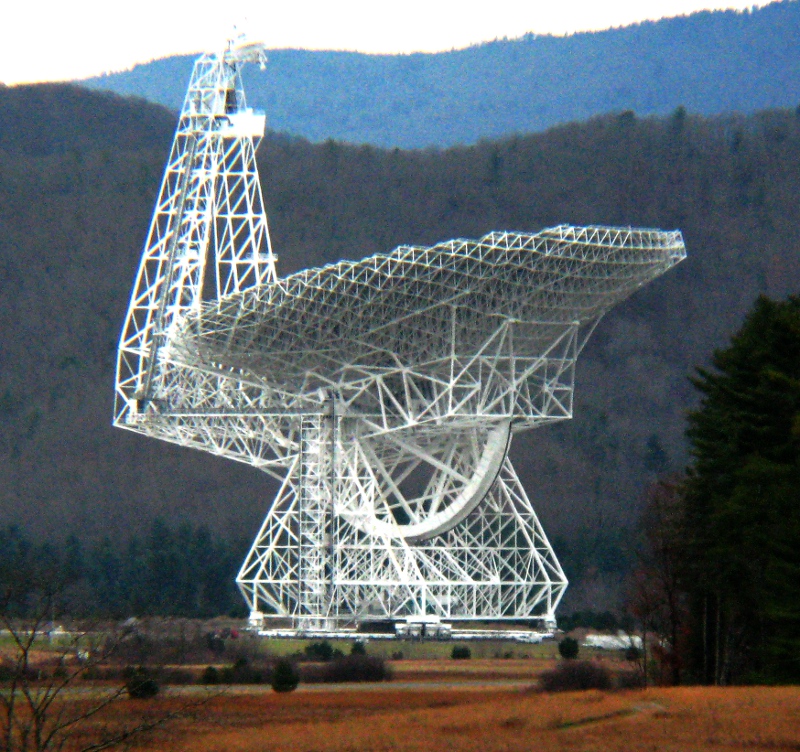
GBT: The Green Bank radio Telescope at The national Radio Astronomy Observatory, Green Bank WV.
Click image to enlarge.
05/03/2012 – Ephemeris – Eclipse cycles
Ephemeris for Thursday, May 3rd. The sun rises at 6:29. It’ll be up for 14 hours and 21 minutes, setting at 8:50. The moon, 2 days before full, will set at 5:11 tomorrow morning.
Eclipses of the sun and moon were most terrifying events for the ancient and primitive peoples. The Chinese thought a dragon was devouring the sun would bang on gongs and shoot arrows into the air to drive the dragon away. It worked every time. Predicting these eclipses became an important matter for ancient astronomers. It was the Chaldeans several centuries before the common era that apparently discovered the interval at which like eclipses occur. The period of 18 year 11 and a third days is called the saros cycle. There are many saros cycles running at any one time. A saros series contains 71 or 72 eclipses, crossing the earth slowly from north to south or south to north. We’ll talk more about eclipses later this month.
Times are for the Traverse City/Interlochen area of Michigan. They may be different for your location.
Addendum
For more information check out Saros in Wikipedia

Saros 136 animation, Public Domain (official work for NASA by Fred Espenak)
Above is an animation of eclipse paths running south to north for saros 136.
05/02/2012 – Ephemeris – Where are the bright planets this week?
Wednesday, May 2nd. The sun rises at 6:30. It’ll be up for 14 hours and 18 minutes, setting at 8:48. The moon, half way from first quarter to full, will set at 4:39 tomorrow morning.
Let’s see what’s happening with the bright planets for this week. Venus is high in the west as it gets dark. Enjoy it now, because it will be gone in 5 weeks. Venus will set at 12:28 a.m. in the west northwest. That’s 8 minutes earlier than last week, so it’s noticeable drawing closer to the sun. Venus is 40.1 million miles away and closing. It is a breautiful brilliant crescent in telescopes. Mars is high in the south in the evening with its unmistakable bright reddish color. It’s in the constellation Leo the lion now. It is 89 million miles from us and moving away. Mars will pass due south at 9:30 p.m. and will be setting in the west at 4:18 a.m. Saturn will be in the east southeast just to the left of the bright star Spica. It will pass due south at 12:33 a.m.
Times are for the Traverse City/Interlochen area of Michigan. They may be different for your location.
Addendum
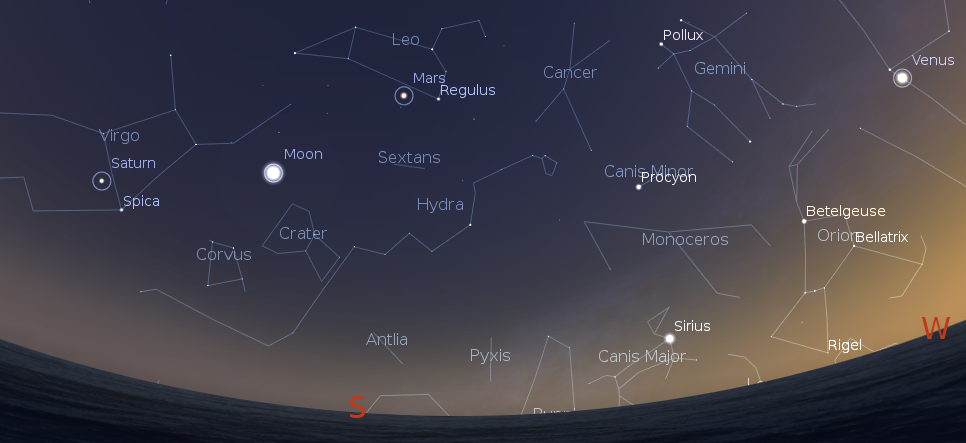
The stars and planets at 9:30 p.m. on May 2, 2012. Created using Stellarium.
05/01/2012 – Ephemeris – The May 20th Eclipse
Ephemeris for Tuesday, May 1st. The sun rises at 6:32. It’ll be up for 14 hours and 15 minutes, setting at 8:47. The moon, 2 days past first quarter, will set at 4:09 tomorrow morning.
(Note: The eclipse visible from most of the United States will be interrupted by sunset. See the Addendum for a link to NASA’s page on the eclipse.)
Let’s give you a heads up on the solar eclipse that will occur on the evening of May 20th. In northern lower Michigan we will see the tail end of the eclipse as the moon’s shadow leaves the face of the earth. The shadow will touch the earth in eastern Asia, cross the Pacific and into North America. This is an annular eclipse, meaning that the moon is too far away to completely cover the face of the sun, leaving a ring (or annulus) of bright sun around the moon at the very center of the eclipse. Some residents of northern California and southern Oregon to west Texas will be able to see this annulus. Your visual safety is paramount when viewing an eclipse and over the next two weeks I’ll be giving you tips on how to view the eclipse safely.
Times are for the Traverse City/Interlochen area of Michigan. They may be different for your location.
Addendum
Here’s a NASA Acrobat file detailing the eclipse. http://eclipse.gsfc.nasa.gov/OH/OHfigures/OH2012-Fig01.pdf
Here’s the Eclipses of 2012 NASA page that links to the above page. It has useful links for those, unlike us are located in the southwestern United States.
 Bob Moler's Ephemeris Blog