Archive
03/08/2013 – Ephemeris – Next week: Comet PanSTARRS enters our skies
Ephemeris for Friday, March 8th. The sun will rise at 7:07. It’ll be up for 11 hours and 32 minutes, setting at 6:39. The moon, 3 days before new, will rise at 5:33 tomorrow morning.
Next week it will be darker in the morning and lighter in the evening as daylight time falls upon the land. But the big attraction next week will be the appearance of Comet PanSTARRS into our northern skies. This comet was discovered by an observatory with that acronym at the summit of the Haleakala on Maui, Hawaii. Tomorrow the comet will come as close to the sun as Mercury does before heading out to deep space again. It’s distance from us will always be farther than the sun. Monday night will be our first time to spot it low in the west 45 minutes after sunset. Tuesday its will appear just to the left of the thin crescent moon. PanSTARRS is not as bright as originally predicted, so it will be difficult to spot in twilight. Binoculars are the best bet for spotting it.
Times are for the Traverse City/Interlochen area of Michigan. They may be different for your location.
Addendum
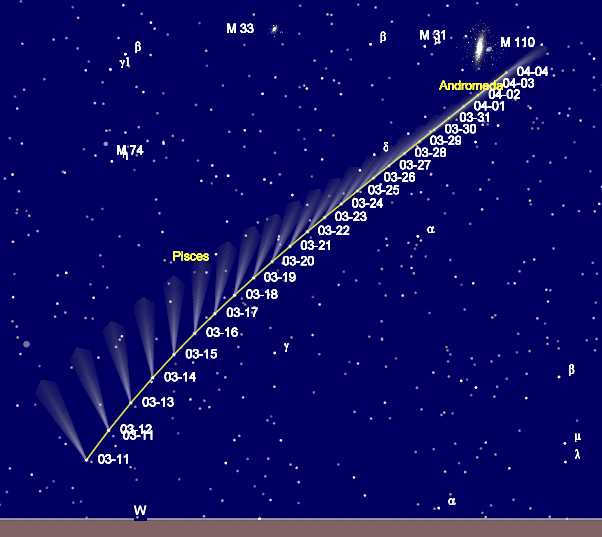
Comet PanSTARRS path in the March evening sky. Created using Cartes duCiel.
Taken and updated from my article in the GTAS newsletter the Stellar Sentinel:
Comet 2011 L4 (PanSTARRS) will be entering our evening sky this month after passing perihelion on March 10th.. Here is my reporting of its discovery in the November 2012 issue:
Obviously PanSTARRS isn’t a person’s name but the first telescope of the Panoramic Survey Telescope and Rapid Response System (Pan-STARRS) located on the summit of the Haleakala volcano on Maui, Hawaii. There are several Comet PanSTARRS so if you use Google or any other search engine to get more information don’t be confused. This one is C/2011 L4. Comet PanSTARRS was discovered on June 6, 2011.
We were hoping for a comet that would reach magnitude 0, as bright as the brightest stars. It seems that this is not going to be the case. The current track of the comet brightness appears to be about a magnitude dimmer than what was previously predicted. To follow PanSTARRS magnitude track, go to the web page http://www.aerith.net/comet/catalog/2011L4/2011L4.html.
The dimness of the comet will make it difficult to spot in the fading twilight. The position of the comet and the moon on the 12th. is seen above, at an hour after sunset. The sliver of the 30 hour old moon will itself be hard to spot. day by day the comet will slowly move higher in the sky and away from evening twilight, On April 1st the comet will begin to pass the Great Andromeda Galaxy.
In photographs displayed on spaceweather.com as I put this issue to bed, the comet appears to have a short tail, divided into a narrow bluish ion tail and a wide dust tail.
Next week I’ll diagram the comet for each of the evenings.
 Bob Moler's Ephemeris Blog