03/20/2013 – Ephemeris – When does spring start, and where is Comet PanSTARRS and the bright planets this week?
Ephemeris for Wednesday, March 20th. The sun will rise at 7:45. It’ll be up for 12 hours and 10 minutes, setting at 7:55. The moon, 1 day past first quarter, will set at 4:17 tomorrow morning.
The sun will cross the earth equator shortly at 7:02 a.m. bringing the season of spring. It’s the vernal equinox. Comet PanSTARRS is in the west northwest low on the horizon. It can best be seen about 9:15 or so. It will set at 9:52 p.m. Jupiter is located in the constellation of Taurus and is in the high southwest during the evening. It will set at 2:00 a.m. Jupiter is a wonderful sight in telescopes with its cloud bands and its moons which change positions each night. The other bright planet Saturn will rise at 11:12 p.m. in the east southeast. It’s located in eastern Virgo. Saturn will pass due south at 4:24 a.m. Saturn is the most beautiful of planets when seen in telescopes. It will be in the southwest for early risers.
Times are for the Traverse City/Interlochen area of Michigan. They may be different for your location.
Addendum
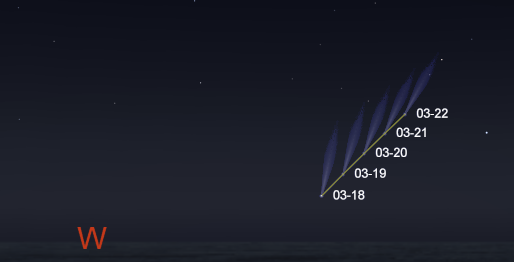
Comet PanSTARRS in the next 5 days at 9:15 p.m. Created using Stellarium and Cartes du Ciel.
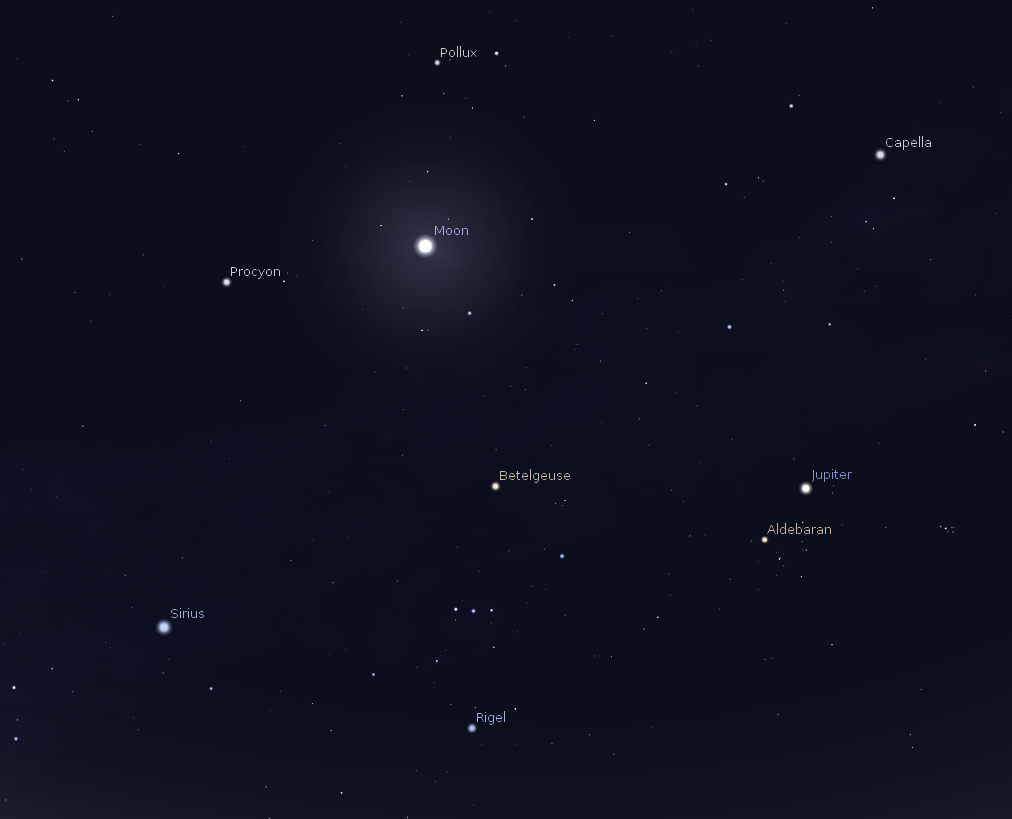
Jupiter, the moon and winter stars at 10 p.m. on March 20, 2013. Created using Stellarium.
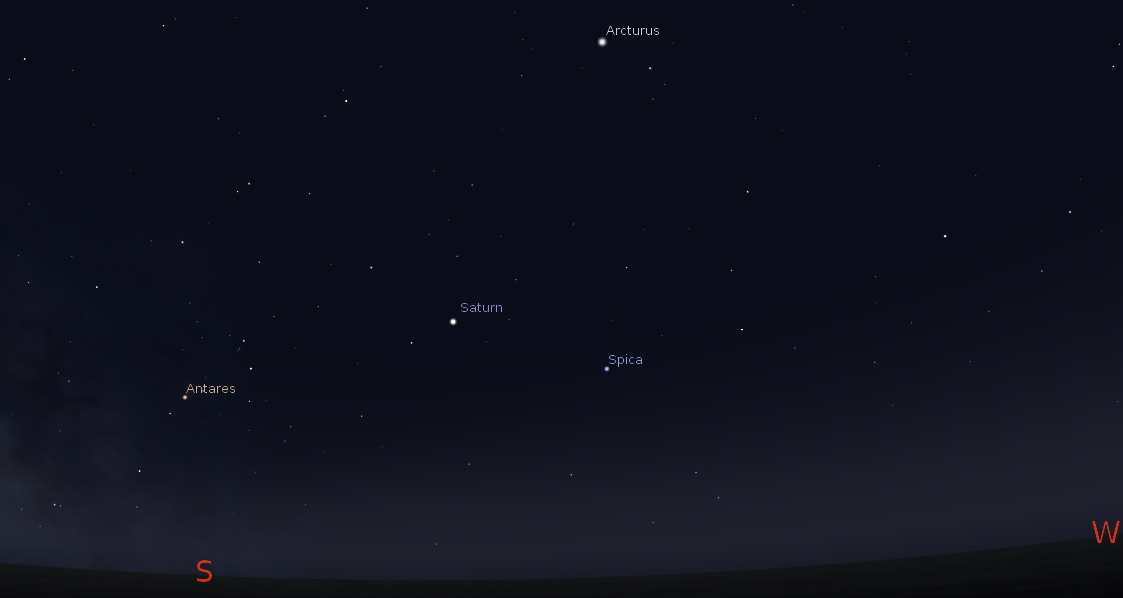
Saturn and the morning stars at 6 a.m. on March 21, 2013. Created using Stellarium.
 Bob Moler's Ephemeris Blog
What I don’t get is last Sunday we had 12 hours from sunrise to sunset. Shouldn’t that happen today? I am, as usual, a little confused..
Richard
To answer your question I dug back in my old web site:
The reason the date in which the sun is actually out exactly 12 hours is different than the equinox date is due to two factors. The definition of instant of sunrise and sunset, and the fact that the earth has an atmosphere. The definition of sunrise is that instant when the top of the sun touches the horizon and first appears. The definition of sunset is the instant the top part of the sun disappears. That’s at least a minute difference for when the center of the sun touches the horizon.
For the equinox to give a true equal night and day the definition of sunrise and sunset would have to state that the event occurred when the center of the sun crossed the horizon. Also the earth must not have an atmosphere. The atmosphere causes light to bend a bit when traveling through it. This is especially pronounced when the object is near the horizon, and makes the object appear higher than it actually is. This bending is called refraction.
Here is the wild part: The sun is half a degree in diameter, and a quarter of a degree in radius. So if there was no atmosphere at the instant of sunrise and sunset the center of the sun would be a quarter of a degree below the horizon. Add atmospheric refraction of a bit more than half a degree, and the center of the sun is officially nearly twice its diameter below the horizon at sunrise and sunset!
To check this out, let’s do a simple calculation. The sun, as I said, is half a degree in diameter. Also the earth’s rotation rate is one degree in 4 minutes. If the sun appears to set when its center is nearly one degree below the horizon, That retards sunset by nearly 4 minutes. Likewise it speeds sunrise by the same amount. So one would expect the sun to be up close to 12 hours 8 minutes on the date of an equinox. My calculations for March 20th show the sun to be out about 12 hours 10 minutes. That’s pretty close for ball park calculations.