Archive
The Rubber Ducky turns out to be kind of an Ugly Duckling
The European Space Agency’s Rosetta spacecraft arrived at its target Comet 67p/Churyumov–Gerasimenko yesterday, August 6th, 2014. The smoothed image 30 pixels across of three weeks ago of a rubber ducky,
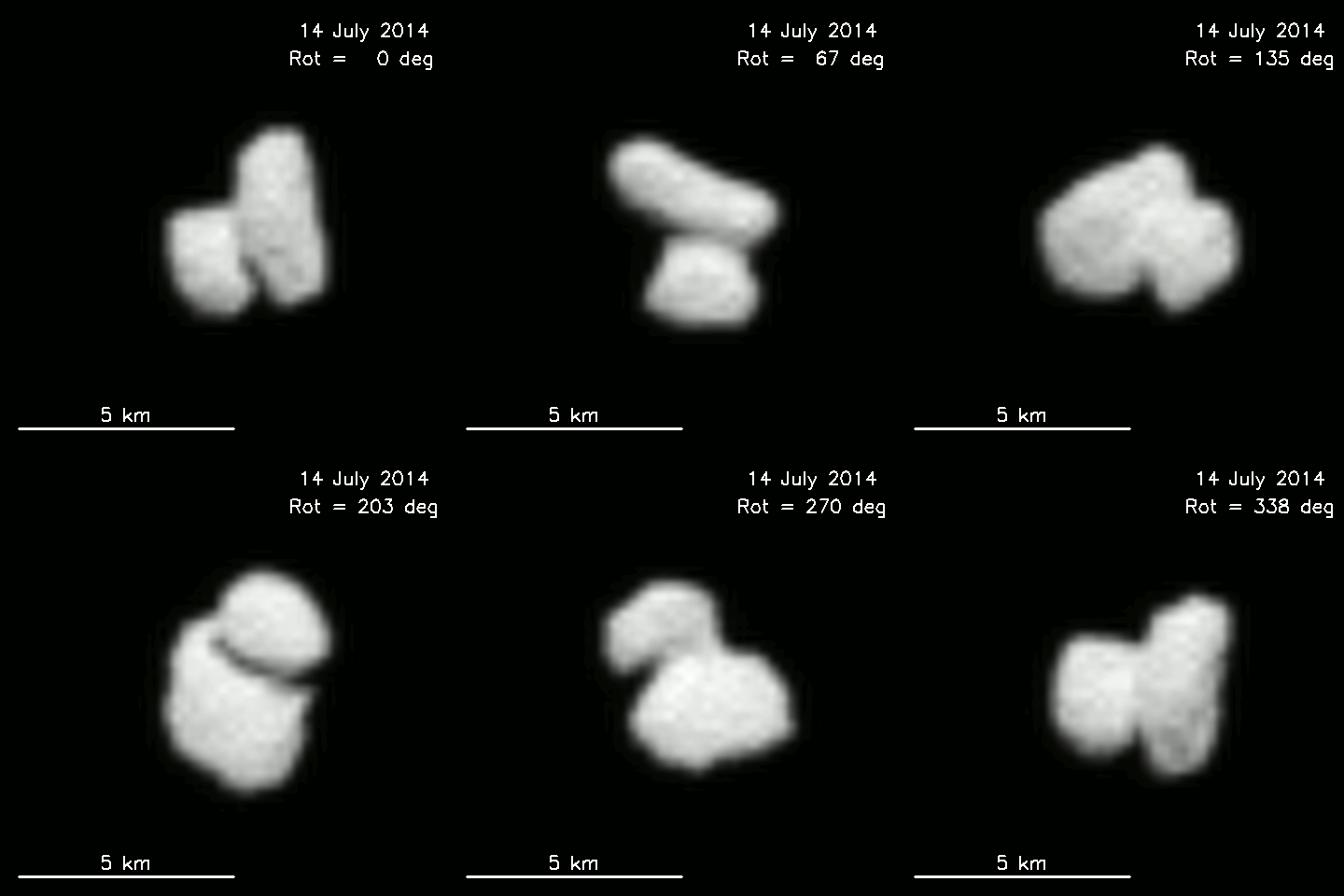
An animation of Comet 67p/Churyumov–Gerasimenko rotation on July 14, 2014. The 30 pixel wide image has been smoothed. The Rotation rate is 1 rotation every 12.4 hours. Credits: ESA/Rosetta/MPS for OSIRIS Team MPS/UPD/LAM/IAA/SSO/INTA/UPM/DASP/IDA
have been replaced by the mega-pixel images we see now of an Ugly Duckling comet, with much more character and battle scars. That’s what happens when you’ve been ’round the Sun to many times.
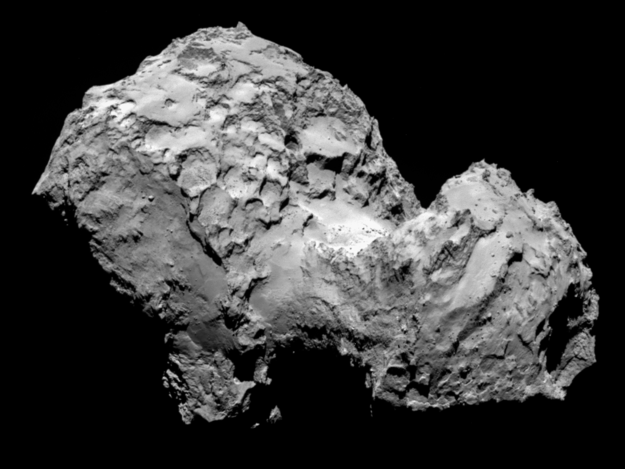
The comet on August 3rd, 2014, 3 days before arrival. Credit: ESA / Rosetta / MPS for OSIRIS Team MPS / UPD / LAM / IAA / SSO / INTA / UPM / DASP / IDA
See Emily Lakdawalla’s post from yesterday at http://www.planetary.org/blogs/emily-lakdawalla/2014/08060249-were-at-the-comet-rosetta.html. It contains lots of images and more information including a 3D image. Grab your red & blue 3D glasses for that one, or if you’ve mastered the techniques of crossed-eye, or parallel-eye stereo viewing.
Also go to ESA’s own Rosetta site at http://www.esa.int/Our_Activities/Space_Science/Rosetta.
I find Emily’s post much more comprehensive. So subscribe to the Planetary Society’s blog feed.
08/07/2014 – Ephemeris – Two large craters of the lunar highlands visible tonight
Ephemeris for Thursday, August 7th. The sun rises at 6:35. It’ll be up for 14 hours and 24 minutes, setting at 8:59. The moon, 3 days before full, will set at 4:07 tomorrow morning.
The gibbous Moon is getting brighter as it becomes more sunlit from the Earth’s prospective. The disk of the Moon will be 89 percent illuminated by the sun tonight. The bright crater Aristarchus, which I’ve talked about before, on the upper left of the moon is now in sunlight. On the lower left there are two interesting craters for the small telescope. Split in half by the sunrise line terminator is the large crater Schickard 137 miles (227 km) in diameter. Craters near the limb of the Moon are foreshortened by the fact that the Moon’s nearly spherical so they there appear elongated. One, more elongated than most, is nearby Schiller which is actually 108 by 43 miles (179 by 69 km), which may be two overlapping craters or a really low angle asteroid impact.
Times are for the Traverse City/Interlochen area of Michigan. They may be different for your location.
Addendum
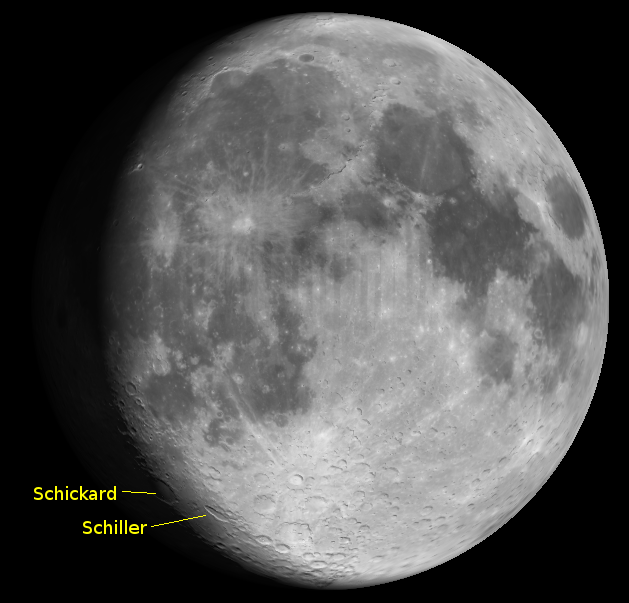
The lunar craters Schickard and Schiller on the lunar terminator at 10 p..m., August 7, 2014. Created using Virtual Moon Atlas.
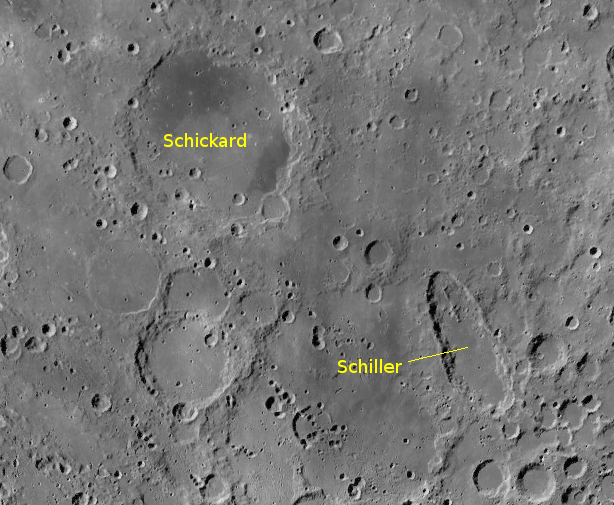
The craters Schickard and Schiller from the Lunar Reconnaissance Orbiter. Credit NASA from Virtual Moon Atlas.
 Bob Moler's Ephemeris Blog