Archive
12/11/2014 – Ephemeris – The Geminid meteors will reach peak numbers Saturday night to Sunday morning
Ephemeris for Thursday, December 11th. The sun will rise at 8:09. It’ll be up for 8 hours and 53 minutes, setting at 5:02. The moon, 3 days before last quarter, will rise at 10:21 this evening.
This weekend is the peak of the Geminid meteor shower. It is the best meteor shower of the year and it is getting more active over the years. The projected peak numbers is 120 meteors an hour spotted by a single observer when the radiant of the shower is overhead. It’s known as the zenithal hourly rate (ZHR). Anyway, the radiant is the point in space where the meteors seem to come from, which is near the star Castor in the constellation Gemini from which the shower gets its name. The meteors will be seen all over the sky, but they all can be traced back to the radiant. The body responsible for this meteor shower is an asteroid rather than a comet. It comes very close to the sun, so may crumble due to heat stress. I suppose I can’t resist this: That’s how the asteroid crumbles.
Times are for the Traverse City/Interlochen area of Michigan. They may be different for your location.
Addendum
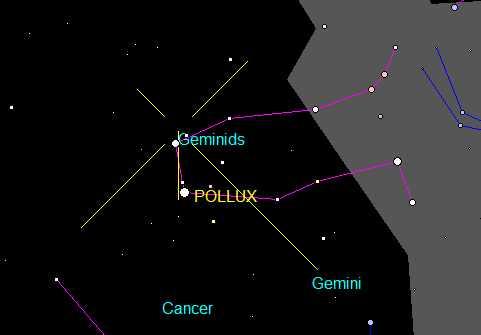
Geminid Radiant. From my LookingUp program.
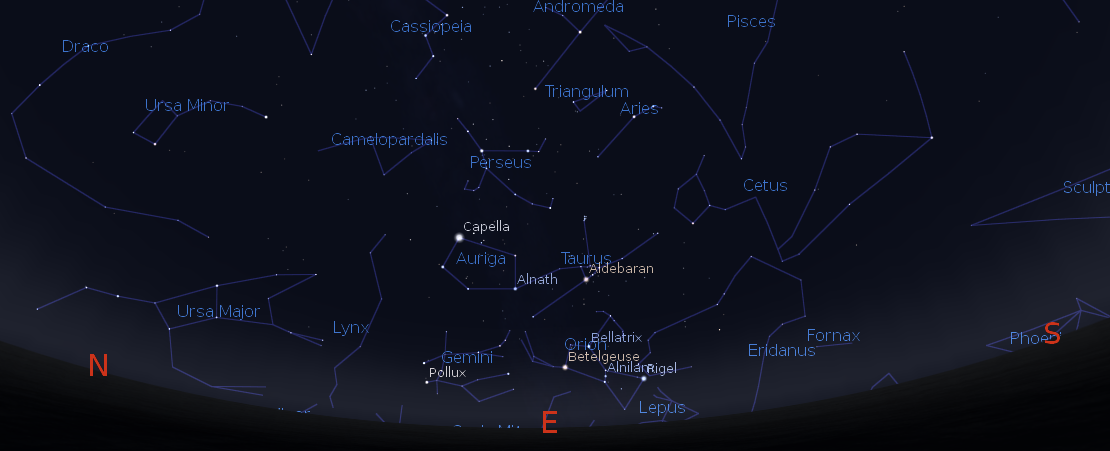
The Eastern sky got the Geminid meteor shower at 8 p.m. December 13, 2014. Created using Stellarium.
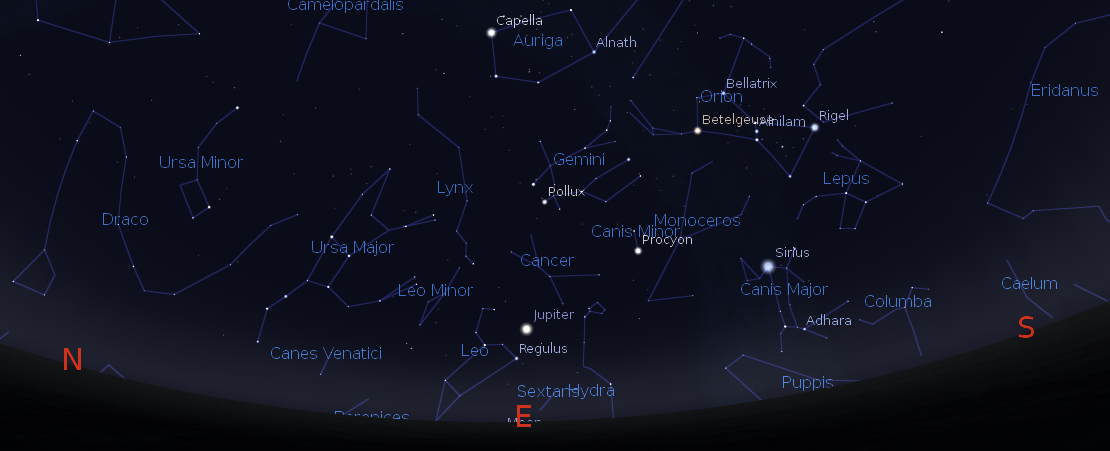
The Eastern sky got the Geminid meteor shower at midnight December 14, 2014. Created using Stellarium.
The Stellarium charts differ from mine at top in how the constellation lines are drawn, especially Gemini. In all charts Castor is not labeled. However it is the bright star above Pollux. The meteors will will appear all over the sky, but true Geminids can be traced back near Castor. Also when the radiant is lowest in the sky, thought the numbers of meteors will be low, the brighter meteors will produce long streaks, since the will hit our atmosphere at a glancing angle.
 Bob Moler's Ephemeris Blog