Archive
Happiness is being a massive galaxy cluster
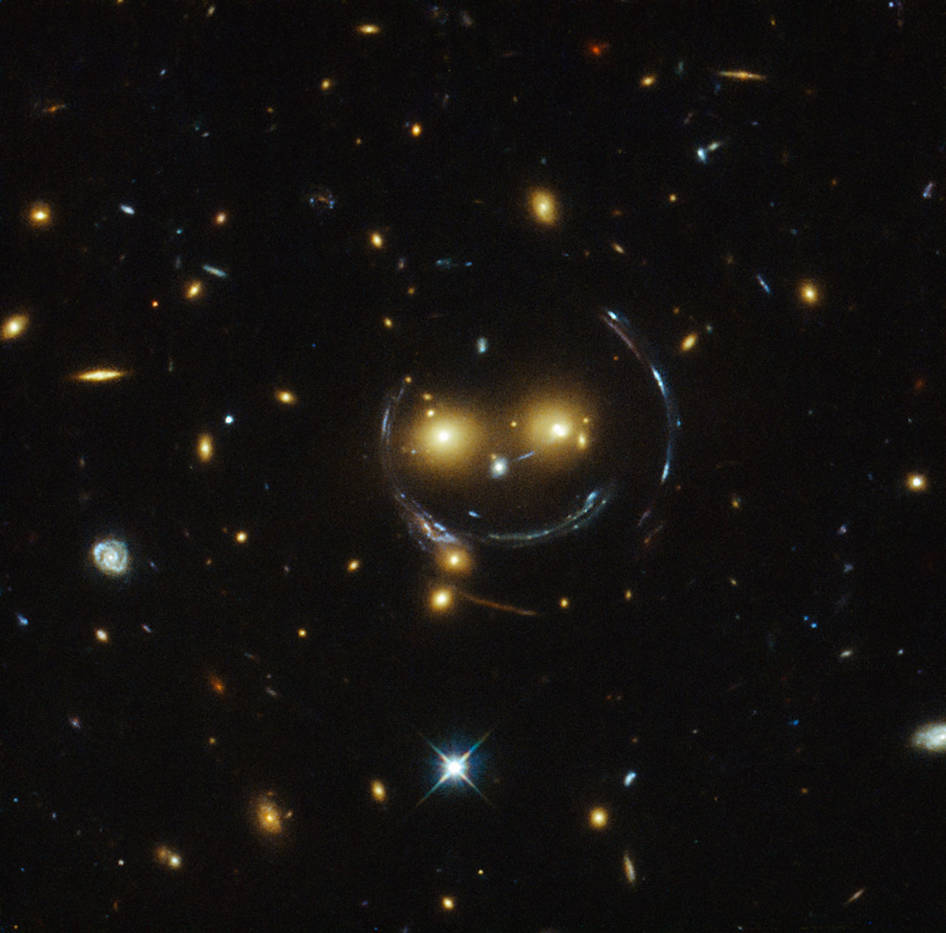
In the centre of this image, taken with the NASA/ESA Hubble Space Telescope, is the galaxy cluster SDSS J1038+4849 — and it seems to be smiling. You can make out its two orange eyes and white button nose. In the case of this “happy face”, the two eyes are very bright galaxies and the misleading smile lines are actually arcs caused by an effect known as strong gravitational lensing. Galaxy clusters are the most massive structures in the Universe and exert such a powerful gravitational pull that they warp the spacetime around them and act as cosmic lenses which can magnify, distort and bend the light behind them. This phenomenon, crucial to many of Hubble’s discoveries, can be explained by Einstein’s theory of general relativity. In this special case of gravitational lensing, a ring — known as an Einstein Ring — is produced from this bending of light, a consequence of the exact and symmetrical alignment of the source, lens and observer and resulting in the ring-like structure we see here. Hubble has provided astronomers with the tools to probe these massive galaxies and model their lensing effects, allowing us to peer further into the early Universe than ever before. This object was studied by Hubble’s Wide Field and Planetary Camera 2 (WFPC2) and Wide Field Camera 3 (WFC3) as part of a survey of strong lenses. A version of this image was entered into the Hubble’s Hidden Treasures image processing competition by contestant Judy Schmidt.
Credit: NASA/ESA
Caption: ESA
This image from the Hubble Space Telescope has been making the rounds. It shows how a massive cluster of galaxies can warp space-time and distort the images of the galaxies behind it into arcs. Here’s more from the Bad Astronomer Phil Plait. It comes in time for Valentine’s day to brighten the dreary month of February.
02/10/2015 – Ephemeris – Orion’s bright red star, Betelgeuse
Ephemeris for Tuesday, February 10th. The sun will rise at 7:50. It’ll be up for 10 hours and 13 minutes, setting at 6:03. The moon, 1 day before last quarter, will rise at 12:51 tomorrow morning.
The bright red star in constellation Orion’s shoulder is Betelgeuse, and its now thought to be about 640 light years away give or take a couple of hundred light years*. The name Betelgeuse means “Armpit of the central one” in Arabic. Orion is seen in the south at 9 in the evening. Even at Betelgeuse’ great distance it’s the star whose surface is easiest seen, after the sun of course. That’s because it’s so big. As large around as the size of the orbit of Jupiter. Betelgeuse is losing mass in a huge cloud around it. It is a massive star in the late stages of its life even though it’s only 7 million years old. Some astronomers speculate that it will explode in a massive supernova within the next million years.
Times are for the Traverse City/Interlochen area of Michigan. They may be different for your location.
Update
* I’m being a bit facetious here. See the addendum, and also by coincidence a post from EarthSky today How far is Betelgeuse?
Addendum
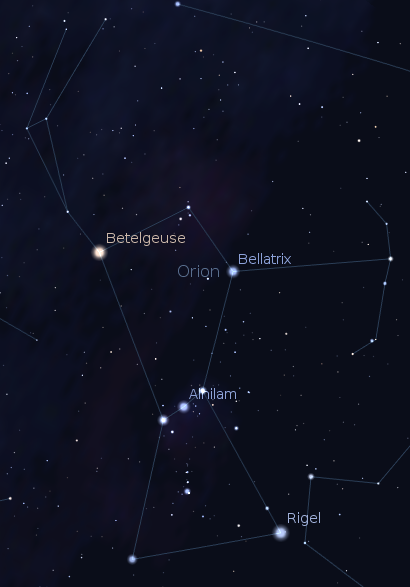
Orion upright and due south. Created using Stellarium.
Our estimates of the size, mass and luminosity of Betelgeuse depend on knowing its distance. The distance is not well-known because Betelgeuse is a single star, it is not a binary for which can be applied Newton’s laws to calculate these values. Therefore these values in the broadcast program, where I have 59 seconds total, appear more certain than they really are. Wait for Thursday’s program when I cover Rigel and see how close the values are between the two. But Rigel appears to be a different star altogether. Somebody’s wrong.
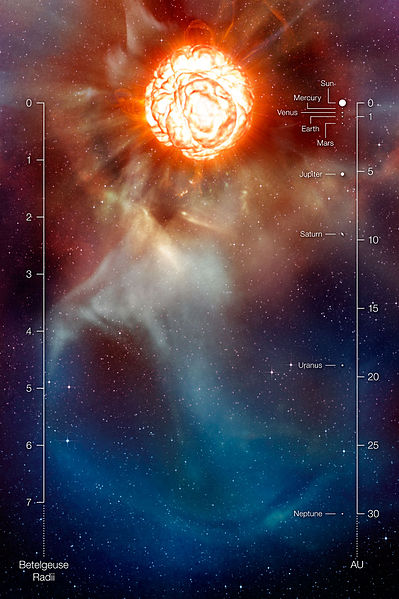
“This artist’s impression shows the supergiant star Betelgeuse as it was revealed thanks to different state-of-the-art techniques on ESO’s Very Large Telescope, which allowed two independent teams of astronomers to obtain the sharpest ever views of the supergiant star Betelgeuse. They show that the star has a vast plume of gas almost as large as our Solar System and a gigantic bubble boiling on its surface. These discoveries provide important clues to help explain how these mammoths shed material at such a tremendous rate. The scale in units of the radius of Betelgeuse as well as a comparison with the Solar System is also provided.” Credit: ESO/L. Calçada (ESO is the European Southern Observatory)
 Bob Moler's Ephemeris Blog