02/27/2015 – Ephemeris – Previewing the month of March
Ephemeris for Friday, February 27th. The sun will rise at 7:24. It’ll be up for 11 hours and 3 minutes, setting at 6:27. The moon, 2 days past first quarter, will set at 4:08 tomorrow morning.
During March the increase in daylight hours are at its greatest, with Spring 3 weeks away. Daylight hours will increase from 11 hours and 9 minutes Sunday to 12 hours and 42 minutes on the 31st. Along with that the altitude of the sun at noon will increase from 38 degrees Sunday to 49 ½ degrees at month’s end. Local noon, by the way for Interlochen and Traverse City is about 12:50 p.m, which is mainly due to the fact that our standard time meridian happens to run through Philadelphia. That’s before daylight time starts in a bit more than a week. Then our time meridian will run by the eastern tip of Nova Scotia, so local noon, when the Sun is due south will occur at 1:50 p.m.
Times are for the Traverse City/Interlochen area of Michigan. They may be different for your location.
Addendum
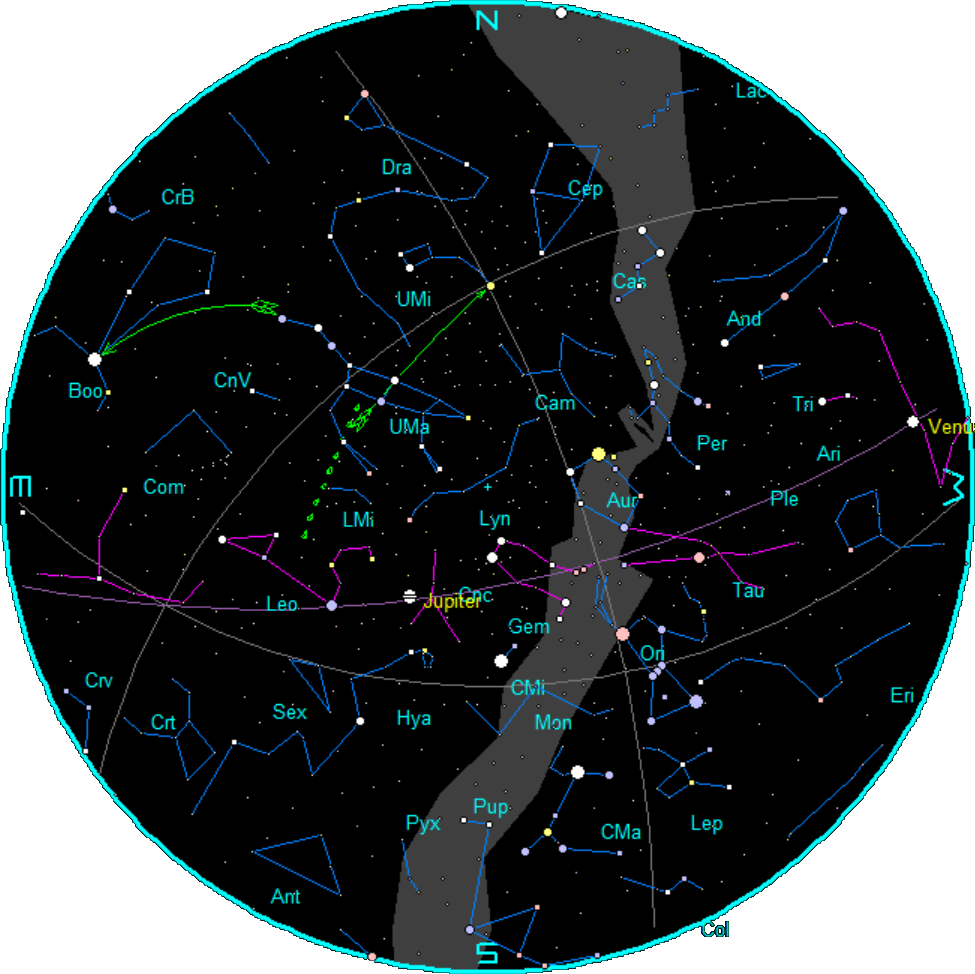
Star Chart for March 2015. Created using my LookingUp program.
The Moon is not plotted. The planets and stars are plotted for the 15th at 10 p.m. EDT. That is chart time.
Evening astronomical twilight ends at 8:07 p.m. EST on March 1st, increasing to 9:49 p.m. EDT on the 31st.
Morning astronomical twilight starts at 5:43 a.m. EST on March 1st, and decreasing to 5:45 a.m. EDT on the 31st. (Yes it is a decrease, thanks to the imposition of daylight time on March 8th)
Add a half hour to the chart time every week before the 15th and subtract and hour for every week after the 15th.
For a list of constellation names to go with the abbreviations click here.
The green pointer from the Big Dipper is:
- Pointer stars at the front of the bowl of the Big Dipper point to Polaris the North Star.
- Drill a hole in the bowl of the Big Dipper and the water will drip on the back of Leo the Lion.
- Follow the arc of the Big Dipper’s handle to Arcturus
Calendar of Planetary Events
Credit: Sky Events Calendar by Fred Espenak and Sumit Dutta (NASA’s GSFC)
To generate your own calendar go to http://eclipse.gsfc.nasa.gov/SKYCAL/SKYCAL.html
Times are Eastern Standard Time on a 24 hour clock. Some additions made to aid clarity.
Conjunctions like the Moon-Saturn: 2.4° S means Saturn will appear 2.4° south of the Moon.
| Mar | 01 | Su | Venus: 30.1° E | |
| 05 | Th | 02:35 | Moon Apogee: 406,400 km | |
| 05 | Th | 13:05 | Full Moon | |
| 07 | Sa | 16:04 | Moon Ascending Node | |
| 12 | Th | 04:25 | Moon-Saturn: 2.4° S | |
| 13 | Fr | 13:48 | Last Quarter | |
| 13 | Fr | 21:39 | Moon South Dec.: 18.3° S | |
| 19 | Th | 15:38 | Moon Perigee: 357,600 km | |
| 20 | Fr | 05:36 | New Moon | |
| 20 | Fr | 05:46 | Total Solar Eclipse | |
| 20 | Fr | 18:45 | Vernal Equinox | |
| 20 | Fr | 22:19 | Moon Descending Node | |
| 21 | Sa | 18:13 | Moon-Mars: 1° N | |
| 22 | Su | 15:51 | Moon-Venus: 2.9° N | |
| 25 | We | 02:55 | Moon-Aldebaran: 0.9° S | |
| 26 | Th | 10:29 | Moon North Dec.: 18.2° N | |
| 27 | Fr | 03:43 | First Quarter |
 Bob Moler's Ephemeris Blog