Archive
06/03/2015 – Ephemeris – The visible bright planets are hanging on in the evening
Ephemeris for Wednesday, June 3rd. Today the Sun will be up for 15 hours and 23 minutes, setting at 9:22. The Moon, 1 day past full, will rise at 10:15 this evening and tomorrow the Sun will rise at 5:59.
Lets take a look at the bright planets for this week. Our brilliant evening star Venus is in the west by 9:45 p.m. It will set at 12:40 a.m. As Venus is reaching its greatest eastern elongation or separation from the Sun it is now setting earlier. Venus apparent orbit of the Sun is also tilting to a lower angle with the horizon, since though east, it is now south of the Sun. Jupiter will appear high in the west-southwestern sky about 10 p.m. It will set at 1:23 a.m. It’s near the sickle-shaped head of Leo the lion, and it’s the second brightest star-like object in the sky after Venus, which is approaching it. Saturn is in the southeast as evening twilight fades. It will set at 5:37 a.m. in the southwest.
Times are for the Traverse City/Interlochen area of Michigan. They may be different for your location.
Addendum
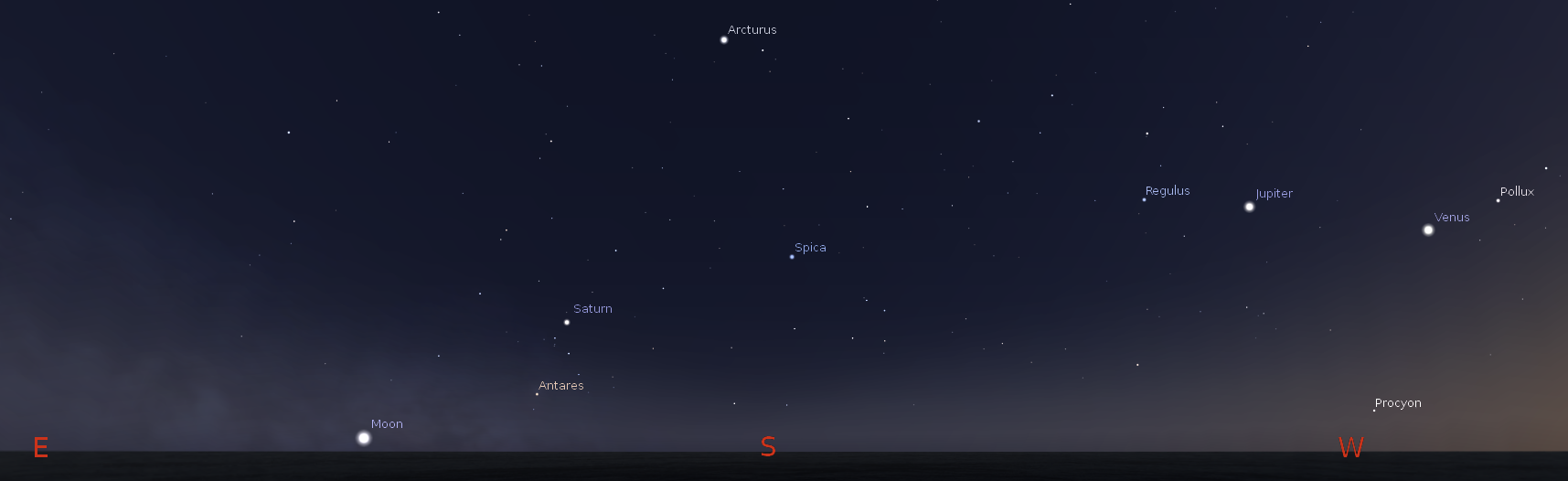
The evening planets and bright stars, including the Moon, at 10:30 p.m. June 3, 2015. Created using Stellarium. Click on Image to enlarge.
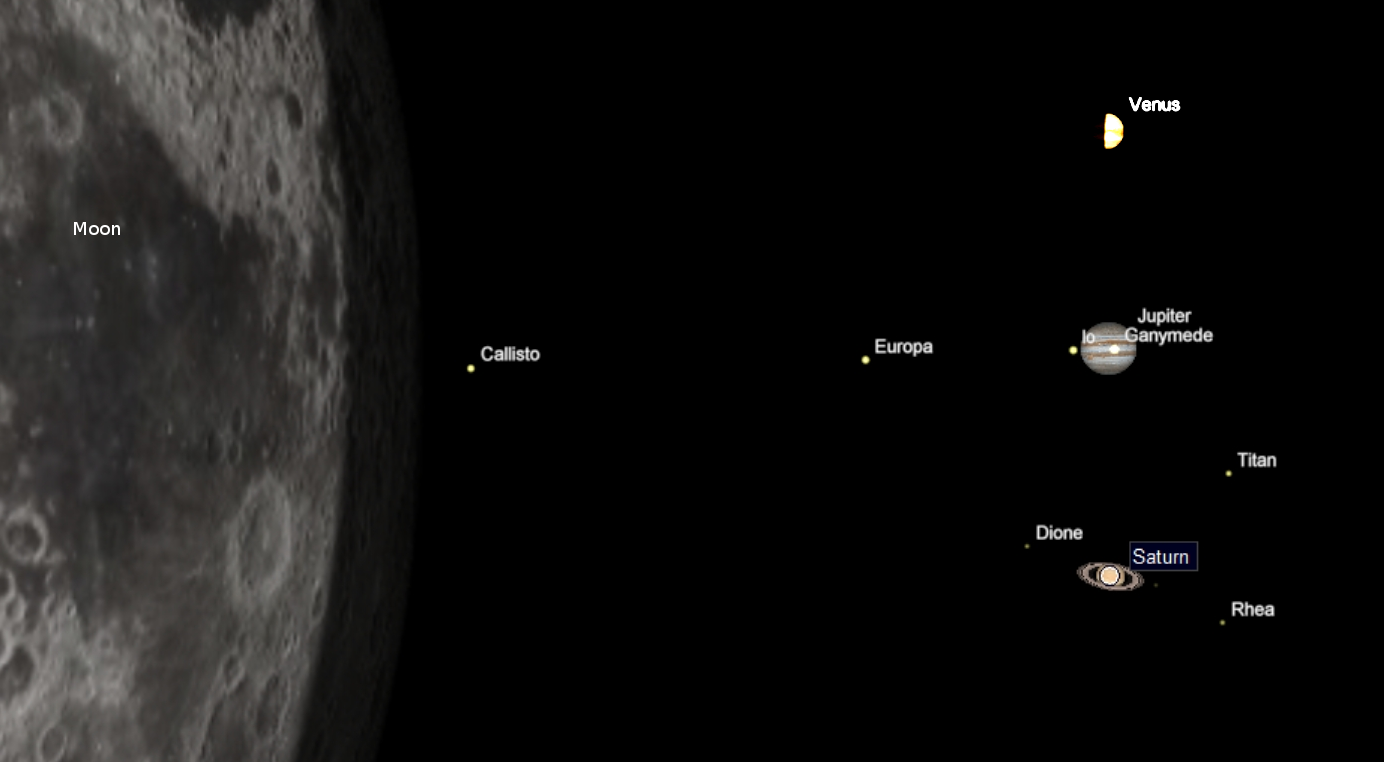
Comparison of the apparent sizes and satellite locations of the bright planets and the Moon at 10:30 p.m. June 3, 2015. Created using Cartes du Ciel (Sky Charts) and GIMP.
Jupiter’s satellites Io and Ganymede have a busy night tonight
Satellite  Event           UT            EDT
Ganymede   Transit Start   June 4  0:17  June 3  8:17 p.m.
Io         Transit Start   June 4  2:46  June 3 10:46 p.m.
Io         Shadow Start    June 4  3:56  June 3 11:56 p.m.
Ganymede   Transit End     June 4  3:56  June 3 11:56 p.m.
Ganymede   Shadow Start    June 4  4:57  June 4 12:57 a.m.
Io         Transit End     June 4  5:04  June 4  1:04 a.m.
Io         Shadow End      June 4  6:13  *
Ganymede   Shadow End      June 4  8:35  *

* Not visible from the Traverse City/Interlochen are, Jupiter has set.
Satellite data was taken from www.projectpluto.com/jevent.htm
06/02/2015 – Ephemeris – Bright clouds that appear near the end of twilight
Ephemeris for Tuesday, June 2nd. Today the Sun will be up for 15 hours and 21 minutes, setting at 9:21. The Moon, at full today, will rise at 9:18 this evening and tomorrow the Sun will rise at 5:59.
This time of year one can see, on rare occasions, some ghostly clouds called noctilucent clouds. Noctilucent means night shining. These are silvery clouds that can be seen near the end of twilight. We’re a bit south of the prime latitudes to see them from 50 to 70 degrees both north and south of the equator. I’ve seen them but a few times. They move rather rapidly, even though they’re at an altitude of around 50 miles. The clouds appear to be made of ice crystals that possibly form around meteoritic dust. Their appearance cannot be predicted, but be aware that they may appear near the end of twilight and they are white, move rapidly, and are not the twilit clouds lower down. These clouds are most numerous during July and August. They seem to be showing up early this year.
Times are for the Traverse City/Interlochen area of Michigan. They may be different for your location.
Addendum
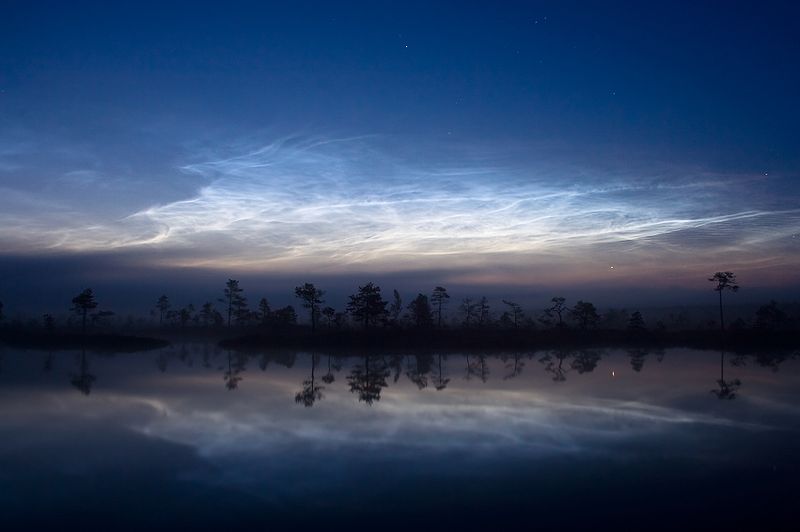
Noctilucent clouds, Kuresoo bog, Soomaa National Park, Estonia. July 26, 2009 by Martin Koitmäe. From Wikimedia Commons.
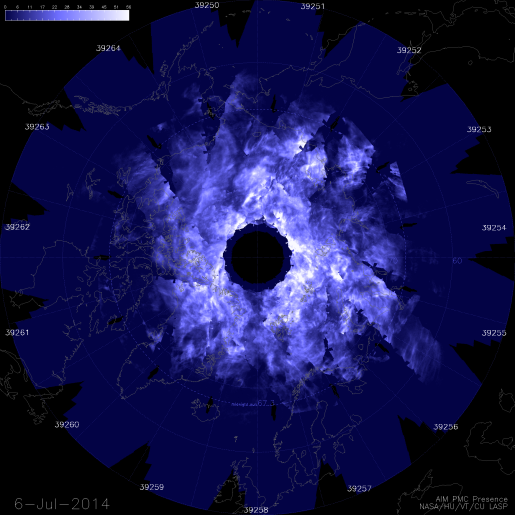
NASA Aeronomy of Ice in the Mesosphere (AIM) satellite data of Earth’s north polar region from July 6, 2014. Credit LASP/University of Colorado.
06/01/2015 – Ephemeris – Starting orbit 41 looking at June skies
Ephemeris for Monday, June 1st. Today the Sun will be up for 15 hours and 20 minutes, setting at 9:21. The Moon, 1 day before full, will set at 6:17 tomorrow morning and tomorrow the Sun will rise at 6:00.
We’ll start Ephemeris’ 41st orbit of the Sun by looking at the skies of June. There’ will be a lot of sun in June and very little night. The daylight hours will increase a bit from 15 hours and 20 minutes today to 15 hours and 34 minutes on the 21st, retreating back to 15 hours 31 minutes at month’s end. At this time of the year the sunset times for Ludington, Interlochen, Petoskey and Mackinaw City are very nearly the same. However the sunrise times are at their most divergent. With Ludington’s sunrise being 14 minutes later than Mackinaw City’s. The altitude of the sun above the southern horizon at local noon will hover around 68 to 69 degrees. Local noon, when the sun is actually due south will occur at about 1:43 p.m. Here’s what we’ve been waiting for: Summer will start on the 21st at 12:38 p.m.
Times are for the Traverse City/Interlochen area of Michigan. They may be different for your location.
Addendum
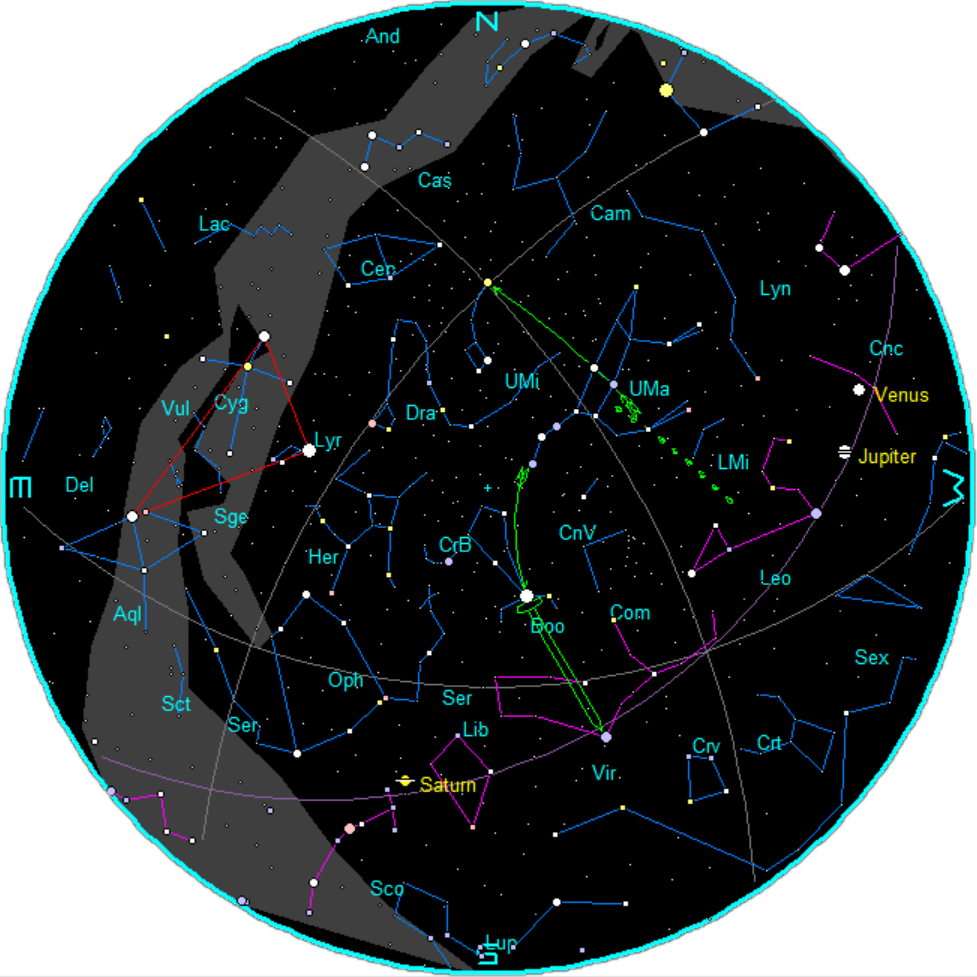
Star Chart for June 2015. Created using my LookingUp program.
The Moon is not plotted.
The planets and stars are plotted for the 15th at 11 p.m. EDT. That is chart time. Note, Traverse City is located 1 hour 45 minutes behind our time meridian. To duplicate the star positions on a planisphere set it to 1 hour 45 minutes earlier than the current time.
Evening Astronomical twilight ends at 11:43 p.m. EDT on June 1st, increasing to midnight EDT on the 30th.
Morning astronomical twilight starts at 4:38 a.m. EDT on June 1st, and decreasing to 3:31 a.m. EDT on the 30th.
Add a half hour to the chart time every week before the 15th and subtract and hour for every week after the 15th.
For a list of constellation names to go with the abbreviations click here.
The green pointer from the Big Dipper is:
- Pointer stars at the front of the bowl of the Big Dipper point to Polaris the North Star.
- Drill a hole in the bowl of the Big Dipper and the water will drip on the back of Leo the Lion.
- Follow the arc of the Big Dipper’s handle to Arcturus
- Continue with a spike to Spica
- The Summer Triangle is shown in red
Calendar of Planetary Events
Credit: Sky Events Calendar by Fred Espenak and Sumit Dutta (NASA’s GSFC)
To generate your own calendar go to http://eclipse.gsfc.nasa.gov/SKYCAL/SKYCAL.html
Times are Eastern Daylight Time on a 24 hour clock. Some additions made to aid clarity.
Conjunctions like the Moon-Saturn: 2.1° S means Saturn will appear 2.3° south of the Moon.
| Jun | 01 | Mo | Venus: 45.3° E | |
| 01 | Mo | 16:02 | Moon-Saturn: 2° S | |
| 02 | Tu | 12:19 | Full Moon | |
| 03 | We | 17:10 | Moon South Dec.: 18.4° S | |
| 06 | Sa | 14:59 | Venus Elongation: 45.4° E | |
| 09 | Tu | 11:42 | Last Quarter | |
| 10 | We | 00:39 | Moon Perigee: 369700 km | |
| 10 | We | 19:29 | Moon Descending Node | |
| 13 | Sa | 04:59 | Venus-Beehive: 0.6° N | |
| 14 | Su | 10:39 | Mars Solar Conjunction | |
| 16 | Tu | 10:05 | New Moon | |
| 16 | Tu | 15:47 | Moon North Dec.: 18.5° N | |
| 20 | Sa | 07:28 | Moon-Venus: 6.3° N | |
| 21 | Su | 12:38 | Summer Solstice | |
| 23 | Tu | 05:39 | Mercury-Aldebaran: 1.9° N | |
| 23 | Tu | 13:01 | Moon Apogee: 404100 km | |
| 24 | We | 07:03 | First Quarter | |
| 24 | We | 12:59 | Mercury Elongation: 22.5° W | |
| 24 | We | 13:23 | Moon Ascending Node | |
| 28 | Su | 21:27 | Moon-Saturn: 2.1° S | |
| 30 | Tu | 22:14 | Venus-Jupiter: 0.3° N | |
| Jul | 01 | We | 02:48 | Moon South Dec.: 18.4° S |
| 01 | We | Venus: 42.4° E | ||
 Bob Moler's Ephemeris Blog